
Algeria
Review the official biometric photo requirements for an Algeria visa application.
Algeria visa photo requirementsEvery embassy has different rules. Explore 68 destination guides covering exact eVisa specifications, digital sizing, background colours and upload file size limits.
By ClonyPDF Editorial Team Compiled from consular and ICAO sources Last reviewed Sources
There is no single global visa photo standard. The most common format is 35 × 45 mm on a plain light background with the head filling 70–80% of the frame, taken within the last 6 months. What changes by destination is the exact size, the background colour and the upload file size limit — and the file size limit is what rejects most online applications.
| Destination | Photo size | Background | Upload limit |
|---|---|---|---|
| Schengen (26 states) | 35 × 45 mm | Light grey | ≤ 240 KB |
| China | 33 × 48 mm | Pure white | 354×472 – 420×560 px |
| United Kingdom | 35 × 45 mm | Light grey / cream | 50 KB – 10 MB |
| United States (DS-160) | 2 × 2 in (51 × 51 mm) | Plain white | ≤ 240 KB, 600×600 px min |
| Australia | 35 × 45 mm | Plain white | ≤ 500 KB |
| Canada | 35 × 45 mm | Plain white | ≤ 240 KB |
| New Zealand | 35 × 45 mm | Light grey | ≤ 250 KB |
| Singapore | 35 × 45 mm | Plain white | ≤ 60 KB |
| South Korea (K-ETA) | 35 × 45 mm | Plain white | ≤ 100 KB |
| Turkey (eVisa) | 50 × 50 mm | Plain white | Check portal |
Figures are the values published for the most common visa category in each destination. Categories differ — a long-stay or work visa may use a different limit from a tourist visa. Open the destination guide for the authoritative specification and its official source.
While applying for a domestic travel document relies on a single national standard, navigating entry permits for foreign nations requires adapting to varying embassy preferences. An accepted passport picture does not guarantee a successful visa application. Compare against the national standards in our passport photo requirements by country hub.
Background is the single most common cause of visa photo rejection, because applicants assume white is universal. It is not.
| Background | Destinations | Note |
|---|---|---|
| Plain white | Most destinations, including China, Singapore, Japan, UAE, Philippines | Must be uniform with no gradient or shadow |
| Light grey | Schengen states, United Kingdom, New Zealand | White is commonly refused for these destinations |
| Blue | Malaysia | Required for certain visa categories |
| Red | Indonesia | Applies to several tourist and business categories |
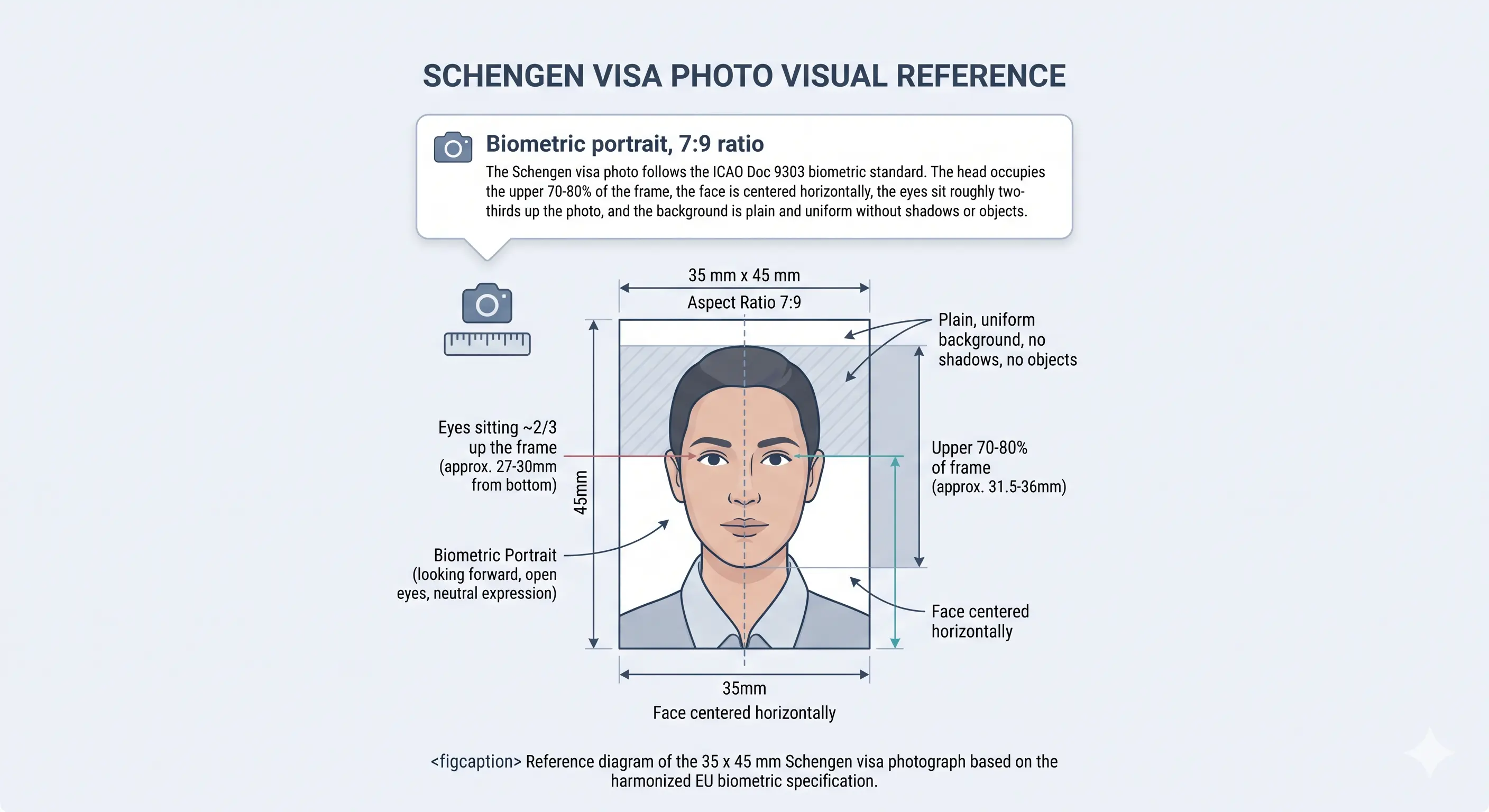
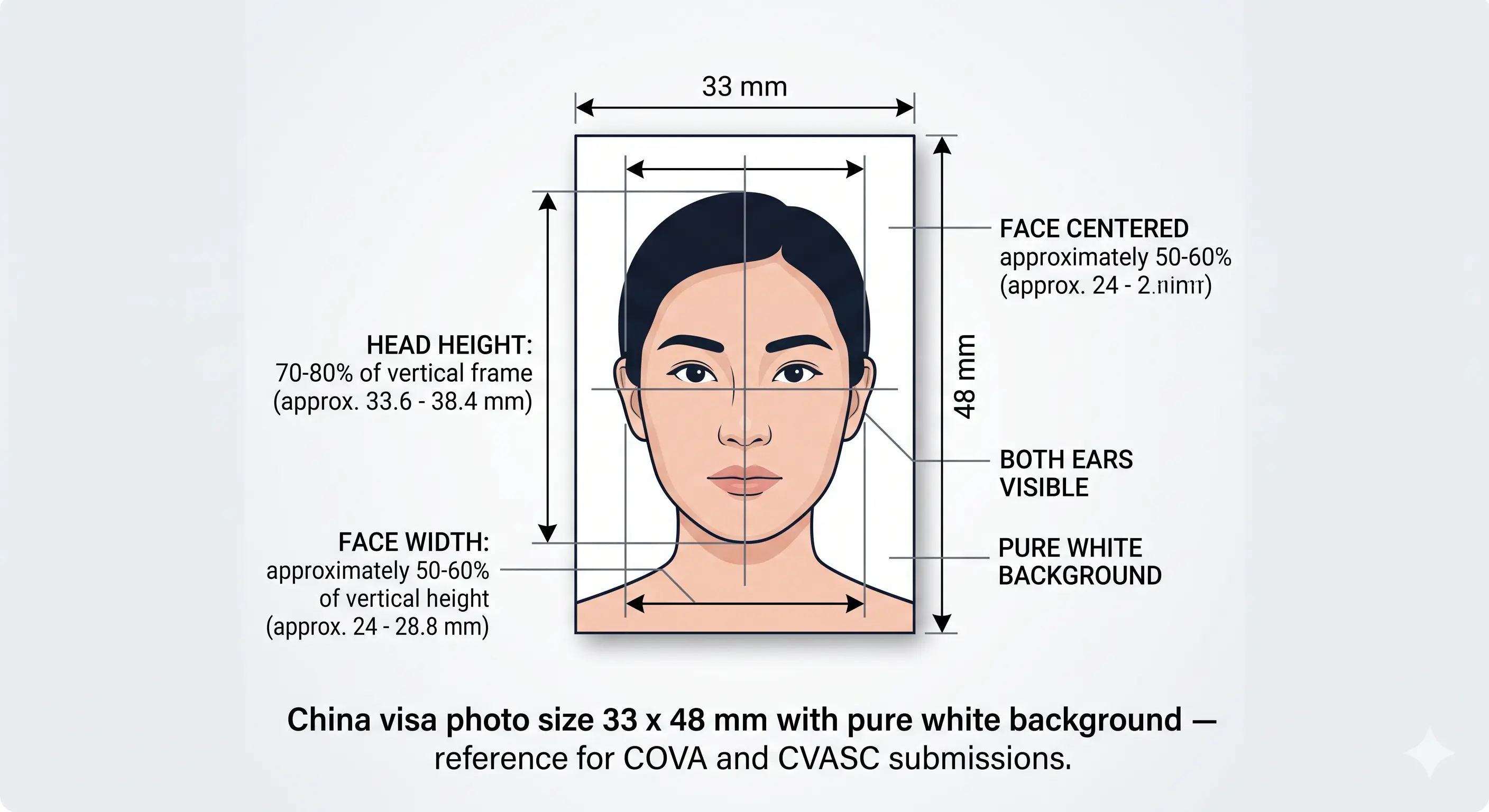
Find the precise embassy and eVisa regulations for your destination. 68 guides, listed alphabetically.
Review the official biometric photo requirements for an Algeria visa application.
Algeria visa photo requirementsCheck the official photo sizing and background regulations for an Argentina visa application.
Argentina visa photo requirementsEnsure your photo complies with the Schengen biometric criteria for Austria.
Austria visa photo requirementsPrepare a Bangladesh visa photo that meets official embassy and eVisa specifications.
Bangladesh visa photo requirementsGet the exact digital photo resolution and print dimensions for a Belgium visa.
Belgium visa photo requirementsReview the distinct size and facial expression guidelines for Brazilian consular visas.
Brazil visa photo requirementsFind the latest biometric standards and dimensions for a Bulgaria visa photo.
Bulgaria visa photo requirementsFind the required proportions and setup rules for a Chilean entry permit photo.
Chile visa photo requirementsThe 33x48 mm white-background standard for COVA and CVASC applications.
China visa photo requirementsPrepare your digital file matching the precise specifications of the Colombian eVisa system.
Colombia visa photo requirementsCheck the official Croatia visa photo requirements for embassy and Schengen applications.
Croatia visa photo requirementsGet the exact dimensions and biometric rules for a Cyprus visa application photo.
Cyprus visa photo requirementsEnsure your Czech Republic visa photo complies with current embassy regulations.
Czech Republic visa photo requirementsMeet the specific Danish immigration standards for short-stay or resident visas.
Denmark visa photo requirementsCreate an Egypt visa photo that satisfies official biometric and digital submission standards.
Egypt visa photo requirementsReview the official Estonia visa photo size, background, and facial positioning requirements.
Estonia visa photo requirementsPrepare a compliant Ethiopia visa photo for embassy or electronic visa applications.
Ethiopia visa photo requirementsLearn about the digital cropping and background constraints for a Finnish visa portrait.
Finland visa photo requirementsGet the precise measurements required for a French travel authorization.
France visa photo requirementsReview the biometric photo rules for your German visa application.
Germany visa photo requirementsReview the official Ghana visa photo specifications for embassy and online applications.
Ghana visa photo requirementsEnsure your Greek Schengen visa photo meets official biometric parameters.
Greece visa photo requirementsReview the specific millimeter setups and background colors for Hong Kong entry permits.
Hong Kong visa photo requirementsCheck the latest Hungary visa photo dimensions and biometric standards.
Hungary visa photo requirementsPrepare a compliant Iceland visa photo using official Schengen requirements.
Iceland visa photo requirementsPrepare your red-background photo for an Indonesian tourist or business visa.
Indonesia visa photo requirementsFind out the correct lighting and posture for your Irish visa picture.
Ireland visa photo requirementsEnsure your Italian Schengen visa photo complies with all biometric standards.
Italy visa photo requirementsCheck the exact dimensions and background rules needed for a Japanese visa.
Japan visa photo requirementsFind the correct digital and printed photo requirements for a Kenya visa.
Kenya visa photo requirementsReview the official Latvia visa photo size, background, and biometric guidelines.
Latvia visa photo requirementsEnsure your Luxembourg visa photo meets all Schengen biometric requirements.
Luxembourg visa photo requirementsLearn about the specific blue background rules for Malaysian eVisas.
Malaysia visa photo requirementsCheck the latest Malta visa photo specifications for embassy submissions.
Malta visa photo requirementsDiscover the specific dimensional and lighting metrics required for a Mexican tourist visa.
Mexico visa photo requirementsCreate a Morocco visa photo that follows current embassy photo regulations.
Morocco visa photo requirementsPrepare a Nepal visa photo with the correct dimensions, background, and face positioning.
Nepal visa photo requirementsMeet the official Dutch consulate requirements for your travel portrait.
Netherlands visa photo requirementsView the digital upload criteria for your NZeTA or resident visa.
New Zealand visa photo requirementsLearn the official Nigeria visa photo requirements for online and embassy applications.
Nigeria visa photo requirementsCheck the biometric guidelines required by the Norwegian Directorate of Immigration.
Norway visa photo requirementsPrepare your Omani eVisa photo with the correct file size and resolution.
Oman visa photo requirementsCheck the official Pakistan visa photo size, background, and biometric requirements.
Pakistan visa photo requirementsFind the accurate background colors and proportions required for a Peruvian visa photo.
Peru visa photo requirementsReview the white background and collar rules for Philippine visas.
Philippines visa photo requirementsVerify the exact digital upload format and biometric constraints for a Polish visa.
Poland visa photo requirementsGet your application picture aligned with Portuguese consular and Schengen protocols.
Portugal visa photo requirementsDiscover the essential guidelines for your Qatari Hayya card or entry permit.
Qatar visa photo requirementsPrepare a Romania visa photo that meets current embassy and biometric standards.
Romania visa photo requirementsDiscover the exact specifications for your Saudi eVisa or consulate application.
Saudi Arabia visa photo requirementsThe universal 35x45 mm biometric standard shared by all Schengen states.
Schengen visa photo requirementsCheck the digital photo rules for your Singapore SG Arrival Card or eVisa.
Singapore visa photo requirementsReview the official Slovakia visa photo dimensions and Schengen requirements.
Slovakia visa photo requirementsFind the latest Slovenia visa photo specifications for embassy submissions.
Slovenia visa photo requirementsReview the mandatory dimensions and background specs for a South African visa application.
South Africa visa photo requirementsGet the official dimensions for your K-ETA or Korean embassy application.
South Korea visa photo requirementsEnsure your Spanish visa photo is up to date and meets biometric guidelines.
Spain visa photo requirementsCreate a Sri Lanka visa photo that complies with ETA and embassy guidelines.
Sri Lanka visa photo requirementsSweden visa photo requirements for Schengen short-stay and long-stay applications.
Sweden visa photo requirementsReview the crisp, high-resolution photo needs for a Swiss short-stay visa.
Switzerland visa photo requirementsCheck the exact sizing rules and feature-exposure requirements for Taiwan visa photos.
Taiwan visa photo requirementsPrepare your Tanzania visa photo using the latest immigration specifications.
Tanzania visa photo requirementsFind the exact specifications for a Thai eVisa or physical sticker visa.
Thailand visa photo requirementsCheck the official Tunisia visa photo dimensions and application guidelines.
Tunisia visa photo requirementsTurkey eVisa and embassy photo rules, including the 50x50 mm biometric layout.
Turkey visa photo requirementsUAE eVisa photo rules for ICP and GDRFA, including background and crop.
United Arab Emirates (UAE) visa photo requirementsReview the latest UK visa photo specifications for online and VFS applications.
United Kingdom (UK) visa photo requirementsVietnam embassy and eVisa portal photo rules, dimensions and digital format.
Vietnam visa photo requirementsNo country found matching your search. Please check the spelling.
Looking for a national passport standard instead of a visa? Browse the passport photo requirements by country hub, or read the underlying standards in the passport photo rules library.
Using our advanced online visa photo maker eliminates the guesswork of embassy regulations.
Take a photo with your smartphone against any well-lit wall and upload it securely.
Our engine automatically strips the background and replaces it with the required embassy color.
Facial recognition centers your head and crops the image to the exact millimeter or pixel requirements. See the crop guide.
Get your compliant digital file instantly, ready for your eVisa application portal.
The destination's size, background colour and head-height band apply to children exactly as they do to adults. There is no smaller format for infants. What sometimes relaxes is the eye and expression rule.
A child applying for a Schengen visa still needs 35 × 45 mm on light grey. A child applying for a Chinese visa still needs 33 × 48 mm on pure white.
No supporting hands, arms, car seat, toy or dummy may be visible, and no other person may appear. Support the child from behind a plain sheet.
Most consulates relax the open-eyes rule for newborns but enforce it for older children. See the eyes requirements.
Lay the child on a plain sheet in soft indirect daylight and shoot from directly above. See the shadow rules.
Hair must not fall across the eyes or obscure the face outline, and ears should be visible where the destination requires it. See hair rules and ears visibility.
Shoot wide and crop down. Cropping tightly in-camera on a small face leaves too few pixels once the destination's frame is applied.
Full positioning and lighting technique for infants is in our baby passport photo at home guide.
Sticker visas issued at a consulate still need physical prints. Print settings matter as much as the crop, and plain paper is refused everywhere.
| Print resolution | 300 DPI minimum. Disable fit-to-page and auto-scaling, which change the physical size |
|---|---|
| Paper | Glossy or matte photo paper, 200–250 gsm. Plain copier paper is refused |
| Copies per 4 × 6 in sheet | Six 35 × 45 mm photos, or eight 33 × 48 mm photos, with cutting margins |
| Copies required | Most consulates ask for one or two identical prints. Confirm before your appointment |
| Colour management | sRGB. Turn off printer auto-enhance, skin smoothing and colour correction |
| Cutting | Guillotine or steel rule for square edges. Do not cut inside the printed border |
| Handling | Let ink dry fully. Do not staple, fold or glue the photo face |
Printer settings and cutting technique are covered in the print at home guide, and multi-copy sheet layout in the 4 × 6 print sheet guide.
Don't let a poorly formatted picture delay your travel plans. Consulates strictly enforce these rules. The full breakdown is in passport photo rejection reasons.
Submitting a 2x2 inch photo when 35x45mm is required.
Using white where light grey is required, or the wrong colour entirely.
Above the portal cap, or so compressed it fails the quality check.
Smiling, frowning, or having your mouth open.
Face taking up too much or too little of the frame.
Harsh lighting creating shadows on the face or background.
Most consulates explicitly ban glasses due to glare.
Cutting off the top of the hair or the shoulders incorrectly.
Specifications in this directory are compiled from published consular and immigration guidance and the international biometric travel document standard ICAO Doc 9303. Where a national requirement differs from ICAO, the national requirement applies.
Last reviewed:
Visa photo rules are set by each destination and can change without notice. Individual consular posts and visa categories may publish additional local requirements. Always confirm the current specification with the authority handling your application before you submit.
Make your document processing seamless. From compressing heavy government forms to editing PDFs, return to our homepage to access our full suite of free tools.
Access all our free PDF merging, splitting, and conversion tools.
Reduce document size to under 1MB or 100KB for official uploads.
Perfectly format your signature and photo for SSC, UPSC & NEET.
Create standard passport and PR photos for 5+ major countries.
Get your embassy-compliant photo ready in under 2 minutes. Free, fast, and completely automated.
Make My Visa Photo Now