
Schengen Visa Photo Requirements (35 x 45 mm Biometric Standard)
A Schengen visa photo is 35 mm × 45 mm on a plain light-coloured background, with the head 32–36 mm from chin to crown, taken within the last 6 months. Most consulates request two identical copies.
Anyone applying for a short-stay visa to a Schengen member state — whether through a consulate in person or a visa application centre such as VFS Global, BLS International, or TLScontact — must submit recent biometric photos that meet this specification. The most common reason Schengen applications are delayed at the counter is photo rejection, usually because the applicant brought a 2x2 inch US-style print, an outdated photo, or a portrait that fails the biometric framing checks. This guide covers the harmonised requirements, the digital file rules that differ by portal, child photo rules, printing, and a free tool that produces a portal-ready 35x45 mm file in under a minute.
Schengen Visa Photo Requirements (Quick Answer)
A Schengen visa photo is generally 35 mm × 45 mm (3.5 × 4.5 cm), on a plain light-coloured background, with the head measuring roughly 32–36 mm from chin to crown and the eye line 30–36 mm up from the bottom edge, taken within the last 6 months with a neutral expression and ICAO biometric framing.
| Requirement | Value |
|---|---|
| Photo size | 35 × 45 mm (3.5 × 4.5 cm) |
| Pixels @ 300 DPI | 413 × 531 px |
| Aspect ratio | 7 : 9 |
| Background | Plain light-coloured, uniform, no shadow |
| Head height (chin to crown) | 32 – 36 mm, about 70–80% of the frame |
| Eye line from bottom edge | 30 – 36 mm |
| Expression | Neutral, mouth closed, both eyes open |
| Age of photo | Within last 6 months |
| Typical quantity | 2 identical printed copies |
| Digital file | Colour JPEG, sRGB, commonly capped at 240 KB |
| Standard | ICAO Doc 9303 biometric photograph |
Visa appointment soon? Generate a 35x45 mm Schengen-ready photo in 60 seconds.
Create Schengen Visa Photo →Schengen Visa Photo Visual Reference
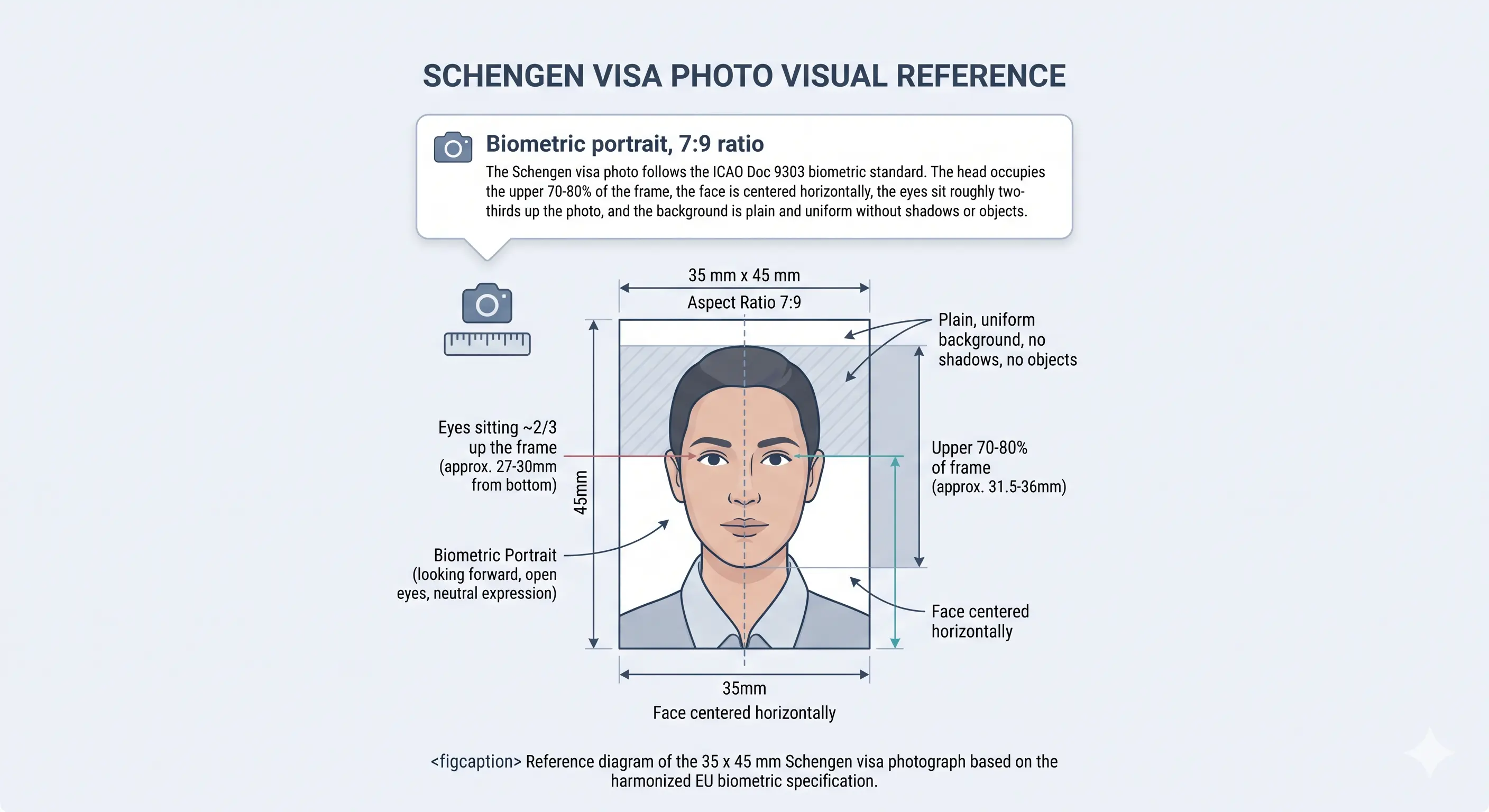
Biometric portrait, 7:9 ratio
The Schengen visa photo follows the ICAO Doc 9303 biometric standard. The head occupies the upper 70–80% of the frame, the face is centred horizontally, the eyes sit roughly two-thirds up the photo at 30–36 mm from the bottom edge, and the background is plain and uniform without shadows or objects.
Full Schengen Visa Photo Requirements
The following table consolidates the core photo rules referenced in EU visa guidance and applied across Schengen consulates. Individual member states publish additional details — confirm them on the destination country's consular or visa application centre website. Each rule links to the detailed standard in the passport photo rules library.
| Photo size | 35 mm × 45 mm (3.5 × 4.5 cm / 1.38 × 1.77 in) |
|---|---|
| Width | 35 mm (413 px @ 300 DPI) |
| Height | 45 mm (531 px @ 300 DPI) |
| Aspect ratio | 7 : 9 portrait |
| Background | Plain light-coloured, uniform, no shadows or patterns. White, off-white or light grey are commonly used — see background colour rules |
| Lighting | Even and diffuse, no shadow on the face or behind the head — see shadow rules |
| Head size (chin to crown) | Approximately 32 – 36 mm — see head size rules |
| Face coverage | Approximately 70 – 80% of frame height — see face size requirements |
| Eye line from photo bottom | Around 30 – 36 mm, both eyes open and looking at the camera — see eyes requirements |
| Hair | Must not cover the eyes or obscure the outline of the face — see hair rules |
| Ears | Not mandatory across Schengen states, but the face outline must be clear — see ears visibility rules |
| Resolution | 300 DPI minimum, 600 DPI accepted by many portals — see resolution rules |
| File format | JPEG (.jpg) for digital uploads |
| File size | Commonly capped at 240 KB; limits vary by country and portal — see the digital file section |
| Colour | 24-bit colour, sRGB colour space, natural skin tones, no filters or beautification |
| Glasses | Many consulates recommend removing them; some accept clear lenses without glare if eyes are fully visible — see glasses rules |
| Headwear | Generally not permitted unless worn for religious reasons, with the face fully visible — see head covering rules |
| Expression | Neutral, mouth closed, both eyes open and visible — see smile rules |
| Age of photo | Taken within the last 6 months |
| Quantity | Commonly 2 identical printed photos cut from one sheet (check destination consulate) |
| Compliance standard | ICAO Doc 9303 biometric photograph, applied through the EU Visa Code |
Schengen Visa Photo Dimensions & Pixels
The Schengen visa photo uses the same 35x45 mm format adopted for UK, Australian and Japanese passports, and for the Canadian visa. The pixel sizes below match the values requested by visa application centres and consular online uploaders.
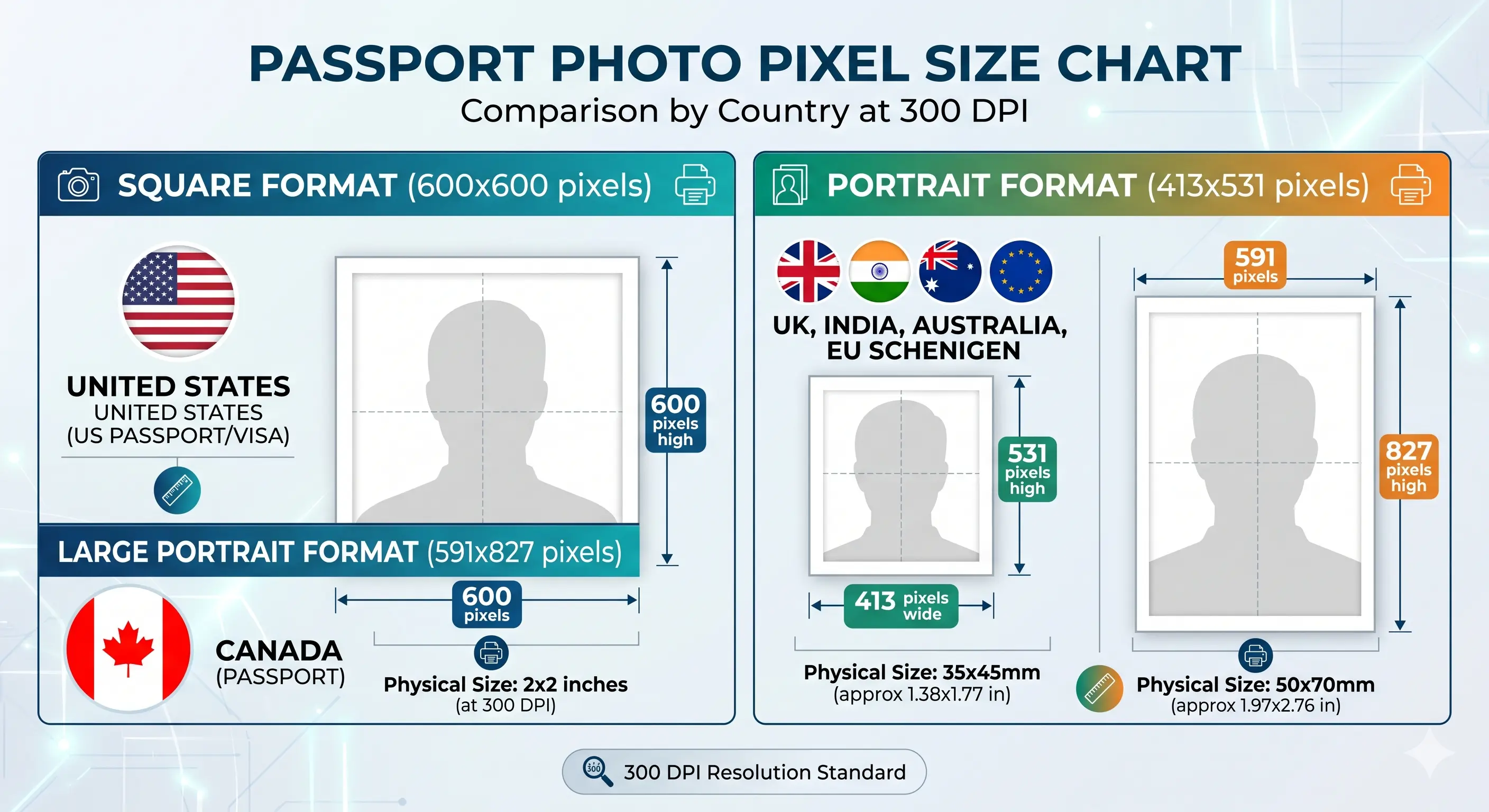
Need a 413 × 531 pixel Schengen-ready file? Use the Passport Photo Maker to generate one automatically at the correct biometric proportions.
For a full breakdown of the 35x45 mm standard across every country that uses it, see our dedicated 35x45 photo size guide. For the master worldwide reference, see passport size photo dimensions, and browse every national standard in the requirements by country hub.
Digital File and File Size for Online Schengen Applications
Where a member state offers an online pre-application or the visa application centre uploads your photo digitally, size in millimetres and size in kilobytes are two separate checks. Passing one does not pass the other, and the KB ceiling is where most uploads actually fail.
| Format | JPEG (.jpg), colour only. Greyscale and black-and-white are refused |
|---|---|
| Colour space | sRGB, 24-bit colour, natural skin tones |
| Pixel dimensions | 413 × 531 px minimum at 300 DPI; 826 × 1062 px at 600 DPI accepted |
| Typical file size ceiling | 240 KB across most Schengen member state portals |
| Recommended export | JPEG quality 85 — usually 45 to 100 KB at 413 × 531 |
| Editing | No filters, skin smoothing, slimming, or brightness and tone adjustment |
If your export is too heavy, the compress to 240 KB guide and reduce file size guide cover the mechanics. iPhone users shooting in HEIC should convert first with the HEIC to JPEG guide. Broader portal rules are covered in the digital passport photo requirements guide.
Schengen Visa Photo Background Colour
The background must be plain and uniform without shadows, patterns, or objects. The exact acceptable tone depends on the destination consulate and its visa application centre.
| Background | Typical Acceptance | Notes |
|---|---|---|
| Plain white | Commonly accepted | Widely used across Schengen states |
| Off-white / cream | Often accepted | Check consulate guidance |
| Plain light grey | Often accepted | Recommended by several consulates, including Germany and France |
| Background with shadows | Not accepted | Background must be uniform |
| Blue, beige, patterned | Not accepted | Immediate rejection |
Schengen Visa Photo Compared to Other Visa Photos
If you hold visas for multiple destinations, do not reuse a photo across them. The formats below are mutually incompatible, and a photo sized for one is refused by the others.
| Visa | Photo Size | Pixels @ 300 DPI | Aspect Ratio | Background |
|---|---|---|---|---|
| Schengen visa | 35 × 45 mm | 413 × 531 px | 7 : 9 | Plain light colour |
| US visa (DS-160) | 51 × 51 mm (2 × 2 in) | 600 × 600 px | 1 : 1 | Plain white |
| China visa | 33 × 48 mm | 390 × 567 px | 11 : 16 | Plain white |
| UK visa | 35 × 45 mm | 413 × 531 px | 7 : 9 | Light grey or cream |
| Canada visa / TRV | 35 × 45 mm | 413 × 531 px | 7 : 9 | Plain white |
| Australia visa | 35 × 45 mm | 413 × 531 px | 7 : 9 | Plain white |
| India e-Visa | 51 × 51 mm (2 × 2 in) | 600 × 600 px | 1 : 1 | Plain white |
Note that although the UK, Canada and Australia share the 35 × 45 mm size with Schengen, their background tones and head-height bands differ. Browse every visa standard in the visa photo requirements by country hub.
Schengen Member States Where This Photo is Accepted
The 35x45 mm biometric photo is the standard short-stay visa photo for every Schengen member state. Select a country below for its specific visa photo specification.
- Austria
- Belgium
- Bulgaria
- Croatia
- Czech Republic
- Denmark
- Estonia
- Finland
- France
- Germany
- Greece
- Hungary
- Iceland
- Italy
- Latvia
- Liechtenstein
- Lithuania
- Luxembourg
- Malta
- Netherlands
- Norway
- Poland
- Portugal
- Romania
- Slovakia
- Slovenia
- Spain
- Sweden
- Switzerland
Membership of the Schengen Area can change. Always confirm the current list and country-specific requirements on the destination country's consulate website before your appointment. For the passport equivalent of these standards, see the EU passport photo guide.
Applying for a visa to any Schengen member state?
Create Schengen Visa Photo →Create Your Schengen Visa Photo Online
The Schengen photo combines three things that are hard to get right manually: a precise 35x45 mm crop, a 32-36 mm head height, and a clean uniform background. Most phone editors handle none of these accurately.
Our Passport Photo Maker reads your uploaded portrait, detects your face, applies the Schengen 7:9 frame, validates the head size, and gives you a clean light-coloured background — even if you photographed yourself against a textured wall.
Upload your photo and our Passport Photo Maker automatically:
- Crops the photo correctly to the 35 x 45 mm Schengen frame
- Centres your face within the 32-36 mm biometric head range
- Generates a clean, plain light-coloured background
- Outputs at 413 x 531 pixels (300 DPI) for digital uploads
- Keeps the JPEG inside the 240 KB portal ceiling
- Creates a print-ready 4 x 6 inch sheet with 6 cuttable copies
How to Create a Schengen Visa Photo
- Take a high-resolution photo — Stand 4-5 feet from a plain light-coloured wall in soft, even daylight, keeping at least 50 cm clear of the wall so no shadow falls behind your head. Face the camera squarely with a neutral expression and closed mouth. Remove hats and large jewellery; for glasses, check the destination consulate's guidance.
- Open the Passport Photo Maker — Visit the ClonyPDF Passport Photo Maker and drag your image into the upload area.
- Choose a 35 x 45 mm European format — Select Germany, France or another 35 x 45 mm preset. The tool locks the crop ratio and applies the 32-36 mm chin-to-crown rule.
- Auto-crop and verify — Face detection centres your head within the 7:9 frame and flags framing issues before you export. The crop guide explains how the ratio and head-height band are applied together.
- Download the result — Export a 413 × 531 pixel JPEG plus a print-ready 4 × 6 inch sheet with 6 copies. Print at any photo kiosk and bring the freshly cut photos to your appointment.
Schengen Visa Photos for Babies, Infants and Children
Every applicant on a Schengen visa application needs their own photo, including infants listed on a parent's application. The 35 × 45 mm size, plain light background and 32–36 mm head-height band apply to minors exactly as they do to adults — there is no smaller format and no relaxed framing rule.
Same size, same head height
35 × 45 mm frame with the head filling 70–80% of the height. No age exemption applies to dimensions or framing.
Child alone in the frame
No supporting hands, arms, car seat, toy or dummy may appear, and no other person may be visible. Support the child from behind a plain light sheet.
Eyes open where achievable
Most consulates relax the open-eyes rule for very young infants but enforce it for older children. See the eyes requirements.
No shadow behind the head
Lay the child on a plain light sheet in soft indirect daylight and shoot from directly above. Side lighting creates the background shadow that fails the check.
Hair off the face
Hair must not fall across the eyes or obscure the face outline. See the hair rules.
Recency matters more
The 6-month rule is stricter in practice for children because appearance changes fast. A photo that no longer resembles the child is refused even inside the window.
Positioning, lighting and timing technique for infants and toddlers is covered in the baby passport photo at home guide.
Photographing a child for the application? Upload the shot and let the tool apply the crop.
Create Child Visa Photo →Printing the 35 x 45 mm Schengen Visa Photo
Because most consulates want two identical printed copies, printing is part of the specification rather than an afterthought. Both photos should be cut from a single sheet so they match exactly — officers do notice when two prints differ in tone or crop.
| Print resolution | 300 DPI — export at 413 × 531 pixels. Disable fit-to-page and auto-scaling |
|---|---|
| Paper | Glossy or matte photo paper, 200–250 gsm. Plain copier paper is refused |
| Copies per 4 × 6 inch sheet | Six 35 × 45 mm photos with cutting margins |
| Copies per A4 sheet | Around twenty |
| Cutting | Guillotine or steel rule for square edges. Do not cut inside the printed border |
| Colour management | sRGB. Turn off printer auto-enhance, skin smoothing and colour correction |
| Handling | Let ink dry fully. Do not staple, fold or glue the photo face. Bring the photos loose or in a clean sleeve |
Printer settings, paper choice and cutting technique are covered in full in the print passport photo at home guide, and multi-copy sheet layout in the print sheet guide.
Submitting Through a Consulate or Visa Application Centre
Most Schengen short-stay visa applications are submitted through outsourced visa application centres such as VFS Global, BLS International, or TLScontact, depending on the destination country and your country of residence. The core 35x45 mm format applies across all of them, although individual centres and consulates may publish additional rules.
| Submission Path | Core Photo Format | Notes |
|---|---|---|
| VFS Global visa application centre | 35 x 45 mm biometric | Follow the specific consulate's published photo guidance |
| BLS International visa centre | 35 x 45 mm biometric | Used for some Spanish and other consular services |
| TLScontact visa centre | 35 x 45 mm biometric | Used for several French, Swiss and other applications |
| Direct consulate appointment | 35 x 45 mm biometric | Quantity and background tone per consulate instructions |
| Online pre-application portals | Digital JPEG at 413 × 531 px or larger | Pixel and file-size limits vary — commonly 240 KB |
If you are submitting in person, take two identical recent photos cut from a single printed sheet — application officers prefer freshly cut photos with sharp edges. Our tool exports a 4 x 6 inch sheet with cutting guides included.
Why Schengen Visa Photos Get Rejected
Each item below links to the detailed rule so you can confirm the exact tolerance before your appointment. The full cross-country breakdown is in passport photo rejection reasons.
Wrong Dimensions
Photo cropped to 2x2 inches (US format) or 30x40 mm instead of the precise 35x45 mm Schengen specification. See the crop guide.
Wrong Background
Textured, patterned, or strongly coloured background. It must be plain, uniform, and light-coloured. See background colour rules.
Head Outside 32-36 mm
Chin-to-crown measurement too small or too large, breaking the biometric framing rules. See head size rules.
Eye Line Off
Eyes below 30 mm or above 36 mm from the bottom edge trigger a face-position failure even when head height is correct. See eyes requirements.
File Size Over the Limit
A 413x531 JPEG at maximum quality often exceeds the 240 KB ceiling most portals enforce. Save at quality 85.
Glare on Glasses
If glasses are worn, any reflection, glare, or partially hidden eyes will trigger rejection. Many applicants simply remove them. See glasses rules.
Poor Lighting and Shadows
Side lighting creates shadows on one cheek or behind the head. Lighting must be even and diffuse. See shadow rules.
Hair Across the Face
A fringe over the eyes or hair obscuring the face outline fails landmark detection. See hair rules.
Smile or Open Mouth
Biometric systems require a neutral expression with closed lips. Even small smiles distort facial-landmark detection. See smile rules.
Headwear (Non-Religious)
Hats or hair accessories that cover the head or face are not accepted. Only religious headwear is permitted, with the face fully visible. See head covering rules.
Filters and Retouching
Portrait blur, skin smoothing and slimming alter facial geometry and are detected by automated validation. Shoot in a plain, unfiltered mode.
Old Photo
A photo older than 6 months is rejected even if everything else is compliant. Officers compare against your current passport and against you in person.
Low Resolution
JPEG below 413 x 531 pixels prints pixelated at 35 x 45 mm. Minimum acceptable resolution is 300 DPI. See resolution rules.
Mismatched Copies
The two printed photos must be identical and cut from the same sheet. Prints from different sessions or with different tone are refused.
Frequently Asked Questions
Size & Specification
What are the Schengen visa photo requirements?
Photos must generally be 35 x 45 mm, on a plain light-coloured background, taken within the last 6 months, with a neutral expression and the head measuring around 32-36 mm from chin to crown. Most consulates request two identical copies. They should follow ICAO Doc 9303 biometric guidance. Always confirm with your destination consulate.
What is the Schengen visa photo size?
The Schengen visa photo size is 35 mm × 45 mm (3.5 × 4.5 cm or 1.38 × 1.77 inches). At 300 DPI it equals 413 × 531 pixels with a 7:9 aspect ratio. At 600 DPI it equals 826 × 1062 pixels.
What is the head size in a Schengen visa photo?
The face from chin to crown should measure around 32 to 36 mm and occupy 70-80% of the vertical frame. The eyes should sit roughly between 30 and 36 mm from the bottom of the photo. Head height and eye line are checked separately, so a correct head size with a low eye line is still refused.
What file size and format does a digital Schengen visa photo need?
A colour JPEG at 300 DPI or higher, in sRGB, sized to 413 × 531 pixels or larger. Most member state portals and visa application centres cap the upload at 240 KB, though the exact ceiling varies by country and system. Save at JPEG quality 85 to land comfortably inside that limit without visible compression artefacts.
How many photos do I need for a Schengen visa application?
Most Schengen consulates request 2 identical recent photos, and both should be cut from the same printed sheet so they match exactly. Some destinations ask for a different number. Always check the requirements of the specific consulate or visa application centre.
Appearance & Compliance
What background colour is required?
A plain light-coloured background is required. White, off-white, and light grey are commonly accepted across Schengen consulates. The background must be uniform with no shadows, gradients, patterns or objects. Check the latest specification published by your destination country before your appointment.
Can I wear glasses?
Many Schengen consulates recommend removing glasses for the photo, while some accept them if the eyes remain fully visible and there is no glare or reflection. Tinted lenses and sunglasses are never accepted. Confirm the policy of your specific consulate before applying.
Are head coverings allowed?
Hats and decorative headwear are not permitted. A head covering worn for religious reasons is generally accepted provided the full face from the bottom of the chin to the forehead stays visible with no shadow across the features. See the head covering rules.
How recent must the photo be?
The photo must be taken within the last 6 months and reflect your current appearance. Significant changes in facial hair, hair colour, or weight require a new photo. Officers compare the photo against your passport and against you in person.
Children & Comparisons
What are the Schengen visa photo rules for a baby or child?
The same 35 x 45 mm size, plain light background and 32-36 mm head-height band apply to minors, including newborns. The child must be alone in the frame with no supporting hands, car seat, toy or dummy visible, and no other person may appear. Eyes should be open where achievable, though most consulates relax this for very young infants. Every child on the application needs their own photo. See the child and infant rules section.
Is a Schengen visa photo the same as a passport photo?
Often yes in size — both typically use the 35 x 45 mm format — but requirements such as background colour, recency, and quantity can vary by country. Always follow the destination consulate's visa photo instructions rather than your own country's passport rules. See the EU passport photo guide for the passport equivalent.
Do all Schengen countries use the same photo requirements?
The 35 x 45 mm biometric specification is harmonised across the Schengen Area under the EU Visa Code and ICAO Doc 9303, but individual member states and their visa application centres can publish additional or slightly different rules on background tone, glasses and file size. Verify with the destination consulate before applying.
Can I use my Schengen photo for a US or China visa?
No. The US uses a square 2 × 2 inch photo at 600 × 600 pixels and China uses 33 × 48 mm at 390 × 567 pixels. Neither accepts the 35 × 45 mm Schengen format. See the comparison table above.
Taking & Printing
Can I take the photo at home?
Yes. Use a smartphone or digital camera against a plain light-coloured wall in soft daylight, standing at least 50 cm clear of the wall, then upload the image to our Passport Photo Maker to apply the correct dimensions and head size.
Can I use my phone camera?
Yes. Modern smartphone cameras far exceed the resolution required. Two settings matter: disable portrait mode and skin smoothing, which alter facial geometry and are detected, and if your phone saves HEIC files, convert to JPEG before uploading.
How do I print a 35x45 mm Schengen visa photo?
Print at 300 DPI on glossy or matte photo paper of 200 to 250 gsm. A 4 x 6 inch sheet holds six 35 x 45 mm copies with cutting margins, so one sheet covers the two photos most consulates request with spares. Cut with a guillotine for square edges and do not trim inside the printed border. See the print at home guide.
Related Passport Photo Tools
Official Sources & References
- European Commission — Schengen Borders & Visa Policy: home-affairs.ec.europa.eu
- European Commission — EU Visa Policy and the Visa Code: home-affairs.ec.europa.eu
- VFS Global — Visa Application Centres: vfsglobal.com
- BLS International — Visa Services: blsinternational.com
- TLScontact — Visa Application Centres: tlscontact.com
- ICAO Doc 9303 — Machine Readable Travel Documents biometric photograph standard: icao.int
Create Your Schengen Visa Photo Now
Skip the embassy photo studio fee. Upload one image and download a 35 × 45 mm Schengen visa photo at 413 × 531 pixels with biometric head proportions applied automatically — in under 60 seconds. Print two copies from one 4 × 6 inch sheet and you are ready for your visa appointment.
Create Schengen Visa Photo →