
Italy Visa Photo Maker — 35×45mm Photos for Tourist, Business, Student & Work Visas
An Italy visa photo must be 35 mm wide by 45 mm high — the standard Schengen biometric format — with your face filling roughly 70–80% of the frame and taken within the last 6 months.
That specification applies whether you are applying through an Italian consulate, VFS Global or TLScontact, and whether the application is for a short-stay tourist visa, a business visa, a student visa, or a work visa. Visa photo rules are often enforced more strictly than passport photo rules for the same country, because biometric pre-checks at VFS and consulate counters are frequently automated and intolerant of small deviations. A rejected photo at this stage can delay your appointment or your entire application by weeks — a meaningfully higher cost than a passport office asking you to retake a photo on the spot. Most rejections come down to background colour, face size, or an outdated photo, all of which are preventable.
Italy Visa Photo Size (Quick Answer)
35 mm × 45 mm (3.5 × 4.5 cm), equal to 413 × 531 pixels at 300 DPI in a 7:9 portrait ratio. Head 32–36 mm chin to crown, filling 70–80% of the frame, neutral expression, plain light background, taken within 6 months.
| Specification | Value |
|---|---|
| Photo size | 35 × 45 mm (3.5 × 4.5 cm) |
| Pixels @ 300 DPI | 413 × 531 px |
| Pixels @ 600 DPI | 826 × 1062 px |
| Aspect ratio | 7 : 9 (3.5 : 4.5) |
| Head height (chin to crown) | 32 – 36 mm, filling 70–80% of the frame |
| Expression | Neutral, mouth closed, eyes open, facing the camera |
| Background | Plain light — white or light grey, see the note below |
| Photo age | Within the last 6 months |
| Printed copies | Two identical prints unless your VAC states otherwise |
| Varies by visa type? | No — tourist, business, student and work share this spec |
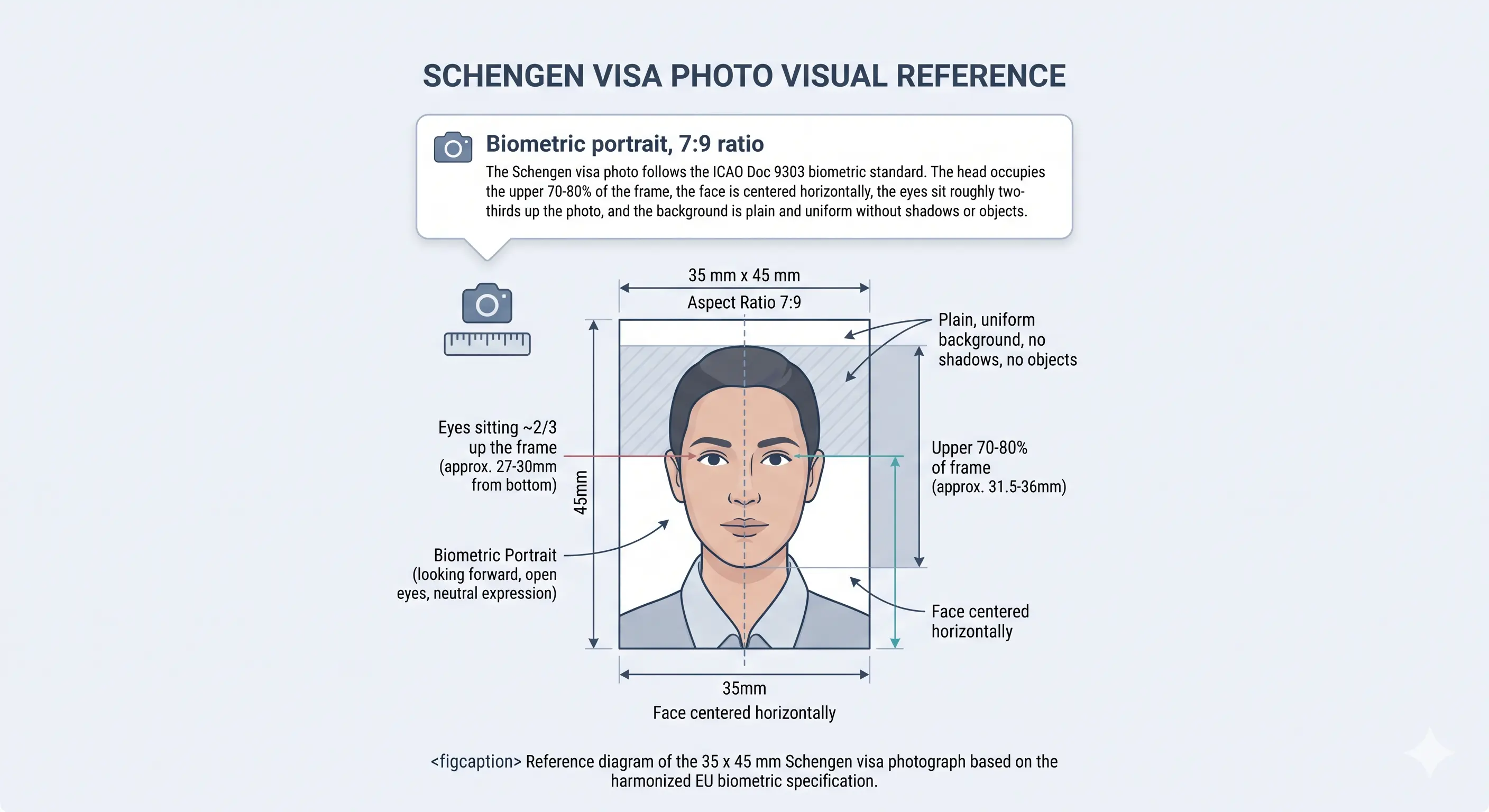
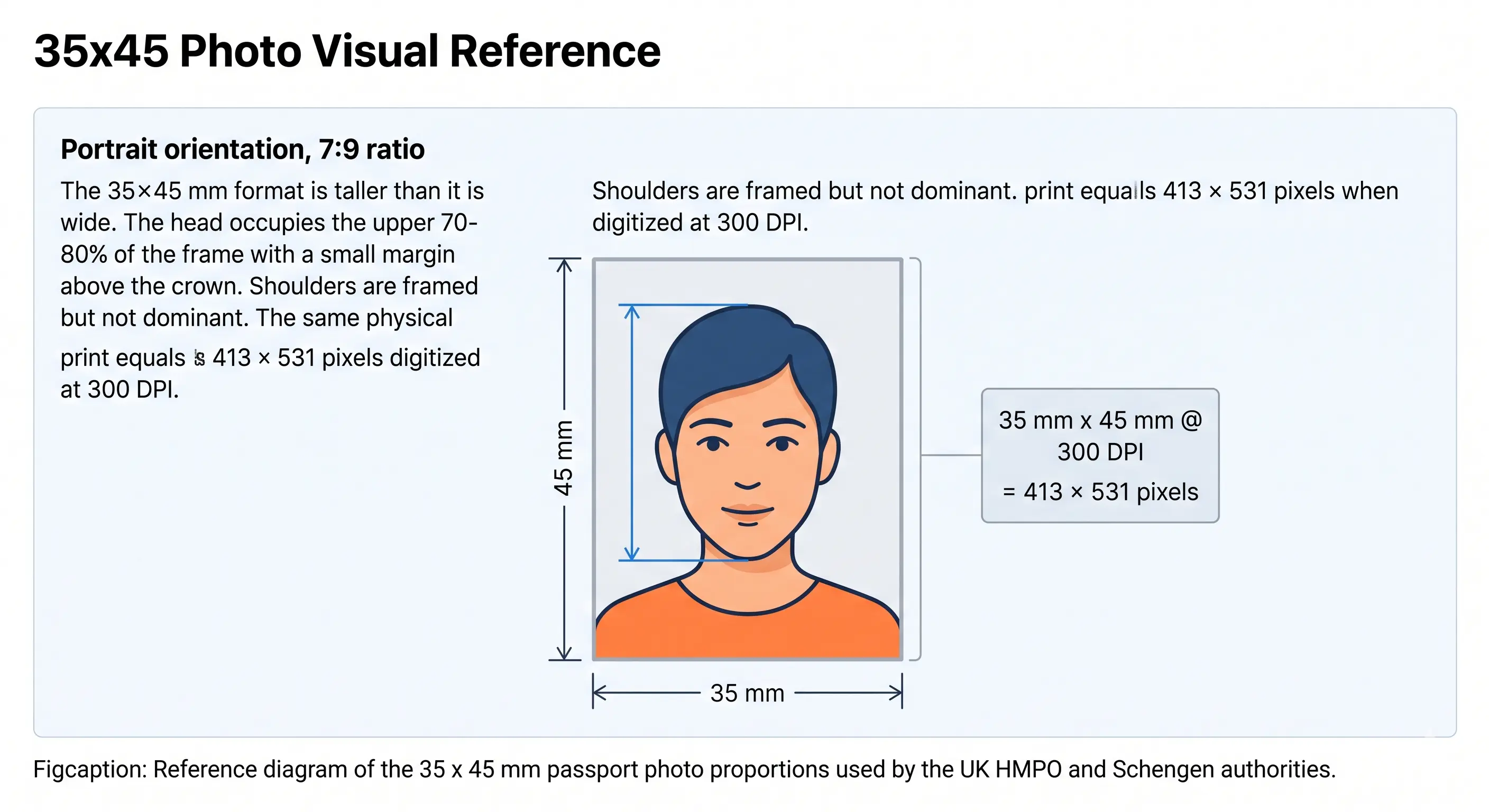
Italy Visa Photo Visual Reference
Italy uses the shared Schengen photo standard, so the framing diagram below applies to Italian visa applications as it does to any other Schengen member state.
Italy Visa Photo Requirements
Every row below must pass for the photo to clear the VAC pre-check. Each rule links to the detailed standard in our passport photo rules library.
| Photo Size | 35mm × 45mm (3.5cm × 4.5cm), the standard Schengen biometric format |
|---|---|
| Pixels | 413 × 531 px at 300 DPI; 826 × 1062 px at 600 DPI. Aim at or above 413 × 531 — see resolution rules |
| Aspect Ratio | 7 : 9 (3.5 : 4.5) portrait |
| Face Height | Roughly 32–36mm from chin to crown, occupying 70–80% of the frame; one source lists a stricter outer band of 27–40mm before automatic rejection. See head size rules and face size requirements |
| Eye Position | Eyes level, open and looking directly at the lens, positioned in the upper portion of the frame. See eyes requirements |
| Background | Plain and light. Sources diverge hereunverified — see note — some VFS one-pagers specify white, others specify light grey (or medium grey for light-colored hair). We default our template to white as the safer common denominator, but confirm with your specific VAC. See background colour rules |
| Lighting | Even and diffuse with no shadow on the face or the wall behind the head. See shadow rules |
| Hair | Must not fall across the eyes or obscure the outline of the face. See hair rules |
| Ears | Not mandatory for Schengen photos, but the full face outline must be clear. See ears visibility rules |
| Head Coverings | Not permitted unless worn for religious reasons, with the face fully visible from chin to forehead. See head covering rules |
| Resolution | At least 600 DPI if printed from a digital photo; for online uploads, one VFS one-pager lists a minimum of 240×320px, though portal-specific specs can differ |
| File Format | JPG/JPEG for digital uploads; physical photos printed on quality photo paper, not glossy |
| Colour | Full 24-bit colour, sRGB, natural skin tones. No filters, beautification or portrait blur |
| File Size (digital) | One source cites a 120KB cap for online Italy visa submissionsunverified — we could not confirm this against an official VFS portal page, so check your VAC's upload page before submitting |
| Printed Copies | Two identical prints unless your appointment confirmation states otherwise — the count varies by consulate |
| Glasses | Permitted if lenses are clear with no glare and eyes are fully visible; tinted or heavy-framed glasses risk rejection. See glasses rules |
| Expression | Neutral, mouth closed, eyes open, looking straight at the camera — no smiling. See smile rules |
| Photo Age | No more than 6 months old, and should still resemble your current appearance |
| Digital Submission Rules | Varies by VAC — see the Digital Submission section below |
| Varies by Visa Type? | No — tourist, business, student, and work visa photos share this same specification |
Visa Authority Overview
Italy visa applications are processed through Italian consulates and embassies abroad under the Ministry of Foreign Affairs and International Cooperation (MAECI), with day-to-day appointment handling, document collection, and biometric enrollment outsourced in many countries to VFS Global or, in some locations, TLScontact. These visa application centres (VACs) check your photo against the published specification before your file even reaches a consular officer — which is why a non-compliant photo can stall your appointment before the substantive review of your application starts.
Because the operational checklist is set by whichever VAC handles your region, the exact photo guidance you'll see on the appointment booking page can read slightly differently from one country to the next, even though the underlying Schengen Visa Code dimension (35×45mm) doesn't change. If your local VAC's page is more specific than what's covered here, treat that page as the authority. The official Italian visa portal is vistoperitalia.esteri.it, and the Schengen-wide legal framework is published by the European Commission.
Differences Between Visa Types
| Visa Type | Photo Spec | What Actually Differs |
|---|---|---|
| Tourist (Schengen, Type C) | 35×45mm, standard | Shortest supporting document list — itinerary, accommodation, travel insurance |
| Business (Schengen, Type C) | 35×45mm, standard | Requires an invitation letter from the Italian host company in addition to standard documents |
| Student (national, Type D) | 35×45mm, standard | Requires university enrollment/acceptance letter and proof of financial means; longer processing window |
| Work (national, Type D) | 35×45mm, standard | Requires an Italian employment contract and is subject to Italy's annual quota system (decreto flussi) |
The takeaway: pick the visa-type filter on this page mainly for the supporting-document checklist you'll see elsewhere on our site — the photo itself does not need adjusting based on which of these four you select.
Digital Visa Submission Rules
An increasing number of Italy VACs ask applicants to upload a digital photo as part of online appointment booking, separate from the printed copy you bring on the day. Because this is run by whichever third-party provider operates in your region, the exact file requirements (maximum size in KB, accepted formats, minimum pixel dimensions) are set at the portal level rather than by a single Italy-wide rule.
- Accepted format is consistently JPG/JPEG across the sources we reviewed.
- One Italy-specific source quotes a small file-size ceiling (120KB) for online uploads — notably tighter than the multi-megabyte limits common on other Schengen e-visa systems. We flag this as unverified rather than asserting it applies to your specific VAC.
- A separate VFS one-pager lists a minimum pixel dimension of 240×320px with a 3.5:4.5 aspect ratio, rejecting anything smaller.
- Bring a printed backup photo to your appointment even if you've uploaded digitally — several VACs note that digital uploads can fail or be flagged for manual review, and a compliant printed copy avoids a delay on the day.
- Do not upscale a small image to reach the minimum pixel size. Enlarging interpolates rather than adding detail, and the softness it creates around the eyes and hairline can fail a sharpness check even when the dimensions read correctly.
Need to hit a tight upload ceiling? The reduce file size guide and compress to 240 KB guide cover the mechanics. If your phone saves HEIC files, convert first with the HEIC to JPEG guide. Portal rules across systems are collected in the digital photo requirements guide.
In-Person Submission at VFS or Consulate
Most Italy visa categories still require an in-person appointment for biometric enrollment — fingerprints plus a photo capture or verification — at a VFS Global centre, TLScontact centre, or the consulate itself, depending on your country of residence. Staff will compare your submitted photo against your in-person appearance and your passport photo, so a photo that's outdated or doesn't resemble your current look can be flagged even if it technically meets the size specification.
Bring two identical physical copies unless your VAC's appointment confirmation says otherwise — the number of required prints is one of the details that varies most by location, with some consulates requesting one photo and others two.
Child & Infant Requirements
Every applicant needs their own photo, including newborns. The 35 × 45 mm size, background and head-height band apply to children exactly as they do to adults — there is no smaller format and no reduced head-height allowance for infants. What is relaxed is positioning guidance for babies who cannot yet sit or hold their head steady.
Same size, same framing
35 × 45 mm frame with the head filling 70–80% of the height. No age exemption applies to dimensions.
Child alone in frame
No other person, supporting hand, arm, car seat, toy or dummy may be visible. Support the child from behind a plain sheet.
Eyes open, mouth closed
The eyes-open, mouth-closed standard still applies. Positioning tolerance is wider for infants, but the biometric check is not waived.
No shadow behind the head
Lay the child on a plain light sheet in soft indirect daylight and shoot from directly above. Side lighting creates the background shadow that fails the check.
Shoot wide, crop after
Cropping tightly in-camera on a small face leaves too few pixels once the 7:9 frame is applied. Frame loose and crop down.
Keep it recent
The 6-month rule matters more for children because appearance changes quickly. A photo that no longer resembles the child can be refused inside the window.
Positioning, lighting and timing technique for babies and toddlers is covered in our baby passport photo at home guide. The eyes requirements and shadow rules pages cover the two checks that fail most often on child photos.
Can I Take My Italy Visa Photo at Home?
Yes, with attention to a few details that are easy to get wrong with a phone camera:
- Phone camera: Use the rear camera, not the front-facing selfie camera — selfies are explicitly disallowed by most sources reviewed, and rear cameras avoid the wide-angle distortion of front cameras.
- Turn off enhancement: Disable portrait mode, background blur, skin smoothing and any beauty filter before you shoot. These alter facial geometry and are detected by biometric pre-checks.
- Lighting: Face a window for even, diffused natural light. Avoid direct flash, which causes red-eye and harsh shadows that lead to rejection.
- Background: Stand at least 1–2 feet from a plain wall so no shadow falls behind your head.
- Distance: Have someone else take the photo from about 3–7 feet away so your face isn't distorted by close-range lens warping, then crop afterward. See the crop guide for how the 7:9 ratio and head-height rule are applied together.
- Digital upload: If your VAC accepts online upload, check its specific file size ceiling before submitting — don't assume the 120KB figure quoted above applies to your location.
- Common mistakes: Smiling, tilted head, shadows from overhead lighting, colored or patterned walls, glasses glare, and reusing an old passport photo that no longer matches your appearance.
Printing Your Italy Visa Photo
Most Italy visa appointments still require physical prints, so printing is part of the specification rather than an afterthought. A 35 × 45 mm photo tiles cleanly onto standard photo paper, so one sheet covers your appointment with spares.
| Print resolution | 300 DPI minimum, 600 DPI preferred by several consulate one-pagers. Disable fit-to-page and auto-scaling, which change the physical size |
|---|---|
| Paper | Photo-quality matte or semi-matte. High-gloss stock reflects under counter lighting and is sometimes refused. Plain copier paper is never accepted |
| Copies per 4 × 6 in sheet | Six 35 × 45 mm photos with cutting margins |
| Copies per A4 sheet | Around twenty, though you only need two |
| Cutting | Guillotine or steel rule for square edges. Do not cut inside the printed border, and do not round the corners |
| Colour management | sRGB. Turn off printer auto-enhance, skin smoothing and colour correction |
| Handling | Let ink dry fully. Do not fold, staple or use glue on the photo face — creasing is a documented rejection cause |
Printer settings and cutting technique are covered in full in our print passport photo at home guide, and multi-copy sheet layout in the print sheet guide.
Italy Visa Photo vs. Italy Passport Photo
| Dimensions | Both use 35×45mm — effectively the same physical size |
|---|---|
| Head Size | Both target 70–80% face coverage within the frame |
| Background | Italian passport photos generally call for a plain white background. Visa photo guidance is less consistent, with white and light grey both appearing across sources — so a background that's "safe" for a passport application is also a safe starting point for a visa application. |
| Submission Format | Passport applications go through your local comune or questura. Visa applications go through a consulate, VFS Global, or TLScontact centre, often with an added digital upload step that passport renewals don't typically require. |
| Compliance Differences | The dimensions are effectively identical between the two. Where they diverge is enforcement: visa photo checks at VAC counters are frequently automated biometric pre-checks, while passport photo review at a comune is more often a manual human check. |
Honest summary: if you already have a compliant Italy passport-style photo on file, it will very likely also satisfy the visa photo specification — the two share the same core dimensions rather than diverging in some meaningful way. See our Italy passport photo guide for the domestic renewal channel.
Compared to Other Photo Formats
If you are applying for several documents at once, note that a 35 × 45 mm photo cannot be reused where a different format is required. These are the formats most often confused with the Schengen standard.
| Format | Pixels @ 300 DPI | Ratio | Used for |
|---|---|---|---|
| 35 × 45 mm | 413 × 531 px | 7 : 9 | Italy visa, all Schengen visas, EU passports, UK, Australia |
| 51 × 51 mm (2 × 2 in) | 600 × 600 px | 1 : 1 | US passport and visa, India in-person applications |
| 50 × 70 mm | 591 × 827 px | 5 : 7 | Canada passport and PR card |
| 33 × 48 mm | 390 × 567 px | 11 : 16 | China passport and China visa |
Full conversions across every standard are in passport photo size in pixels and passport size photo dimensions. Every national standard is indexed in the requirements by country hub.
How to Create an Italy Visa Photo
- Upload your photo. Use the widget above — a recent phone photo against a plain wall works fine as a starting point.
- Select visa type. Choose tourist, business, student, or work — this affects labeling and downstream document checklists, not the photo crop itself.
- Crop & background. The tool automatically frames your face to the 70–80% Schengen target and swaps in a plain, evenly lit background.
- Verify against requirements. Compare the output against the requirements table above before downloading, especially if your specific VAC has published grey-background guidance.
- Download. Get both a print-ready file sized to 35×45mm and a digital file ready for VAC upload portals.
Ready now? Open the Passport Photo Maker and get a 35 × 45 mm file in under a minute.
Common Rejection Reasons
Each item below links to the detailed rule so you can confirm the exact tolerance before you submit. The full cross-country breakdown is in passport photo rejection reasons.
Wrong background colour
Submitting a colored or patterned background, or guessing wrong between white and light grey for your specific VAC. See background colour rules.
Outdated photo
Using a photo older than 6 months or one that no longer matches your current appearance.
Incorrect head size
Face occupying less than 70% or more than 80% of the frame height. See head size rules.
Shadows or glare
Uneven lighting on the face or background, or glasses glare obscuring the eyes. See shadow rules.
Hair across the face
A fringe over the eyes or hair obscuring the face outline fails landmark detection. See hair rules.
Selfie-style photo
Front-camera selfies are flagged by several sources as a frequent, avoidable rejection cause.
Smiling or tilted head
Non-neutral expression or an angled head position instead of looking straight at the camera. See smile rules.
Non-religious headwear
Hats and decorative head coverings are refused. Religious coverings must leave the full face visible. See head covering rules.
Filters or retouching
Portrait blur, skin smoothing and slimming effects alter facial geometry and are detected by automated pre-checks.
Wrong file size for upload
Digital photo exceeding the VAC's upload portal limit — confirm the exact figure with your VAC rather than assuming a generic number.
Upscaled low-resolution file
Enlarging a small image to reach the minimum pixel count creates softness around the eyes that fails a sharpness check. See resolution rules.
Low print quality
Glossy paper, creasing, or low-resolution printing under the recommended 600 DPI. See the print at home guide.
Compliance Notice
- Visa photo requirements vary by visa application centre, change without notice, and are ultimately set by the issuing consulate or VAC — always verify against your specific appointment portal or consulate guidance before submitting.
- Passport Photo Maker helps you produce a photo matching the published 35×45mm Schengen specification, but it does not guarantee visa approval. Final approval rests solely with the Italian consulate or embassy reviewing your application.
- Background color (white vs. light grey) and the digital file-size limit referenced on this page could not be independently verified against a single authoritative Italy-wide source — we've flagged these explicitly above rather than presenting them as settled fact.
Frequently Asked Questions
Size & Specification
What size does an Italy visa photo need to be?
Italy visa photos follow the standard Schengen biometric format: 35mm wide by 45mm high, with your face occupying roughly 70–80% of the frame. This applies to tourist, business, student, and work visa applications alike. Some consulate one-pagers list a minimum pixel size of 240×320px for digital uploads, so check your specific VAC's digital submission page if you're applying online.
What is the Italy visa photo size in pixels?
At 300 DPI a 35 × 45 mm photo equals 413 × 531 pixels, and at 600 DPI it equals 826 × 1062 pixels. One VFS one-pager for Italy lists a minimum acceptable upload of 240 × 320 pixels with a 3.5:4.5 aspect ratio. Aim for 413 × 531 pixels or larger, because portals can downscale a large file but cannot recover detail from a small one.
Does the photo background need to be white or grey for an Italy visa?
This is genuinely inconsistent across the sources we reviewed. Some VFS Global one-pagers for Italy specify a plain white background, while others reference light grey (suggesting medium grey for light hair, light grey for dark hair, for contrast). We haven't found one authoritative page that resolves this for every Italy VAC location. Until you confirm with your specific consulate or VAC, white is the lower-risk default, since no source rejects it outright, while grey is occasionally preferred but never described as mandatory everywhere.
Can I wear glasses in an Italy visa photo?
Glasses are permitted for Italy visa photos provided the lenses are clear, there is no glare, and both eyes are fully visible. Tinted lenses, sunglasses and heavy frames that obscure the eyes or eyebrows risk rejection. Removing glasses entirely is the lowest-risk option because it eliminates the glare check.
Visa Types & Documents
Do tourist, student, and work visa photos for Italy have different specs?
No. The photo itself — size, background, expression, framing — follows the same 35×45mm Schengen standard regardless of which Italy visa category you're applying for. What changes between visa types is the supporting documentation (employment contract for work visas, enrollment letter for student visas), not the photo specification.
What's the difference between an Italy visa photo and an Italy passport photo?
For Italian citizens renewing a domestic passport, the photo standard is the same 35×45mm ICAO-style format used across most of Europe — effectively identical dimensions to the visa photo. Where they can diverge is background guidance and submission channel: passport applications go through a comune or questura with local conventions, while visa applications go through a consulate or VAC with Schengen-wide rules layered on top. See our Italy passport photo guide if you're unsure which page applies to you.
Submission & Printing
Can I submit a digital photo for my Italy visa application instead of a printed one?
It depends on your Visa Application Centre. Many VFS Global and TLScontact locations now request a digital upload ahead of your appointment in addition to a printed copy you bring on the day. File size limits vary by VAC — one source cited a 120KB cap for online Italy uploads, but we couldn't independently verify that against an official VFS portal page, so confirm the exact limit on your VAC's website first.
How many printed photos do I need for an Italy visa application?
Bring two identical printed photos unless your appointment confirmation says otherwise. The required count is one of the details that varies most by location: some Italian consulates request a single photo and others request two. A spare identical print costs nothing and avoids being turned away at the counter.
How do I print an Italy visa photo at home?
Print at 300 DPI or higher on photo-quality matte or semi-matte paper. Avoid high-gloss stock, which reflects under counter lighting and can be refused. A 4 × 6 inch sheet holds six 35 × 45 mm photos and an A4 sheet holds around twenty. Cut with a guillotine for square edges and do not trim inside the printed border. See our print at home guide.
Timing, Children & Approval
How old can my Italy visa photo be?
Most sources agree your photo should be no more than 6 months old and should still resemble your current appearance. If you've changed your look substantially since the photo was taken, consulates may ask for a retake even within the 6-month window.
Can children and infants use the same Italy visa photo requirements?
Yes, every applicant including infants needs an individual photo meeting the same 35×45mm specification, with no other person, toy, or supporting hand visible in frame. Positioning guidance is more relaxed for infants who can't yet sit or hold their head steady, but the eyes-open, mouth-closed standard still applies. See the child and infant requirements section.
Will Passport Photo Maker guarantee my Italy visa is approved?
No tool can guarantee visa approval, and it's worth being cautious of any that claims otherwise. Passport Photo Maker helps you produce a photo matching the published 35×45mm Schengen dimensions, framing, and background guidance, but final acceptance is decided solely by the Italian consulate, embassy, or VAC processing your application.
Sources & References
Dimensions, framing and expression guidance on this page are compiled from the following. Where sources disagree — notably on background colour and the digital file-size ceiling — we have said so explicitly rather than picking one and presenting it as settled.
- Ministry of Foreign Affairs and International Cooperation (MAECI) — official Italian visa portal: vistoperitalia.esteri.it
- Ministry of Foreign Affairs and International Cooperation — consular services: esteri.it
- European Commission — Schengen Borders and Visa Policy, including the Visa Code photo standard: home-affairs.ec.europa.eu
- ICAO Doc 9303 — Machine Readable Travel Documents, the underlying biometric photograph standard: icao.int
- VFS Global and TLScontact Italy visa application centre photo one-pagers — operational checklists that vary by country of residence and are the source of the background and file-size discrepancies flagged above.
Create Your Italy Visa Photo Now
Whether you're heading to Italy for a holiday, a business trip, university, or a new job — get a properly sized 35×45mm photo ready for your VFS or consulate appointment in under a minute.
Reminder: we help you meet the published photo specification but cannot guarantee visa approval. See the sources for the official references behind this page.