
Germany Visa Photo Maker — 35x45mm Online, Compliant in Seconds
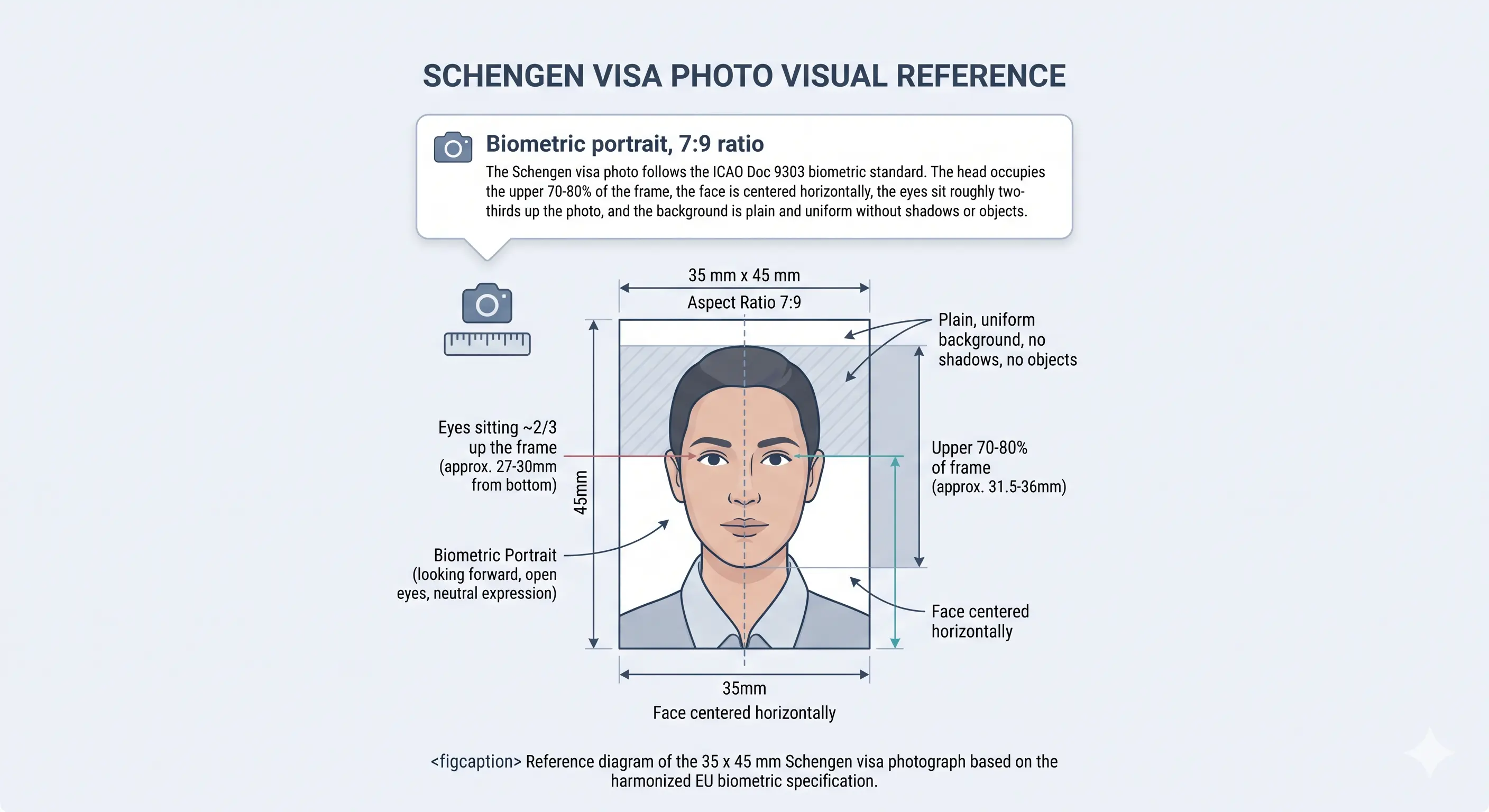
A Germany visa photo must be 35 × 45 mm (413 × 531 pixels at 300 DPI) on a light grey background, with the head measuring 32–36 mm from chin to crown and the photo taken within the last 6 months.
If you're a foreign national applying for a German visa — whether through VIDEX for a Schengen tourist or business visa, or through Germany's Consular Services Portal for a national long-stay visa — your application photo has to match that biometric standard as it is applied by German consulates, embassies, and VFS Global centers worldwide. This isn't the same checklist as a German passport renewal: visa reviewers measure face height closely and have a track record of rejecting photos over background shade, faint shadows, or eyewear glare that a passport office might overlook. A rejected visa photo doesn't just cost you a reprint — it can delay or derail the whole application — so getting it right the first time matters more here than almost anywhere else in the process.
- No registration required
- Result in under 30 seconds
- Preview before you commit
- Re-upload as many times as you need
Germany Visa Photo Requirements at a Glance
Last reviewed: · Reviewed by the ClonyPDF Passport Photo Team against current German consular and Schengen guidance.
- German Federal Foreign Office (Auswärtiges Amt) visa and biometric photo guidance — auswaertiges-amt.de
- VIDEX national visa application form — videx-national.diplo.de
- European Commission, Schengen borders and visa policy — home-affairs.ec.europa.eu
- VFS Global / TLScontact visa application center checklists — vfsglobal.com
- ICAO Doc 9303 biometric photo standard — icao.int
Germany is one of the highest-volume Schengen visa processors in the EU, and consulates rely on automated biometric photo checks to keep decisions consistent across that volume. That is a large part of why photo compliance is enforced more strictly here than the written specification alone suggests.
Does the Photo Requirement Differ by Visa Type?
No. Tourist (Schengen), business, student, and national long-stay (D) applications all use the same 35x45mm biometric photo. What does change is how the photo reaches the authority: applications filed abroad at an embassy or visa center typically still require printed photos, while certain processes handled inside Germany have shifted toward on-site or digitally-captured biometric photos instead of paper prints. The table below shows where that distinction actually matters.
| Visa Type | Photo Size | Typical Submission |
|---|---|---|
| Tourist / Schengen (Type C) | 35x45mm | Printed photo at VFS/consulate, or digital upload via VIDEX depending on location |
| Business | 35x45mm | Same as tourist — processed under the same Schengen short-stay rules |
| Student (National D) | 35x45mm | Uploaded via Consular Services Portal, biometrics confirmed at in-person appointment |
| National / Long-Stay (D, family, work) | 35x45mm | Consular Services Portal upload + appointment; some in-Germany follow-up steps use on-site digital capture |
Submission channel rules can vary by consulate and have shifted since 2025 — always confirm the exact upload or print requirement on your specific embassy's or VFS center's checklist before your appointment.
Precisely cropped to 35x45mm with correct head positioning — no guessing with a ruler.
Face height set to fall within the 32–36mm range German reviewers measure for.
Swapped automatically to the shade German consulates prefer over plain white.
Get a print-ready file for in-person submission and a digital file sized for online portals.
Skip manual editing — the tool handles sizing, cropping, and background in one step.
Tourist, business, student, or long-stay — one correctly sized photo covers them all.
Germany Visa Photo Requirements
Every row below must pass for the photo to be accepted. Each rule links to the detailed standard in our passport photo rules library.
| Photo Size | 35 x 45 mm (3.5 x 4.5 cm) — see 35x45 photo size guide |
|---|---|
| Width | 35 mm (413 px @ 300 DPI) |
| Height | 45 mm (531 px @ 300 DPI) |
| Aspect ratio | 7 : 9 portrait |
| Background | Light grey preferred; plain white technically allowed but sometimes flagged as non-preferred — see background colour rules |
| Lighting | Even and diffuse, no shadow on the face or behind the head — see shadow rules |
| Head Size | Chin-to-crown height of approximately 32–36 mm — see head size rules |
| Face coverage | Roughly 70–80% of the frame height — see face size requirements |
| Eye line | Eyes level, open, and looking directly at the camera — see eyes requirements |
| Hair | Must not cover the eyes or obscure the outline of the face — see hair rules |
| Ears | Not mandatory under Schengen guidance, but the face outline must stay clear — see ears visibility rules |
| Head coverings | Not permitted unless worn for religious or medical reasons, with the full face visible — see head covering rules |
| Resolution | Minimum ~413 x 531 px at 300 DPI for digital upload; higher resolution recommended for print — see resolution rules |
| Colour | 24-bit colour, sRGB, natural skin tones, no filters or beautification |
| File Format | JPEG typically required for digital portal uploads; high-quality photo paper for printed submissions |
| Copies required | Usually two identical printed photos where biometrics are not captured on-site |
| Glasses Rules | Technically allowed, but German consulates frequently flag eyewear for glare or frame shadows — removing glasses is the safer choice. See glasses rules |
| Expression Rules | Neutral expression, mouth closed, both eyes open, looking directly at the camera — see smile rules |
| Photo Age | Taken within the last 6 months and must reflect current appearance |
| Digital Submission Rules | Portal-dependent (VIDEX / Consular Services Portal); follow the file size and format shown at upload, since e-visa portals tend to reject files passport offices would accept |
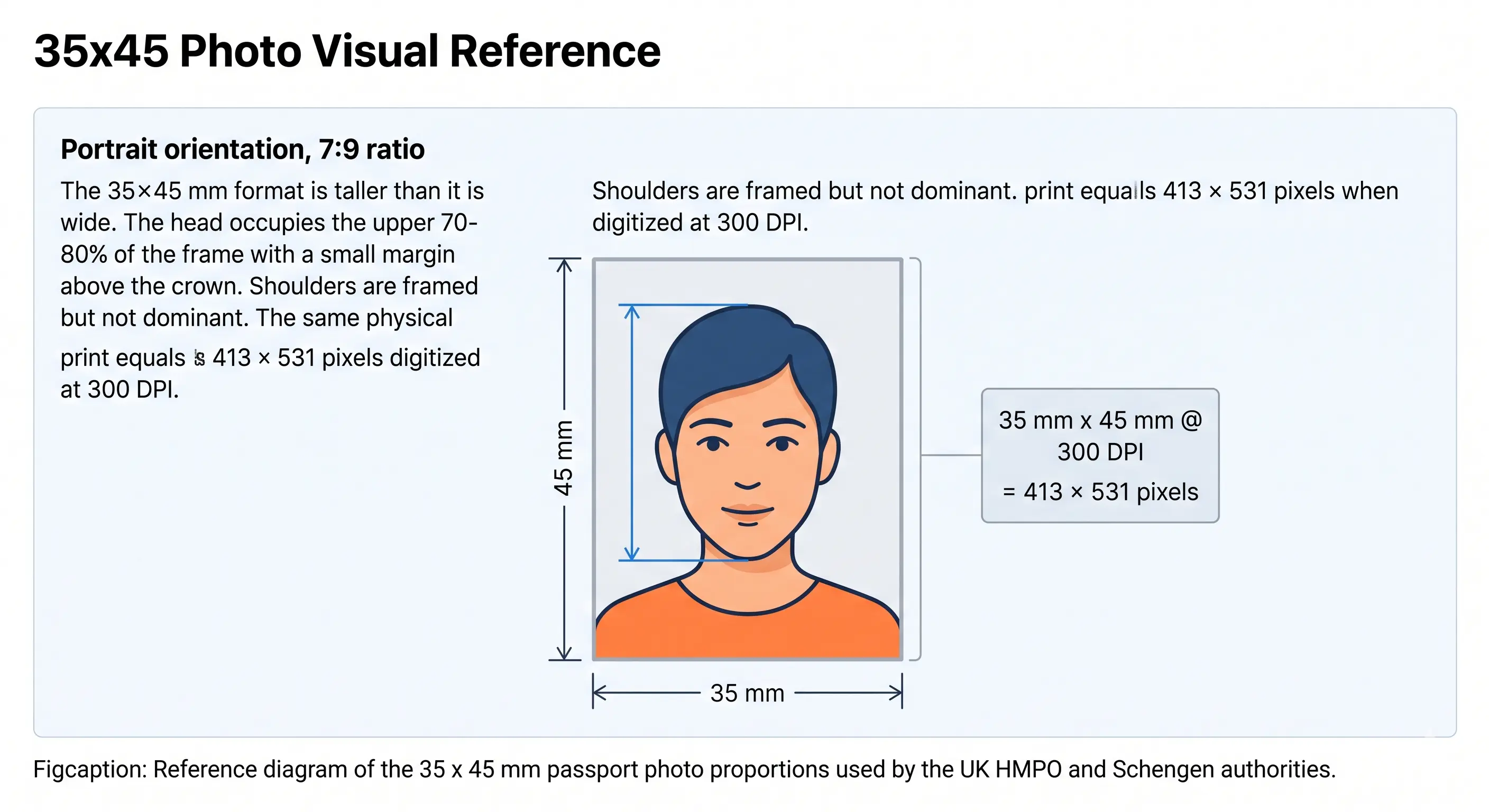
These specifications reflect German and EU Schengen biometric photo guidance as published by German consulates and visa centers. Some figures, such as the exact resolution floor for a given portal, aren't published identically across every German mission, so we've given the commonly cited range instead of presenting one number as universal — confirm the specific figure on your consulate's or VFS center's own checklist. For the broader Schengen baseline this builds on, see our Schengen visa photo guide, and for how every national standard compares, the passport size photo dimensions reference.
Visa Authority & Application Process Overview
German visa applications are decided by the German Embassy or Consulate-General responsible for your place of residence, but the application is usually filed through an intermediary: VIDEX for the paper-based application form, the Consular Services Portal for many national long-stay categories, or in person at a VFS Global or TLScontact visa application center, which handles document checks and biometric capture before forwarding your file to the consulate for the actual decision.
For a short-stay Schengen visa (tourist or business), you'll typically complete the VIDEX form, book an appointment, and attend in person to submit your passport, photo, and supporting documents while biometrics are captured. For a national long-stay visa (student, work, family reunification), many applicants now start through the Consular Services Portal, uploading documents in advance before a single in-person appointment to verify originals and capture biometrics.
Because Germany applies the Schengen baseline, the same 35 × 45 mm photo also satisfies visa applications for neighbouring Schengen states. If your trip covers more than one country, see our guides for France, Italy, the Netherlands, Austria and Switzerland, or browse every country in the requirements by country hub.
Can I Take My Germany Visa Photo at Home?
Yes, with care. A phone camera is sufficient as long as you control the lighting and background.
- Camera: Any modern smartphone camera works; avoid heavy beauty filters or auto-retouching modes, and switch off portrait blur.
- Lighting: Diffused, even daylight or two soft light sources at 45-degree angles — avoid harsh shadows on the face or behind the head. See the shadow rules.
- Background: A plain light grey wall or backdrop is the safest choice for German reviewers; plain white works but is more likely to be flagged. See the background colour rules.
- Distance: Stand roughly 1.5–2 meters from the camera, held at eye level.
- Framing: Shoot wide and crop down rather than zooming in — the crop guide explains how the 7:9 ratio and the 32–36 mm head band are applied together.
- Hair and ears: Keep hair off the eyes and clear of the face outline. See the hair rules and ears visibility rules.
- Printing: If your application requires a printed photo, use high-quality matte or glossy photo paper — avoid home inkjet prints on regular paper. See the print at home guide.
- Digital upload: Match the file size, format, and resolution shown by your specific portal (VIDEX or Consular Services Portal) — these limits aren't always identical to printed-photo specs. Our digital photo requirements guide covers the common windows.
- iPhone users: If your camera saves HEIC files, convert them first with the HEIC to JPEG guide — German portals accept JPEG only.
- Common mistakes: Off-white or patterned backgrounds, faint shadows behind the head, glasses glare, and photos older than 6 months are what we see flagged most often.
Germany Visa Photo vs. Other German Documents
| Specification | Visa Photo | Passport Photo | Residence Permit Photo |
|---|---|---|---|
| Dimensions | 35 x 45mm | 35 x 45mm | 35 x 45mm |
| Head Size | ~32–36mm | ~32–36mm | ~32–36mm |
| Background | Light grey preferred | Light grey preferred | Light grey preferred |
| Submission Format | Often printed for embassy/VFS filing abroad; some in-Germany visa-linked processes use digital capture | Increasingly digital/on-site capture for in-Germany passport applications since 2025 | Digital biometric capture or certified-provider upload has largely replaced paper photos for in-Germany residence permit and eAT appointments since 2025 |
| Compliance Differences | Reviewed against consulate-specific checklist; rejection delays the visa decision itself | Reviewed by passport office staff against the same biometric standard | Reviewed by the local Ausländerbehörde; a QR code from a certified provider often replaces the printed photo entirely |
Here's the honest answer: across these German documents, the underlying photo specification stays the same at 35x45mm. There's no separate "visa-only" dimension to track down. What actually shifts is submission — passport and residence-permit processes handled inside Germany have moved toward digital biometric capture at the authority, while visa applications filed at an embassy or visa center abroad more often still expect a printed photo. If you're applying for more than one of these — say a German passport renewal alongside a residence permit appointment — the same compliant file can usually work for both, provided you match the output format to whichever submission method each process actually requires. The shared European baseline is set out in our EU passport photo guide.
Digital Visa Submission Rules & Biometric Data
Most Schengen and national visa applications now begin online — through VIDEX for the paper form or the Consular Services Portal for supported long-stay categories — but biometric data (fingerprints and a live photo capture) is still collected in person at your appointment for first-time applicants. Your uploaded or printed photo is checked against this biometric capture, which is one reason an outdated or heavily edited photo can cause friction even if it technically meets the size requirement.
If your visa type is processed through the Consular Services Portal, follow the file format and size limits shown at the upload step exactly — these portals reject files more strictly than a human reviewer would a printed photo, particularly on file size and color profile. If your export comes out too heavy, the compress to 240 KB guide and reduce file size guide cover how to get under a ceiling without dropping below the pixel minimum. Our Passport Photo Maker tool generates both a print and a portal-ready digital file from the same upload, so you're not formatting two separate images by hand.
Germany Visa Photo Requirements for Babies, Infants and Children
Every child needs their own photo on their own application, and the 35 × 45 mm size, light grey background and 32–36 mm head band apply to minors exactly as they do to adults. There is no smaller format for infants. Schengen guidance relaxes only a narrow set of expression and eye rules for the very young.
Same size, same framing
35 × 45 mm frame with the head filling roughly 70–80% of the height. No age exemption applies to dimensions or head size.
Expression relaxed under one
Schengen guidance does not require a neutral expression or a closed mouth for infants under one year. Older children are held to the adult standard.
Eyes open where achievable
Open eyes are expected wherever possible and are enforced for older children. See the eyes requirements.
Child alone in the frame
No supporting hands, arms, car seat, toy or dummy may appear, and no other person may be visible. Support the child from behind a plain light sheet.
No shadow behind the head
Lay the child on a plain light sheet in soft indirect daylight and shoot from directly above. Side lighting creates the background shadow German reviewers catch.
Own application, own photo
A child included on a parent's travel plans still files a separate application with their own photo. Photos cannot be shared between applicants.
Positioning, lighting and timing technique for infants and toddlers is covered step by step in our baby passport photo at home guide.
Printing Your Germany Visa Photo
Most German visa applications filed at an embassy or VFS center still expect two identical printed photos, so printing is part of the specification rather than an afterthought.
| Print resolution | 300 DPI minimum — export at 413 x 531 pixels or larger and disable fit-to-page scaling |
|---|---|
| Paper | Glossy or matte photo paper, 200–250 gsm. Plain copier paper is refused |
| Copies per 4 x 6 inch sheet | Six 35 x 45 mm photos — covers the two most applications request, with spares |
| Copies per A4 sheet | Around twenty 35 x 45 mm photos |
| Cutting | Guillotine or steel rule for square edges. Do not cut inside the printed border |
| Colour management | sRGB. Turn off printer auto-enhance, skin smoothing and colour correction |
| Handling | Let ink dry fully. Do not staple, fold or glue the photo face. Bring both copies uncut-free of bent corners |
Printer settings, paper choice and cutting technique are covered in full in our print passport photo at home guide, and multi-copy sheet layout in the print sheet guide.
Will Your Germany Visa Photo Pass?
Run through this before you submit anything — most rejections trace back to one of these.
- ✓ Face centered
- ✓ Eyes level & open
- ✓ Light grey background
- ✓ Head height 32–36mm
- ✓ Even lighting
- ✓ No shadows
- ✓ No glasses glare
- ✓ Neutral expression
- ✓ Hair off the face
- ✓ Sharp resolution
- ✓ Taken within 6 months
- ✓ Two identical prints ready
How to Create a Germany Visa Photo
- Upload a clear, front-facing photo — a recent smartphone photo against a plain background works well.
- Select visa type in the tool — tourist, business, student, or national long-stay all use the same Germany template, so any selection produces the correct size.
- Crop & background are handled automatically — the tool centers your face and swaps in a compliant light grey background.
- Verify against requirements using the built-in compliance check before downloading, so sizing or background issues are caught early.
- Download both a print-ready file (for embassy/VFS submission) and a digital file (for portal upload), since German visa processes can require either depending on where you apply.
Common Rejection Reasons
Each item below links to the detailed rule so you can confirm the exact tolerance before you submit. The full cross-country breakdown is in passport photo rejection reasons.
- Background reading as off-white or slightly tinted instead of true light grey — see background colour rules
- A faint shadow behind the head or across the face — easy to miss on a phone screen, caught instantly by a reviewer. See shadow rules
- Glasses glare, or frames partially covering the eyes — see glasses rules
- Head size outside the ~32–36mm range, from zooming in or out too far — see head size rules
- A fringe over the eyes or hair obscuring the outline of the face — see hair rules
- Non-religious headwear, or a religious head covering that shadows the face — see head covering rules
- A photo older than 6 months, or one that no longer matches your current appearance
- Heavy retouching or a beauty-mode filter that smooths out natural skin tone
- A file the Consular Services Portal or VIDEX rejects for size or format, even when the printed version would have been accepted
- Bringing a passport-style photo to an appointment when the consulate's checklist asked for an additional or different digital file
- Bringing one printed photo when the checklist asked for two identical copies
Frequently Asked Questions
Size & Specification
What size does a Germany visa photo need to be?
Germany visa photos must be 35x45mm, in line with the Schengen and ICAO biometric photo standard. At 300 DPI that equals 413 × 531 pixels. This applies whether you are applying for a short-stay Schengen visa or a long-stay national (D) visa.
What head size does a Germany visa photo need?
The head measured from chin to crown should be approximately 32 to 36 mm, which places it at roughly 70 to 80 percent of the 45 mm frame height. German reviewers measure this figure precisely, and a head outside the band is one of the most common causes of rejection even when everything else looks correct.
What background color does Germany require for visa photos?
A light grey background is the preferred and most consistently accepted option for German visa and biometric photos. A plain white background is technically allowed under EU rules but is sometimes flagged by German reviewers as non-preferred, so light grey is the safer default.
Can I wear glasses in my Germany visa photo?
Glasses are technically permitted under Schengen rules, but German consulates are known to scrutinize eyewear closely, and many applicants report rejections over glare or frame shadows. Removing glasses entirely is the safer choice for a Germany visa photo. Tinted lenses are never accepted.
Visa Types & Submission
How many photos do I need for a German visa application?
Most German visa applications, whether Schengen short-stay or national long-stay, ask for two identical printed photos when biometrics aren't already captured digitally on-site. Always confirm the exact count with your specific consulate or VFS center checklist.
Is the photo requirement different for a German student or work visa compared to a tourist visa?
The photo specification itself (35x45mm, ICAO-style biometric photo) is the same across tourist, business, student, and family reunification visas. What changes is how the photo is submitted and processed, not its dimensions.
Can I submit my German visa photo digitally instead of printing it?
It depends on where you're applying. For Schengen and national visa applications submitted abroad at an embassy or VFS center, printed photos are still commonly required. For certain residence permit and document processes handled inside Germany, the workflow has shifted toward digital biometric capture rather than printed photos. Always check your specific appointment instructions.
Children & Printing
What are the Germany visa photo rules for a baby or child?
The same 35x45mm size and light grey background apply to children, and each child needs their own photo on their own application. Schengen guidance relaxes the neutral-expression and open-eyes rules for infants under one year, but the child must be alone in the frame with no supporting hands, toy or dummy visible, and no other person may appear. See the child and infant requirements section.
How do I print a 35x45 mm Germany visa photo?
Print at 300 DPI on glossy or matte photo paper of 200 to 250 gsm, never on plain copier paper. A 4 × 6 inch sheet holds six 35 × 45 mm copies, which covers the two photos most German applications request with spares. Cut with a guillotine for square edges and do not trim inside the printed border.
Rejections, Validity & Alternatives
Why was my German visa photo rejected even though it looked fine?
German visa reviewers are known to measure face height precisely and reject photos for subtle issues like faint shadows behind the head, a background shade that reads as off-white rather than light grey, or eyewear glare, even when the overall photo looks acceptable to the applicant.
Does a German visa photo expire?
There's no fixed printed expiry date, but the photo must have been taken within the last 6 months and must still accurately reflect your current appearance. If your look has changed noticeably, take a new one even if the old photo is technically still within that window.
Where can I get a Germany visa photo near me?
Most photo studios, pharmacies, and print shops near consulates and VFS centers offer biometric visa photos. If you'd rather skip a trip out, an online tool lets you produce a compliant 35x45mm photo from your phone and either print it yourself or order prints, without needing to find a local studio that knows the German spec.
Can I get my Germany visa photo online instead of going to a studio?
Yes. An online visa photo maker can crop, resize, and replace the background of an existing photo to the 35x45mm German standard, producing both a print-ready file and a digital file for portal upload, all without an in-person studio visit.
Is there an app for taking a Germany visa photo?
Rather than a dedicated downloaded app, most applicants use a browser-based visa photo tool: you upload a photo taken on your phone, and the tool handles cropping, background, and sizing in the browser without installing anything.
Create Your Germany Visa Photo Now
Whether you're heading to a VIDEX appointment for a tourist visa or uploading documents through the Consular Services Portal for a long-stay visa, get a 35x45mm photo sized and backgrounded to German consulate standards before you go.
Compliance notice: requirements are set by German consular authorities and can change without notice. This tool helps you create a compliant photo but does not guarantee visa approval — always verify against the official portal or your consulate's checklist before submitting.