
Portugal Visa Photo Requirements (35 x 45 mm)
A Portugal visa photo must be 35 mm wide by 45 mm high on a plain light background, with the head measuring 32–36 mm from chin to crown and the photo taken within the last 6 months.
The same specification applies to every Portuguese visa category. Whether you are applying for a short-stay Schengen tourist or business visa, or a long-stay residency route such as the D7 passive income visa or the D8 digital nomad visa, the photograph is identical. Applications are handled largely through VFS Global and Portuguese consulates on behalf of the Portuguese authorities, and the published European standard is applied to all of them.
Visa photo checks are enforced more rigidly than routine passport renewals, because a third-party handler screens the dossier against a fixed checklist before it reaches the consulate. A shadow on the wall, a background that is not uniform, or a head sitting outside the 32–36 mm band is enough to be turned away at the counter.
- Schengen & National visa spec
- Exact 35 × 45 mm output
- Automatic background replacement
- Print sheet & digital file
Portugal Visa Photo Size (Quick Answer)
The Portugal visa photo size is 35 mm × 45 mm (3.5 × 4.5 cm, or 1.38 × 1.77 inches). At 300 DPI that is 413 × 531 pixels with a 7:9 portrait ratio. The head must fill 32–36 mm chin to crown on a plain light background, with a neutral expression and closed mouth.
| Requirement | Value |
|---|---|
| Photo size | 35 × 45 mm (3.5 × 4.5 cm) |
| Pixels at 300 DPI | 413 × 531 px |
| Aspect ratio | 7 : 9 portrait |
| Head height (chin to crown) | 32 – 36 mm, about 71–80% of frame height |
| Eye line from bottom edge | 30 – 36 mm |
| Background | Plain light grey or white, uniform, no shadow |
| Expression | Neutral, mouth closed, both eyes open |
| Age of photo | Taken within the last 6 months |
| Printed copies | Two identical prints for in-person submission |
| Applies to | Schengen Type C and National Type D, including D7 and D8 |
Why Prepare Your Visa Photo Here
- Exact cropping: Precision crop to the 35 × 45 mm frame at a true 7:9 ratio.
- Biometric framing: Positions the head inside the 32–36 mm chin-to-crown band and checks the eye line.
- Background correction: Replaces an uneven wall with the plain light grey or white backdrop Schengen submissions require, with no photo editor needed.
- Both output formats: A digital file for portal uploads and a 4 × 6 inch print sheet holding six copies for your VFS appointment.
Portugal Visa Photo Visual Reference
Portugal applies the Schengen photograph standard. The diagrams below mark every dimension a visa officer checks: the 35 × 45 mm frame, the 32–36 mm head height and the plain light background.
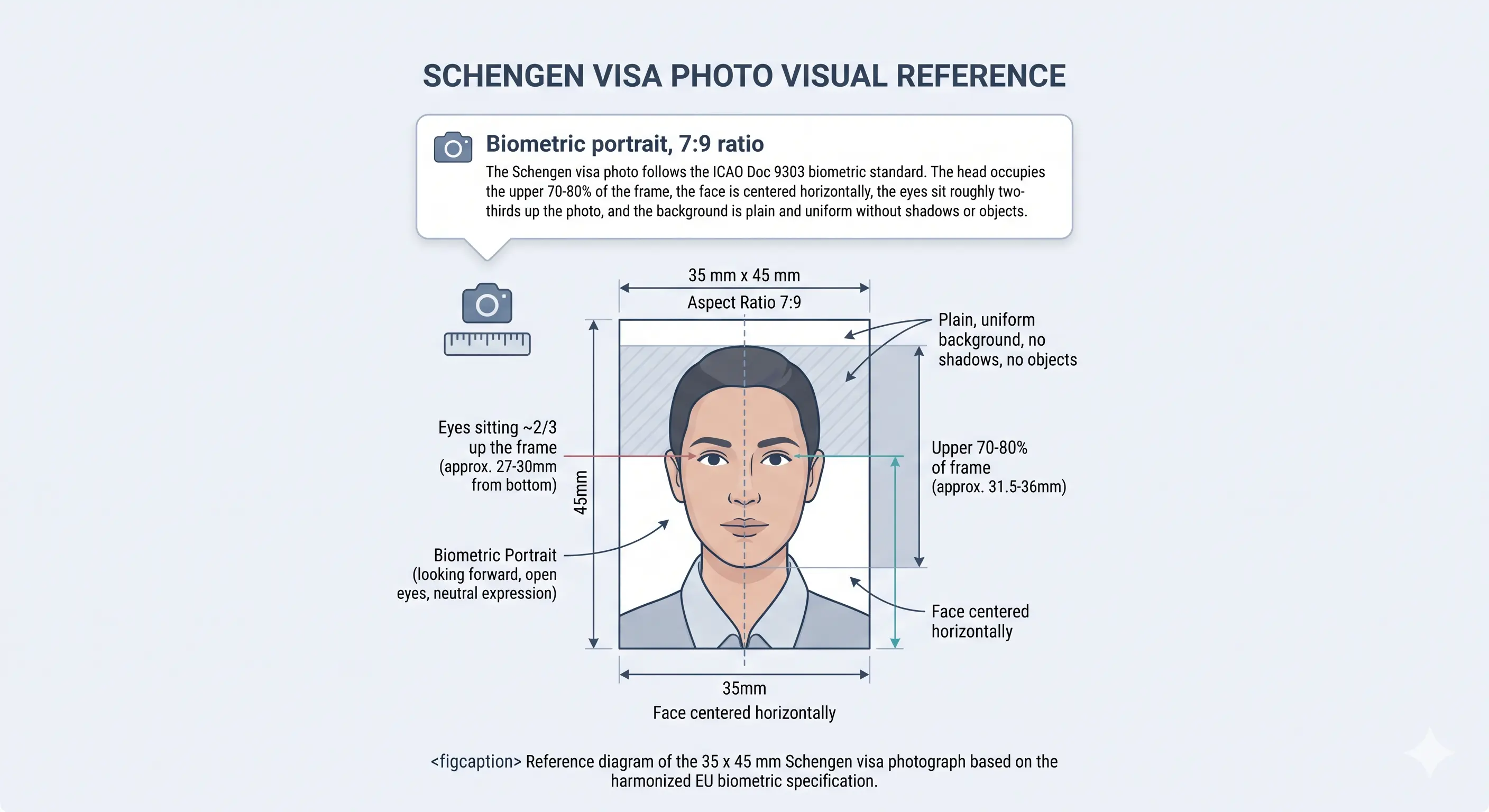
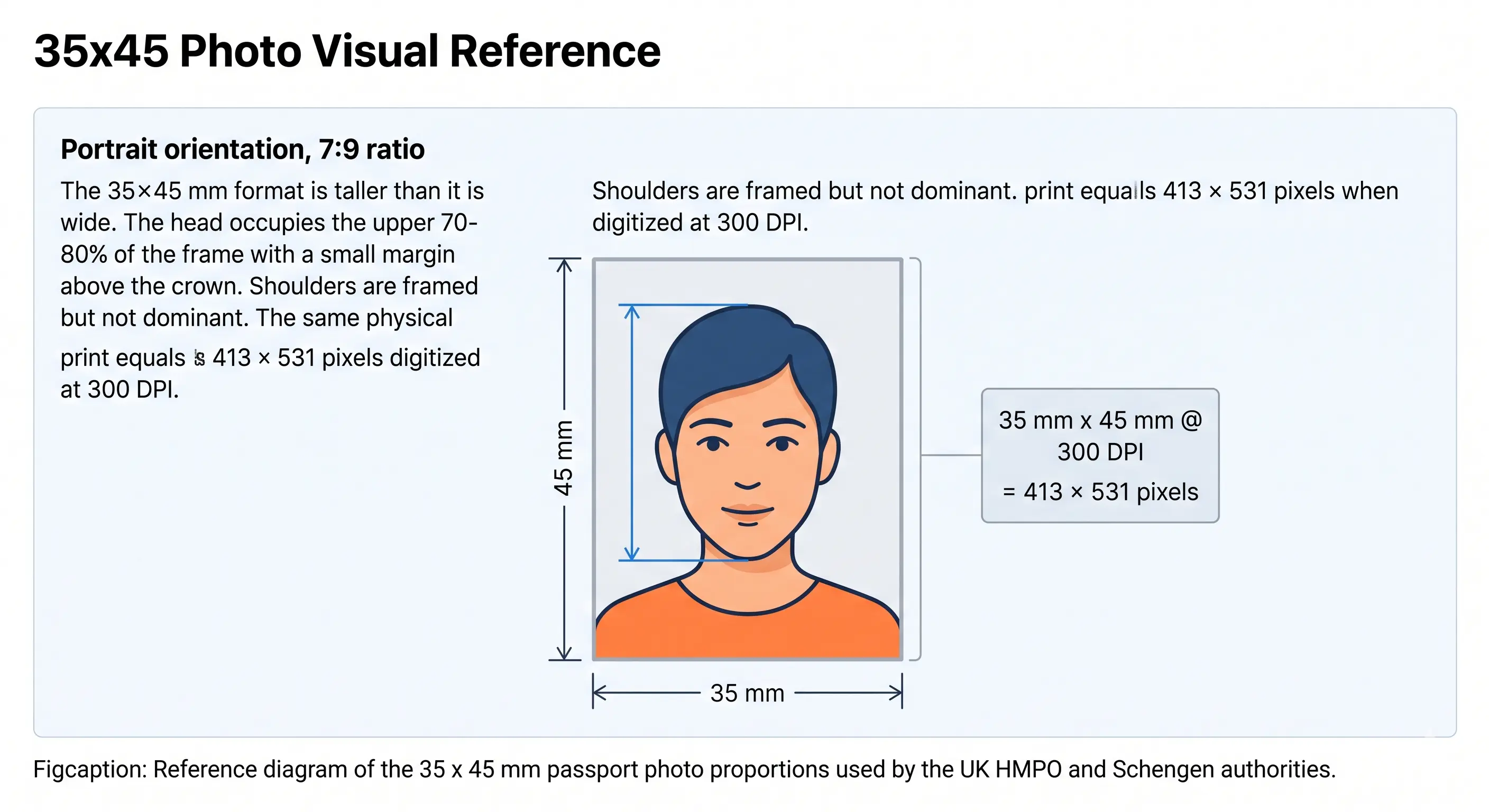
Portugal Visa Photo Requirements Table
Every row below must pass for the photograph to be accepted. Each rule links to the detailed standard in the passport photo rules library.
| Specification | Requirement |
|---|---|
| Photo size | 35 mm (width) × 45 mm (height) — see 35x45 photo size |
| Digital equivalent | 413 × 531 pixels at 300 DPI — see passport photo size in pixels |
| Aspect ratio | 7 : 9 portrait — see the crop guide |
| Background | Plain, uniform light colour. Light grey is safest for Schengen; white is accepted — see background colour rules |
| Head size | 32–36 mm chin to crown, roughly 71–80% of frame height — see head size rules |
| Face coverage | 71–80% of the vertical frame — see face size requirements |
| Eye position | Eyes 30–36 mm from the bottom edge, open and facing the lens — see eyes requirements |
| Lighting | Even and diffuse, no shadow on the face or the wall — see shadow rules |
| Hair | Must not cover the eyes or obscure the outline of the face — see hair rules |
| Ears | Not mandatory for Schengen photos, but the face outline must be clear — see ears visibility |
| Resolution | Minimum 300 DPI — see resolution rules |
| File format | JPEG or PNG for digital upload; photo-quality paper for print |
| Colour | Full colour, natural skin tones, sRGB. No filters, beautification or retouching |
| Glasses | Not recommended. If worn, no glare, no tinted lenses, frames must not obscure the eyes — see glasses rules |
| Head coverings | Not permitted except for religious reasons, with the full face visible — see head covering rules |
| Expression | Neutral, mouth completely closed, eyes open and looking at the camera — see smile rules |
| Clothing | Everyday clothing. Avoid uniforms and light tops that blend into the background — see dress code rules |
| Photo age | Taken within the last 6 months and reflecting your current appearance |
| Printed copies | Two identical prints for in-person submission |
| Visa type variance | None. Identical for tourist, business, D7 and D8 — see why |
Need the file now? Open the Passport Photo Maker and export a 35 × 45 mm photo plus a print sheet.
35 x 45 mm in Pixels, Centimetres and Inches
Portuguese consulates publish the requirement in millimetres, while upload portals validate in pixels. Both describe the same photograph.
For every country's conversion see passport size photo dimensions, or browse the visa photo requirements by country hub.
Does the Visa Type Change the Photo?
Whether you apply for a short-stay Schengen visa (Type C) for tourism or business, or a long-stay national visa (Type D) such as the D7 passive income visa or the D8 digital nomad visa, the photo requirements are identical. Portugal does not vary photo dimensions, head size or background by visa category. All routes require the standard 35 × 45 mm biometric photograph.
This matters practically: if you are preparing a family D7 application you can shoot every applicant in one session using the same setup, and the prints are interchangeable across forms. What does change between categories is the supporting paperwork, not the photograph.
Background Colour: Light Grey or White
Schengen guidance calls for a plain, uniform light background, and light grey is the safest choice because it gives clear separation from both dark and light hair. Plain white is accepted, but it is less forgiving: any unevenness in the wall or a shadow behind the head becomes obvious against pure white.
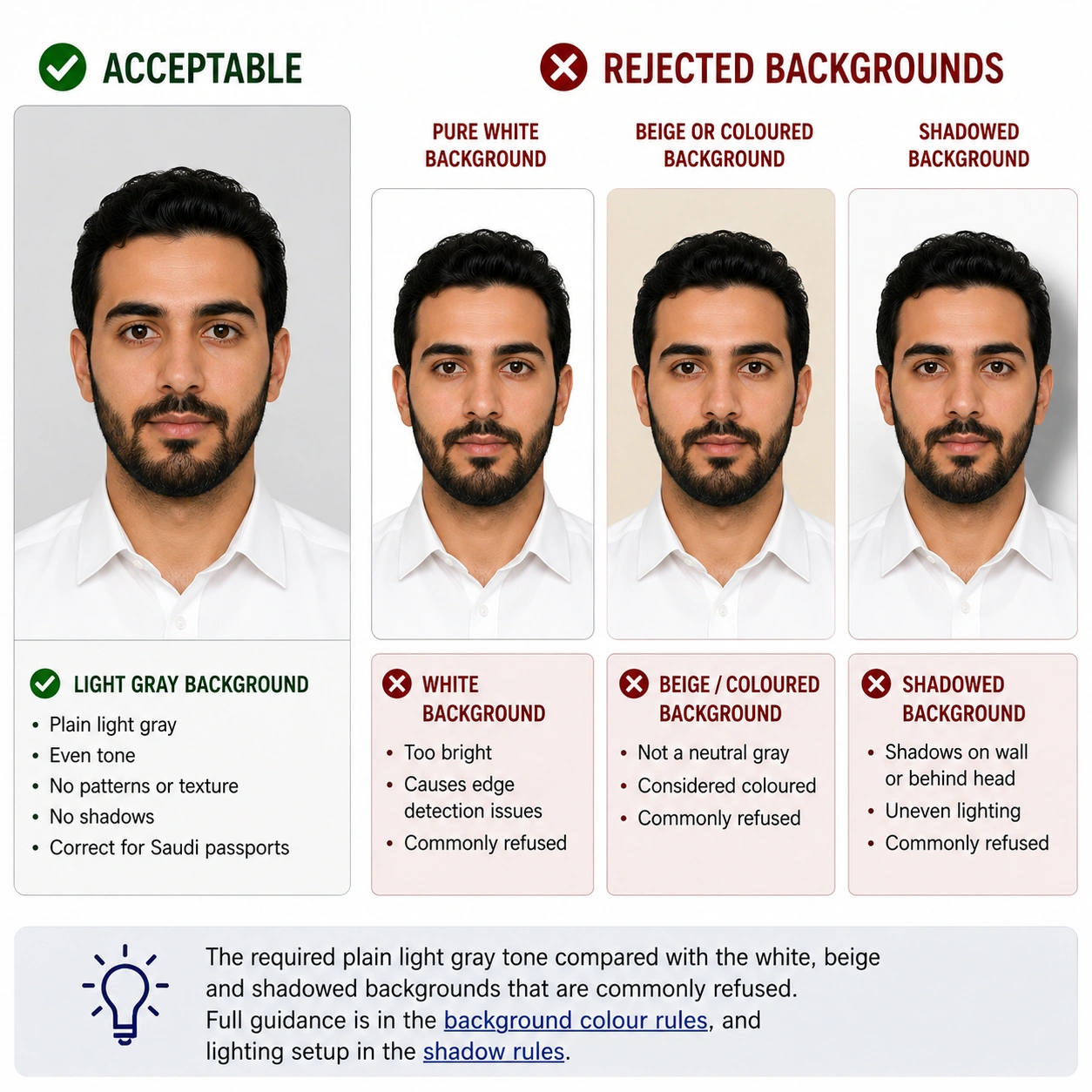
Shadow on the background is one of the most frequent counter rejections. Stand at least half a metre clear of the wall and light your face from the front — the lighting requirements and shadow rules pages cover the setup.
In-Person Submission Rules (VFS Global)
Most foreign nationals apply for a Portuguese visa through an outsourced partner such as VFS Global. When submitting a physical application packet:
- Bring two identical printed photographs.
- Print on high-quality photographic paper with accurate colour. Standard printer paper is rejected immediately.
- One photograph is normally lightly glued to the designated box on the Schengen or National Visa application form. Do not staple it — staples leave marks across the face that break biometric readability.
- The print must be undamaged: no creases, stains, fingerprints or bent corners.
- Cut exactly on the printed border. An oversized or undersized trim is treated as the wrong dimensions.
Digital Upload Rules
Some Portuguese visa categories and pre-clearance steps let you upload documents through an online portal. When submitting digitally:
- Keep the exact 35 × 45 mm proportion — a 7:9 ratio, which is 413 × 531 pixels at 300 DPI.
- Supply a JPEG or PNG in full colour with an sRGB profile.
- Do not upload a photograph of a printed photograph. A scan that shows the paper edge or the surface behind it is refused; generate a native digital file instead.
- File size ceilings differ between portals. Use the limit displayed by the form you are completing rather than a figure from a guide.
Printing Your Portugal Visa Photos
Because two prints are required, printing is part of the specification rather than an afterthought. A 35 × 45 mm photo tiles cleanly onto standard photo paper.
| Print resolution | 300 DPI minimum — export at 413 × 531 pixels or larger |
|---|---|
| Paper | Glossy or matte photo paper, 200–250 gsm. Plain paper is refused |
| Copies per 4 × 6 inch sheet | Six 35 × 45 mm photos with cutting margins |
| Cutting | Guillotine trimmer or sharp scissors, exactly on the border. Do not cut inside the printed edge |
| Colour management | sRGB. Turn off printer auto-enhance and colour correction |
| Handling | Let ink dry fully. Do not staple, fold or glue the photo face |
Printer settings and trimming technique are covered in the print at home guide, and multi-copy sheet layout in the print sheet guide.
Biometric Data and the Visa Information System
Portugal participates in the Schengen Visa Information System (VIS). Regardless of the photographs you supply, you will still attend an appointment at a consulate or visa centre to give fingerprints and have a live digital image captured. Your submitted 35 × 45 mm prints are used for the physical application dossier and the printed visa sticker, not as the biometric enrolment itself. That is why the prints must be clean and unmarked even though a live capture also takes place.
Portugal Visa Photos for Children and Infants
The same 35 × 45 mm size, light background and 32–36 mm head height apply to minors, including infants added to a family D7 application. There is no reduced format for children. The difficulty is meeting an adult framing standard with a subject who cannot sit still, so these are the points that most often cause a child photo to be refused.
Same size, same framing
35 × 45 mm frame with a 32–36 mm chin-to-crown head height. No age exemption applies to dimensions.
Child alone in the frame
No supporting hands, arms, car seat, toy or dummy may be visible, and no other person may appear. Support the child from behind a plain light sheet.
Eyes open and forward
Both eyes should be open and looking towards the camera wherever achievable. See the eyes requirements.
No shadow behind the head
Lay the child on a plain light sheet in soft indirect daylight and shoot from directly above. Side lighting creates the background shadow that fails the check.
Shoot wide, crop down
Cropping tightly in-camera on a small face leaves too few pixels once the 7:9 frame is applied. Start wide and let the tool crop.
Keep it recent
The 6-month rule matters more for children because appearance changes quickly. A photo that no longer resembles the child is refused even inside the window.
Step-by-step technique for infants and toddlers is in the baby passport photo at home guide.
Common Rejection Reasons
Visa rejections and re-submissions are expensive. Officers at visa centres frequently turn applicants away at the counter for the following photo errors. The cross-country breakdown is in passport photo rejection reasons.
- Incorrect head size: the face fills less than 71% or more than 80% of the frame — see head size rules.
- Eye line off: correct head height but eyes sitting outside the 30–36 mm band from the bottom edge.
- Shadows: flash shadow behind the head, or uneven shadow across one side of the face.
- Background not plain: a textured wall, gradient, dark tone or busy scene instead of uniform light grey or white.
- Staple marks: the photo was stapled to the form instead of lightly glued.
- Glasses glare: even a small reflection on the lens invalidates the photo.
- Smile or open mouth: a neutral expression with closed lips is required.
- Filters or retouching: portrait blur, skin smoothing and slimming alter facial geometry and are detected.
- Printed on plain paper: refused on sight; photo-quality stock is mandatory.
- Trimmed incorrectly: cut inside the border, or trimmed to a size other than 35 × 45 mm.
Can I Take My Portugal Visa Photo at Home?
Yes, and it is entirely practical if you control four things:
- Lighting: stand facing a window in daylight. Natural front light removes the harsh artificial shadows that cause most refusals.
- Camera distance: have someone hold the phone about 1.5–2 metres (5–6 feet) away and use the rear camera. Selfies distort facial proportions and are rejected. See the camera distance rules.
- Background: stand roughly half a metre clear of a plain wall so you cast no shadow. The wall does not need to be a perfect grey — the tool replaces the background.
- Attire and settings: wear a darker, contrasting top so your shoulders do not merge into the light background, and switch off portrait mode, background blur and any beautification before you shoot.
Shot taken? Upload it to the Passport Photo Maker to apply the 35 × 45 mm crop, head-height check and background replacement.
Portugal Visa Photo vs Portugal Passport Photo
If you hold or are applying for Portuguese nationality as well, the two document photos are easy to confuse. The specification is the same; the process is not.
| Requirement | Portugal visa photo | Portugal passport photo |
|---|---|---|
| Size | 35 × 45 mm | 35 × 45 mm |
| Head height | 32 – 36 mm | 32 – 36 mm |
| Background | Plain light grey or white | Plain light grey or white |
| Who it is for | Foreign nationals applying to enter or reside in Portugal | Portuguese citizens renewing or applying for a passport |
| Who screens it | VFS Global or consulate staff, against a fixed checklist | IRN civil registry, frequently captured live on site |
| Submission | Two prints with the dossier, plus any portal upload | Usually captured at the registry office |
The full citizen-side specification is in the Portugal passport photo guide.
How to Create Your Portugal Visa Photo
- Take the photo — plain wall, daylight from the front, rear camera at 1.5–2 m, neutral expression, no filters.
- Upload it — drop the file into the widget on this page, or open the Passport Photo Maker directly.
- Set the 35 × 45 mm format — select the European 35 × 45 mm option so the tool locks the 7:9 crop and the 32–36 mm head band.
- Check the crop — confirm the head sits inside the band, both eyes are open and level, and no shadow falls on the wall. The crop guide explains how ratio and head height are applied together.
- Export both files — a 413 × 531 pixel digital file for any portal upload, and the 4 × 6 inch print sheet with six copies for your appointment.
Frequently Asked Questions
Size and specification
What size is a Portugal visa photo?
A Portugal visa photo is 35 mm wide by 45 mm high, equal to 3.5 × 4.5 cm or 1.38 × 1.77 inches. At 300 DPI that is 413 × 531 pixels, a 7:9 portrait ratio. Portugal applies the standard Schengen and European format, so the same size covers tourist, business, D7 and D8 applications.
Do Portugal D7 and Schengen tourist visas require different photo sizes?
No. Both the short-stay Schengen tourist visa (Type C) and the long-stay national visas (Type D, including the D7 and D8) use the exact same 35x45 mm European standard photograph. Portugal does not vary photo dimensions or specifications by visa category.
What head size does a Portugal visa photo need?
The head must measure 32 to 36 mm from the bottom of the chin to the crown, which fills roughly 71 to 80 percent of the 45 mm frame height. The eye line should sit between 30 and 36 mm up from the bottom edge. A photo with a correct head height but a low eye line is still refused.
What background colour is required for a Portugal visa photo?
A plain, uniform light background. Light grey is the safest choice for Schengen submissions, and plain white is also accepted. Patterned, textured, gradient, dark or coloured backgrounds are refused, as is any shadow falling on the wall behind the head.
Submitting your photos
How many photos do I need for a Portugal visa application?
Two identical printed photographs are generally required for an in-person submission at VFS Global or a Portuguese consulate. One is affixed to the designated box on the application form and the second is retained with the dossier. Confirm the exact count with the centre handling your appointment, as practice varies by country.
Should I staple or glue my photo to the Portugal visa application form?
When submitting physical documents to VFS Global or a Portuguese consulate, you should lightly glue one photo to the designated box on the application form. Do not staple it, as staples leave marks on the face that invalidate biometric scanning.
What are the digital upload requirements for a Portugal visa photo?
Where a portal accepts a digital photo, it should keep the 35x45 mm proportion at a minimum of 300 DPI, which is 413 × 531 pixels, and be supplied as a JPEG or PNG. File size ceilings differ between portals and are commonly in the low megabytes, with some pre-clearance systems capping far lower. Always use the limit displayed by the form you are completing rather than a generic figure.
How do I print a 35x45 mm Portugal visa photo at home?
Print at 300 DPI on photo-quality paper. A standard 4 × 6 inch sheet holds six 35 × 45 mm photos with cutting margins. Cut cleanly on the printed borders with a guillotine trimmer, and do not write on the front. Plain printer paper is refused at the counter.
Appearance and compliance
Are glasses allowed in a Portugal visa photo?
While technically permitted if the frames are thin and there is zero glare, Portuguese consulates heavily prefer applicants to remove their glasses. Leaving them on is one of the most common reasons for VFS Global rejections. Tinted lenses and sunglasses are never accepted.
Can I smile in my Portugal visa photo?
No. A neutral expression is strictly required. Your mouth must be closed and you must look directly into the camera lens. Smiling distorts the facial geometry that automated biometric checks measure.
Can I wear a hat or head covering in a Portugal visa photo?
Hats and decorative headwear are not permitted. A head covering worn for religious reasons may be accepted provided the full face stays visible from the bottom of the chin to the forehead and the covering casts no shadow across the features.
Can I wear makeup in the photo?
Light, everyday makeup is allowed. Heavy contouring that alters your face shape or conceals identifying features such as moles or scars will result in rejection. See the makeup rules.
Is there a dress code for the visa photo?
There is no formal dress code, but avoid uniforms and camouflage. Wear a darker or contrasting top so you stand out against the required light background.
Children and related documents
What are the Portugal visa photo rules for a baby or child?
The same 35 × 45 mm size, light background and 32 to 36 mm head height apply to minors, including infants added to a D7 family application. There is no reduced format for children. The child must be alone in the frame with no supporting hands, car seat, toy or dummy visible, and no other person may appear. Eyes should be open and facing the camera wherever that can be achieved. See the children and infants section.
Is a Portugal visa photo the same as a Portugal passport photo?
The technical specification is identical: 35 × 45 mm, a 32 to 36 mm head height and a plain light background. What differs is the process. Visa photos from foreign nationals are checked by third-party handlers such as VFS Global against a rigid checklist before reaching the consulate, whereas passport photos for Portuguese citizens are usually captured live at an IRN civil registry office. See the Portugal passport photo guide.
Sources and compliance basis
The specification on this page reflects the Schengen photograph standard that Portugal applies to both short-stay and national visas, and the international biometric travel document standard it derives from.
- European Commission — Schengen borders and visa policy: home-affairs.ec.europa.eu
- ICAO Doc 9303 — Machine Readable Travel Documents, biometric photograph standard: icao.int
- Ministério dos Negócios Estrangeiros — Portuguese visa information portal (consult the official portal for your country of residence)
- AIMA — Agência para a Integração, Migrações e Asilo, for residency routes including the D7 and D8
- Instituto dos Registos e do Notariado (IRN) — civil registry, for Portuguese citizen documents
- VFS Global — outsourced application centre checklists for the country you apply from