
Passport Photo Face Size Requirements: Chin, Crown & Proportion Rules
Face size is measured from the bottom of the chin to the top of the head and must fall inside a narrow millimetre range set by your issuing authority — 25–35 mm in the US, 29–34 mm in the UK, 31–36 mm in Canada. A photo 2 mm outside that range is rejected.
It is one of the most rejected passport photo criteria because it is measured, not judged. Every range on this page derives from the same biometric baseline in ICAO Doc 9303, then gets expressed against each country's own photo dimensions — which is why the numbers differ even though the underlying proportion does not. Below: the published figures by authority, how reviewers actually take the measurement, where guidance is genuinely ambiguous, and how to check your own photo before you submit.
Passport Photo Face Size (Quick Answer)
Measure from the bottom of the chin to the top of the head, including hair volume. The result must sit inside your authority's published range, and the face must fill roughly 70–80% of the photo's height with the eye line in the upper half of the frame.
| Authority | Photo size | Face height (chin to crown) |
|---|---|---|
| United States | 51 × 51 mm (2 × 2 in) | 25–35 mm (1 to 1 3/8 in) |
| United Kingdom | 35 × 45 mm | 29–34 mm |
| Canada | 50 × 70 mm | 31–36 mm |
| Australia | 35 × 45 mm | 32–36 mm |
| Schengen / EU (typical) | 35 × 45 mm | 32–36 mm |
| India (Passport Seva online) | 35 × 45 mm | Face fills 70–80% of frame height |
Who Enforces Face Size Rules?
Face size is a universally applied rule with country-specific numbers. Every ICAO-member country enforces some version of "the face must fill roughly 70–80% of the vertical frame," but the exact millimetre thresholds vary because the underlying photo size varies. A 35 × 45 mm UK photo cannot use the same face height as a 51 × 51 mm US photo. That is why "my face was fine for my US passport, why is my UK visa photo rejected?" is one of the most common complaints applicants file.
Common edge cases handled below: my hair adds height to my head, I have a shaved head so where is the crown, my child won't hold still for a measurement, and the online portal accepted it but the passport office rejected it. Where guidance between authorities is genuinely ambiguous — hair volume in particular — we say so instead of guessing.
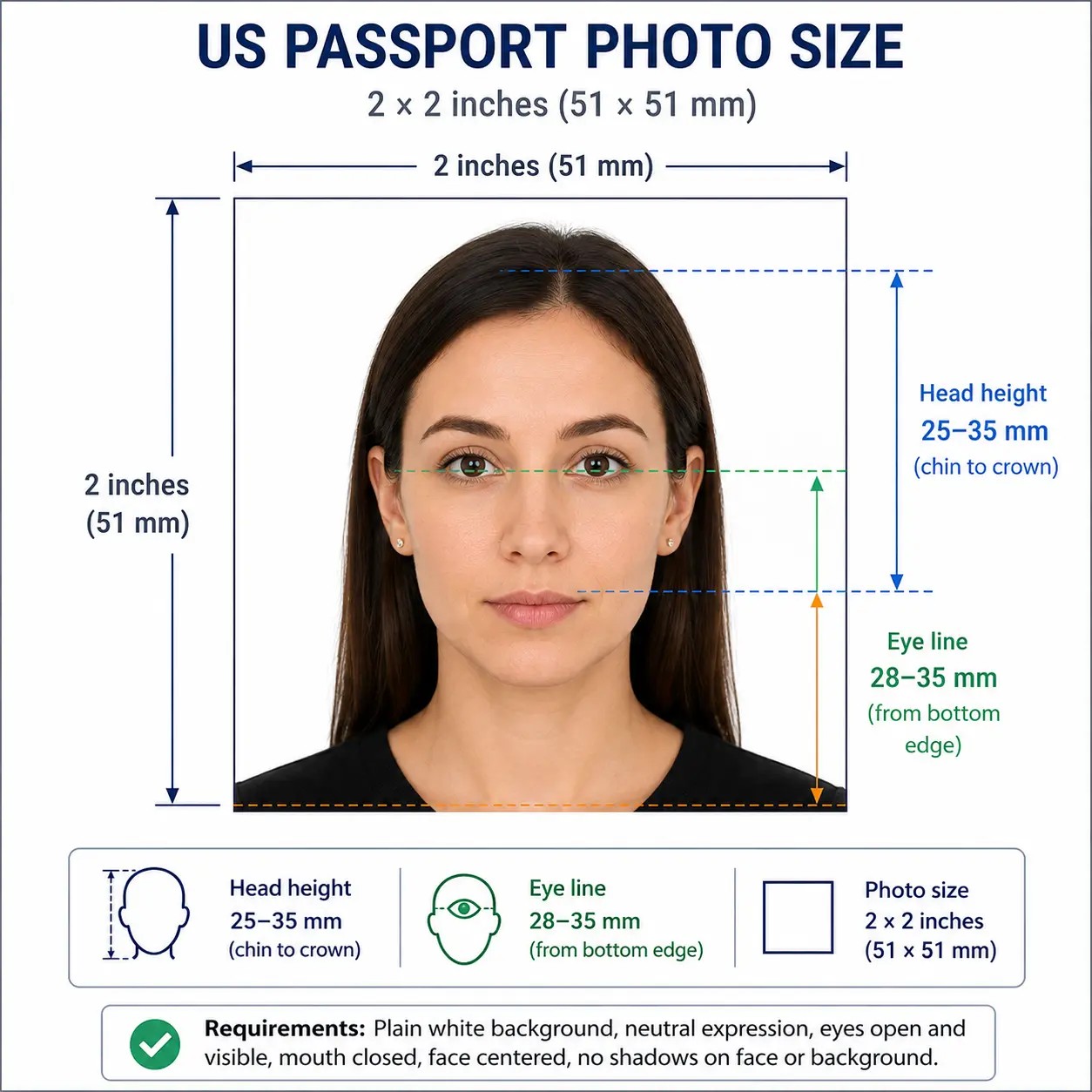
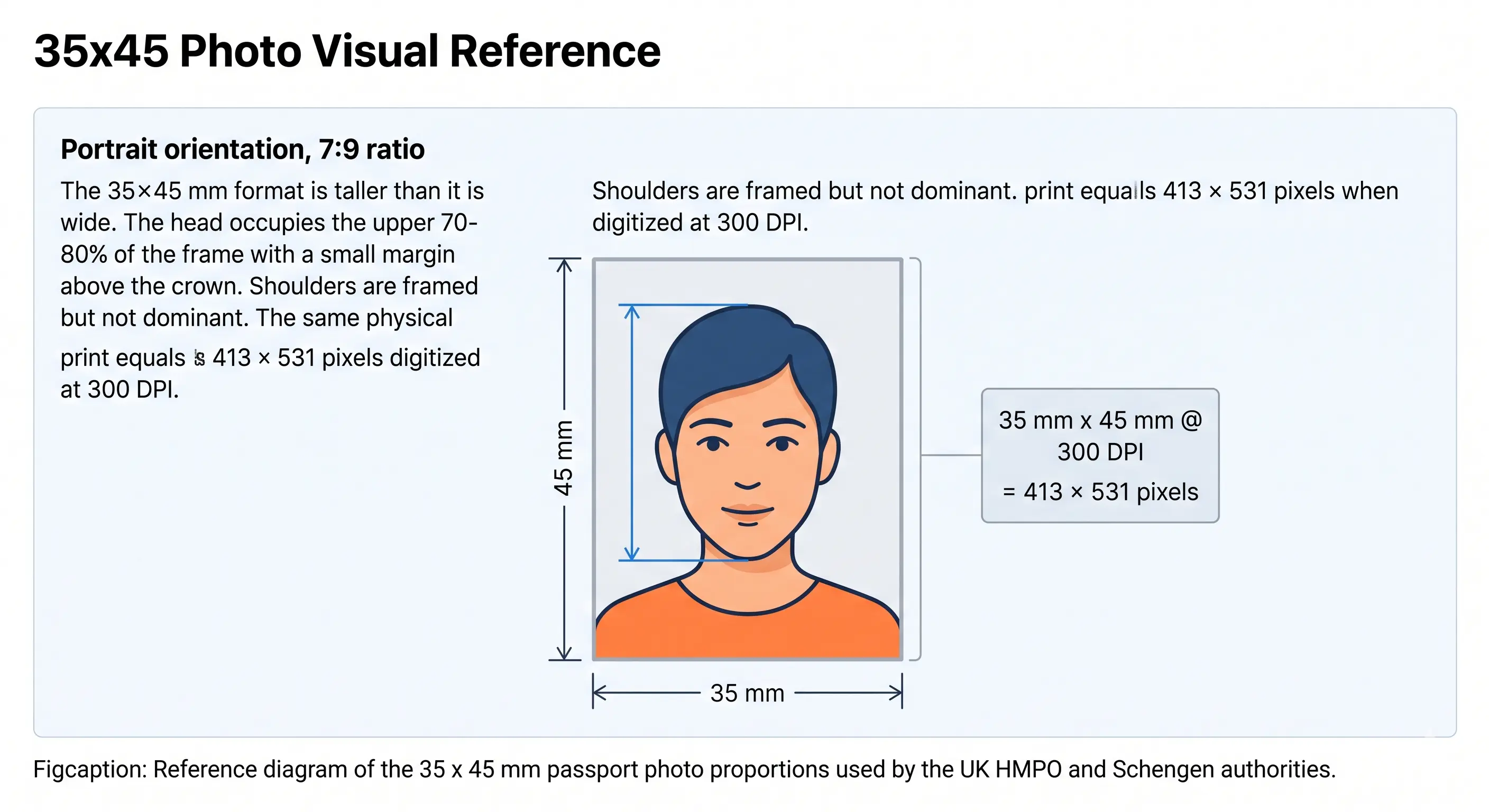
How Face Height Sits on the Two Common Canvases
Face size only makes sense in relation to the photo it is measured on. The two diagrams below show the same proportion rule expressed on the two canvases that cover most of the world's passport applications: the square 51 × 51 mm US format and the portrait 35 × 45 mm format used across the UK, Schengen area and Australia.
What Passport Photo Maker Checks for Face Size
- Chin-to-crown pixel measurement — the tool locates the bottom of the chin and the top of the head (including hair), converts to millimetres against the country's target print size, and flags anything outside the accepted range.
- Face-to-photo vertical ratio — a secondary check that catches photos where the face is technically in range but the overall framing is off (too much sky above, shoulders cropped tight).
- Eye-line position — many authorities specify not just face height but where the eyes must sit in the frame; the checker validates both together, since fixing one can break the other. See eyes requirements.
- Print sheet plus digital JPEG output — the same measured photo exports as a 4x6 print sheet for physical submission and as a resized JPEG for online applications, with no re-cropping needed in between. See the print at home guide.
What Are the Passport Photo Face Size Requirements?
In plain English: the distance from the bottom of your chin to the top of your head must fall within a narrow millimetre range on the printed photo, and your face must fill a defined proportion of the frame. Two measurements, both enforced together.
The rule traces back to ICAO Doc 9303 (Machine Readable Travel Documents), which specifies that the face image should occupy approximately 70 to 80 percent of the photo's vertical height, with the eye line in the upper half of the frame. Every ICAO-signatory country implements that baseline, but each expresses it in absolute millimetres tied to its own photo size.
Where the rule gets tricky is the definition of top of head. Some authorities (the US, most Schengen countries) explicitly include hair in the measurement — the crown is the highest visible point. Others, notably UK HMPO in its written guidance, say "top of the head, not including hair" but in practice measure to the top of the hair when reviewing digital submissions. If your hairstyle adds noticeable height, treat the top of the hair as the crown point; that is the stricter and therefore safer interpretation across authorities. Related: hair rules covers styling that obscures the face outline, which is checked separately.
How Face Size Rules Differ by Country
Face size is measured against the country's official photo dimensions, so the numbers only make sense in that context. Here are the current published ranges for the highest-volume issuing authorities, each linked to its source:
| Country | Photo Size | Face Height (chin to crown) | Key Restriction | Source / Authority |
|---|---|---|---|---|
| United States | 51 × 51 mm (2 × 2 in) | 25–35 mm (1 to 1 3/8 in) | Eyes 28–35 mm from bottom edge; head centred and squared to camera | US Department of State |
| United Kingdom | 35 × 45 mm | 29–34 mm | Written guidance says "not including hair" but the digital checker measures to the top of the visible head | HM Passport Office |
| Canada | 50 × 70 mm | 31–36 mm | Measured from chin to natural top of head; face must be centred | IRCC |
| Australia | 35 × 45 mm | 32–36 mm | Face must occupy roughly 70–80% of photo height | Australian Passport Office |
| Schengen / EU (typical) | 35 × 45 mm | 32–36 mm | Face must fill 70–80% of the frame; national portals may differ slightly | European Commission / ICAO Doc 9303 |
| India | 35 × 45 mm (Passport Seva online); 51 × 51 mm in person | Face fills approximately 70–80% of frame height | Strict automated enforcement on Passport Seva portal uploads; confirm which format your appointment type requires | Passport Seva, Ministry of External Affairs |
| China | 33 × 48 mm | 28–33 mm | Head width 15–22 mm is checked as a separate parameter alongside height | National Immigration Administration |
Rows are omitted where we could not verify a current published figure. Always verify against the official portal for your country before submitting — face size specs are among the specs that get updated most quietly. Every national standard we cover is indexed in the passport photo requirements by country hub.
Why Face Size Is Enforced So Precisely
Face size is not an aesthetic rule. It exists because modern passports are read by machines before they are read by humans, and those machines expect a face at a predictable scale.
- Biometric enrolment. When a passport is issued, the photo is used to generate a facial template stored on the chip. Template quality depends on the face occupying a known proportion of the source image — too small, and there are not enough pixels of the face to produce a reliable template. This is also why resolution rules are enforced alongside face size.
- Automated border gates (eGates). Border facial recognition compares a live camera capture with the chip photo. Consistent face-to-frame ratios make that match faster and more accurate.
- Manual reviewer efficiency. Passport reviewers process thousands of photos daily. A fixed template lets them scan for compliance quickly rather than assess each image individually.
In practice, this means face size sits alongside head size and positioning as the most mechanically enforced spec in passport photography. It also explains why the tolerance is only a few millimetres — beyond that, biometric matching degrades measurably.
The ICAO Standard for Face Size
ICAO Doc 9303 does not publish millimetre values directly. Instead it specifies proportions: the face should occupy roughly 70 to 80 percent of the photo's vertical height, and the eye line should sit in the upper half of the frame. Countries then multiply those proportions by their own photo dimensions to derive absolute measurements.
This is why a 35 × 45 mm photo lands on a 29–36 mm face height range (depending on country) while a 51 × 51 mm US photo lands on 25–35 mm. Both are the same underlying ICAO proportion expressed against different canvases. Understanding this makes it much easier to reason about which face size you actually need for a specific application — start from the photo size, then multiply. If you need the underlying dimensions for any format, the passport photo dimensions reference lists them side by side, and passport photo size in pixels gives the digital equivalents.
What Counts as a Face Size Violation
A face size violation is any of the following, measured on the submitted photo:
- Chin-to-crown height falls below the country's minimum (face too small — the most common rejection).
- Chin-to-crown height exceeds the country's maximum (face too large, often because the applicant cropped in tightly to make sure their face was "clearly visible").
- Face-to-photo ratio falls outside the 70–80% band, even if chin-to-crown is technically in range (this happens when the photo has too much or too little space around the head).
- Top of head is cut off, making measurement impossible — treated as a hard rejection regardless of face size.
- Chin obscured by a clothing collar or scarf so the measurement start point cannot be located.
Reviewers do not typically ask for clarification. If measurement is uncertain, the default response is rejection with a request to resubmit. The full catalogue of failure modes across all criteria is in passport photo rejection reasons.
How Photo Reviewers Actually Check Face Size
Modern passport applications almost always run through an automated pre-check before a human sees them. That pre-check uses facial landmark detection — the algorithm locates the chin and the top of the head, calculates the pixel distance, and converts to millimetres based on the declared print size. Photos flagged by the automated pass go into a manual review queue.
Manual reviewers use one of two methods: a physical millimetre gauge overlaid on the printed photo, or a digital ruler tool in the review software. Either way, the measurement is deterministic — there is no "close enough" allowance. A photo measured at 28 mm on a UK application (minimum 29 mm) gets rejected even though the applicant might argue the difference is invisible to the eye.
Face Size Rules for Child Passport Photos
The millimetre ranges published for adults apply to children in most countries. What changes is enforcement flexibility:
- UK HMPO allows children under one to appear with eyes closed or with a slightly relaxed face size range, acknowledging that infants cannot be positioned precisely.
- US State Department requires the same face size range for infants but explicitly permits the child to be photographed lying on a plain white sheet, provided no other person's hands are visible.
- Canada and Australia apply the standard face size range but allow reviewers discretion for children under six months.
For toddlers and older children, the adult rules apply without relaxation. If you have a wriggling three-year-old, expect the same 31–36 mm (Canada) or 29–34 mm (UK) enforcement you would face as an adult applicant. Positioning, lighting and timing technique for infants is covered step by step in the baby passport photo at home guide, and shadow rules explains the overhead-lighting mistake that fails most cot-shot photos.
Rule Severity: Will Face Size Definitely Reject My Photo?
Yes. Face size sits in the "hard rejection" tier alongside background colour, head tilt beyond tolerance, and closed eyes. It is not discretionary. If the measured face height is outside the published range — even by 1 mm — the photo is rejected in every automated review pipeline we can verify (US, UK, Canada and Schengen online portals).
This contrasts with more discretionary rules like neutral expression (reviewers sometimes accept a very faint smile) or hair partially covering the ear (reviewers sometimes accept if both eyes are still clearly visible — see ears visibility rules). Face size gets no such leeway because it is directly measured, not visually judged.
Taking Your Passport Photo at Home: Face Size Checklist
Before you take the photo
- Measure the distance from the camera to your face — around 1.2 to 1.5 metres is usually right for a phone or webcam. Standing further shrinks the face; standing closer distorts nose and forehead proportions. See camera distance.
- Frame the shot from mid-chest up. If you can only see the top of your head and your chin with a small margin, you are cropped too tight and face size will exceed the maximum.
- Tie back or flatten hair that adds significant vertical height only if the resulting shape still looks like your everyday appearance. Do not slick down naturally full hair to hit a target — the reviewer will compare it to your ID.
- Wear a top with a visible neckline. A high collar hides the chin and can defeat automated measurement entirely. Head coverings have their own rules — see head covering rules.
- Use a plain, evenly lit wall. Shadow behind the head interferes with crown detection — see background colour rules.
After you take the photo
- Open the image and locate the chin and the crown. If either is cropped off or ambiguous, retake before you try to correct in post-processing.
- Check that the face occupies clearly more than half but less than the full vertical frame — the 70–80% band.
- Verify that both eyes sit in the upper half of the frame; if the eye line is at or below the vertical centre, the face is too small.
Common home-photo mistakes
- Selfie-style photos taken at arm's length — this consistently distorts face proportions and often exceeds face size maximums.
- Photos taken with a wide-angle phone lens close to the face, which makes the face appear correctly sized but geometrically distorted (rejected under a different rule but often flagged together with face size).
- Cropping the top of the head to fix a "face too small" issue — this trades one rejection reason for another (head not fully visible). The crop guide explains how ratio and head height are applied together.
Passport Photo Maker catches these automatically. When the checker flags face size, it also shows you which direction to adjust — closer to the camera, further from the camera, or reframe — rather than a generic rejection message.
How to Make Sure Your Passport Photo Complies with Face Size Rules
-
Position yourself at the correct distance from the camera
Stand or sit 1.2 to 1.5 metres away. Too far and the face lands under the minimum; too close and you exceed the maximum or distort proportions.
-
Identify the true crown of your head
The measurement runs from the bottom of your chin to the highest point of your head, including any hair volume. That is your top-of-head reference — not your hairline.
-
Upload the photo to Passport Photo Maker
Open the tool, select your issuing country, and upload the image. The compliance checker measures chin-to-crown height and face-to-photo ratio against your country's published range.
-
Review the face size compliance flag
If face size is outside the range, the tool shows the measured value alongside the required range and points to whether you need to reframe or retake. If it is inside the range, you get a green pass on this rule.
-
Export the print sheet and digital file
Once face size is compliant, export both the print-ready 4x6 sheet for physical submission and the digital JPEG sized for online portals. Both are measured, not just cropped. Portal pixel and file-size limits are covered in the digital photo requirements guide.
Why Passport Photos Get Rejected for Face Size Violations
Face too small (under the minimum chin-to-crown)
Description: The face occupies less than roughly 70% of the vertical frame.
Why it triggers rejection: Facial landmark detection cannot generate a reliable biometric template from too few face pixels. Border eGates fail to match the chip photo against a live capture.
How to avoid: Move closer to the camera, or use a longer focal length so the face fills more of the frame without cropping the top of the head.
Face too large (over the maximum chin-to-crown)
Description: The face fills more than about 80% of the frame, often because the photo was cropped tightly to make sure the face was clearly visible.
Why it triggers rejection: There is not enough margin around the head for the algorithm to detect head contours. Manual reviewers also lose the ability to check head tilt and centring.
How to avoid: Reframe to include your shoulders and roughly 10–15 mm of space above the head in the original capture, not the crop.
Top of head cropped off
Description: The crown of the head is not visible because the photo cuts off above the hairline.
Why it triggers rejection: Chin-to-crown height cannot be measured, so the automated check fails on missing data rather than out-of-range data.
How to avoid: Always include the full head with a small margin above. Never crop tighter to force face size compliance.
Chin obscured by clothing or accessories
Description: A collar, scarf, or turtleneck covers the bottom of the chin.
Why it triggers rejection: The measurement start point cannot be located. Reviewers reject rather than guess where the chin would be.
How to avoid: Wear a top that leaves the full jaw and chin visible. Fold high collars down before shooting.
Hair edited after the fact
Description: A photo edited to add or remove hair, changing the measured crown position.
Why it triggers rejection: Automated forensic checks flag edited pixels around the head silhouette. Both the manipulation and the resulting face size mismatch are grounds for rejection.
How to avoid: Do not retouch head or hair. If your hairstyle causes issues, retake the photo with the hairstyle you want to submit.
Off-centre framing that skews the ratio
Description: The face is technically in the correct millimetre range but shifted left, right or down within the frame.
Why it triggers rejection: Face-to-photo ratio is measured against a centred face; off-centre framing changes the effective proportion and fails the secondary check.
How to avoid: Centre the face horizontally with the eye line in the upper half of the frame. See face position rules. Passport Photo Maker auto-centres on export.
Face Size Rules: Passport Photo vs. Visa Photo
For the majority of countries and visa types, face size rules are identical between the passport photo and the visa photo — both derive from the same ICAO baseline and both are sized against the same national photo dimensions. A photo that passes for a US passport almost always passes for a US visa, and vice versa.
Two honest caveats:
- Online visa portals sometimes enforce face size more strictly than physical submission. The DS-160 photo uploader and the Schengen visa online portals reject in real time based on automated measurement, whereas a printed photo submitted in person may occasionally pass a lenient reviewer with a 1 mm out-of-range face height. Do not count on this leniency — design for the online portal spec.
- Some visa types have their own photo size and therefore their own face size band. The clearest examples are the Indian OCI card and the US Green Card photo, where published guidance differs from the plain passport spec. Country-specific visa formats also diverge — the China visa photo uses 33 × 48 mm with a 28–33 mm face height and a separately checked 15–22 mm head width, and the Schengen visa photo follows the 35 × 45 mm band. If you are applying for a specific visa or residency card, check its published spec rather than reusing your passport photo.
Passport Photo Maker lets you pick the specific document type (passport, visa, OCI and so on) so the face size check runs against the right target range, not a generic one. Every visa format we cover is listed in the visa photo requirements hub, and the underlying canvas dimensions are in 2x2 photo size and 50x70 photo size.
Frequently Asked Questions
Measurement & Definitions
How is passport photo face size actually measured?
Face size is measured from the bottom of the chin to the top of the head (the crown), not from chin to hairline. Most authorities also expect the face to fill roughly 70 to 80 percent of the photo's vertical frame. The measurement is taken on the printed or digital photo, not on the person.
What is the ICAO standard for face size in a biometric passport photo?
ICAO Doc 9303 expresses face size as a proportion rather than a millimetre value: the face should occupy roughly 70 to 80 percent of the image height, with the eye line in the upper half of the frame. Each country multiplies that proportion by its own photo size to derive absolute millimetres, which is why the numbers differ between a 51 × 51 mm US photo and a 35 × 45 mm UK photo.
Does face size include hair volume or just the skull?
Guidance is not uniform, and this is a genuine ambiguity rather than a settled rule. Most European authorities measure to the natural top of the head, which for tall or thick hairstyles means the top of the hair. UK HMPO's written guidance says the measurement excludes hair, but its digital checker measures to the top of the visible head. If your hair adds noticeable height, treat the top of the hair as the crown point, because that is the stricter and therefore safer interpretation.
Where should my eyes sit in the frame?
Eye line is a second measurement checked alongside face height, and passing one does not pass the other. The US specifies 1 1/8 to 1 3/8 inches (about 28 to 35 mm) from the bottom edge of a 51 × 51 mm photo. On a 35 × 45 mm photo the eye line typically falls around 30 to 36 mm from the bottom. In every case the eyes sit in the upper half of the frame; if they land at or below the vertical centre, the face is almost certainly too small.
Is face size the same rule as head size?
They overlap and are calculated from the same landmarks, but they are checked as two things. Face size is the chin-to-crown measurement expressed in millimetres against the print size. Head size in most published guidance refers to that measurement expressed as a percentage of frame height, together with the surrounding margin. A photo can satisfy the millimetre range and still fail the proportion check if the framing leaves too much or too little space around the head. See head size rules.
Country-Specific
Does the US require a specific face size on a 2x2 inch passport photo?
Yes. The US Department of State requires the height of the head, from the bottom of the chin to the top of the head, to be between 1 inch and 1 3/8 inches (approximately 25 to 35 mm) on a 2 × 2 inch (51 × 51 mm) photo. The eyes should sit between 1 1/8 and 1 3/8 inches (roughly 28 to 35 mm) from the bottom edge. Full spec: US passport photo requirements.
What face size does the UK HMPO accept?
UK HMPO expects the face, measured from the bottom of the chin to the top of the head, to be between 29 mm and 34 mm on a standard 35 × 45 mm passport photo. The face must be centred and looking straight at the camera. Full spec: UK passport photo requirements.
Troubleshooting & Children
Why does my passport photo keep getting rejected for face size?
The most common causes are standing too far from the camera (face too small), cropping in too tightly (face too large or top of head cut off), and measuring to the hairline instead of the crown. Reviewers reject any photo that falls outside the millimetre range published by the issuing authority, even by 1 to 2 mm.
If my face is too small, can I just crop the photo to fix it?
Cropping helps only if the original photo has enough resolution and enough space around the head. If you crop too tightly you lose the required margin above the head and beside the shoulders, which is a separate rejection reason. When the face is well under the minimum, retaking the photo closer to the camera is usually faster than trying to salvage the original.
Are child passport photos held to the same face size rules?
The millimetre ranges are the same for children in most countries, but authorities acknowledge that infants and toddlers cannot always be positioned precisely. Some issuers, including the UK and Canada, publish explicit relaxations for babies under one year: the face still needs to be visible and roughly centred, but strict proportion enforcement is loosened. For toddlers and older children the adult ranges apply without relaxation. See the baby passport photo guide.
Sources & References
Face height ranges on this page are taken from the following official publications. Where a figure could not be verified against a current official source, the row is omitted rather than estimated.
- U.S. Department of State, Bureau of Consular Affairs — passport photo requirements: travel.state.gov
- HM Passport Office — photos for passports: gov.uk
- Immigration, Refugees and Citizenship Canada — passport photo specifications: canada.ca
- Australian Passport Office — photo guidelines: passports.gov.au
- European Commission — Schengen borders and visa policy: home-affairs.ec.europa.eu
- Passport Seva, Ministry of External Affairs (India): passportindia.gov.in
- ICAO Doc 9303 — Machine Readable Travel Documents, biometric photograph standard: icao.int
Measure Your Photo Against Your Country's Face Size Range
You now know the exact chin-to-crown range your issuing authority expects. Rather than eyeballing it, run the photo through a measurement pass — the tool applies the same landmark detection that automated review portals use, and it does so before you commit to a print or an online upload.
Want the full toolkit? Head to the main Passport Photo Maker for background replacement, print layout and multi-country compliance checks in one flow, or browse every step-by-step photo guide.