
Germany Passport Photo Size: 35x45mm Biometric Specs
Direct Answer: The Germany passport photo must be exactly 35 × 45 mm. The background must be uniformly light (grey preferred), and your head must occupy 71% to 80% of the photograph. You must maintain a neutral expression with both eyes open.
Source: Personalausweisportal Fotomustertafel
Last reviewed SourcesGerman Passport Photo Size (Quick Answer)
A German passport photo is 35 × 45 mm on a plain light grey background, with the face 32–36 mm from chin to crown and 16–20 mm wide, filling 70–80% of the frame. Since 1 May 2025 it must be submitted digitally — printed photos are no longer accepted.
- Size: 35 × 45 mm
- Face height: 32–36 mm (chin to crown)
- Face width: 16–20 mm (ear to ear)
- Background: Plain light grey (not white)
- Submission: Digital only since 1 May 2025
- Glasses: Not permitted (since Nov 2020)
- Expression: Neutral, mouth closed
- Resolution: 600 DPI recommended
- Pixels @ 300 DPI: 413 × 531 px
- Photo age: Within 6 months
Printed photos are no longer accepted (since 1 May 2025)
This is the single biggest change to German passport photos in decades, and most photo guides have not caught up. Under the Gesetz zur Stärkung der Sicherheit im Pass-, Ausweis- und ausländerrechtlichen Dokumentenwesen of 3 December 2020, from 1 May 2025 every application for a Reisepass or Personalausweis must use a digitally transmitted photo. Paper photos handed over at the counter are refused.
There are exactly two compliant routes:
- On-site capture. Use the self-service photo terminal (Selbstbedienungsterminal) at your Bürgeramt or registration office. The image goes straight into the application system.
- Certified photo studio. A registered photographer takes the photo, transmits it electronically through a secure cloud channel, and gives you a QR code. You bring that code to your appointment instead of a photograph.
The measured specification below has not changed — 35 × 45 mm, light grey, 32–36 mm face height. What changed is how the image reaches the authority. A self-made photo, however perfectly cropped, cannot be submitted for a German passport.
If you are applying for a new Reisepass, renewing an expired one, or applying for a child's travel document, the same biometric photo rules apply nationwide. The German standard is tighter than most — particularly the 32–36 mm face-height range, the additional 16–20 mm face-width rule, the prohibition on glasses, and the light grey background rather than white.
Bürgeramt staff and the terminal software in Berlin, Munich, Hamburg and Frankfurt both check compliance automatically, so a small error — a smile, a slightly tilted head, a shadow on the wall — means retaking the photo. Knowing the exact specification before you sit down at the terminal or the studio saves a wasted appointment.
Biometric Standard (Important)
Germany requires the photo to be biometric-grade: head perfectly straight, face centred, eyes on a horizontal line, chin-to-crown distance between 32 and 36 millimetres, and face width between 16 and 20 millimetres ear to ear. Standard passport photos cropped from older templates often fail the face-height rule.
Both measurements are checked. A photo with a correct 34 mm head height but a face cropped too narrow still fails. See the head size rules and face size requirements.
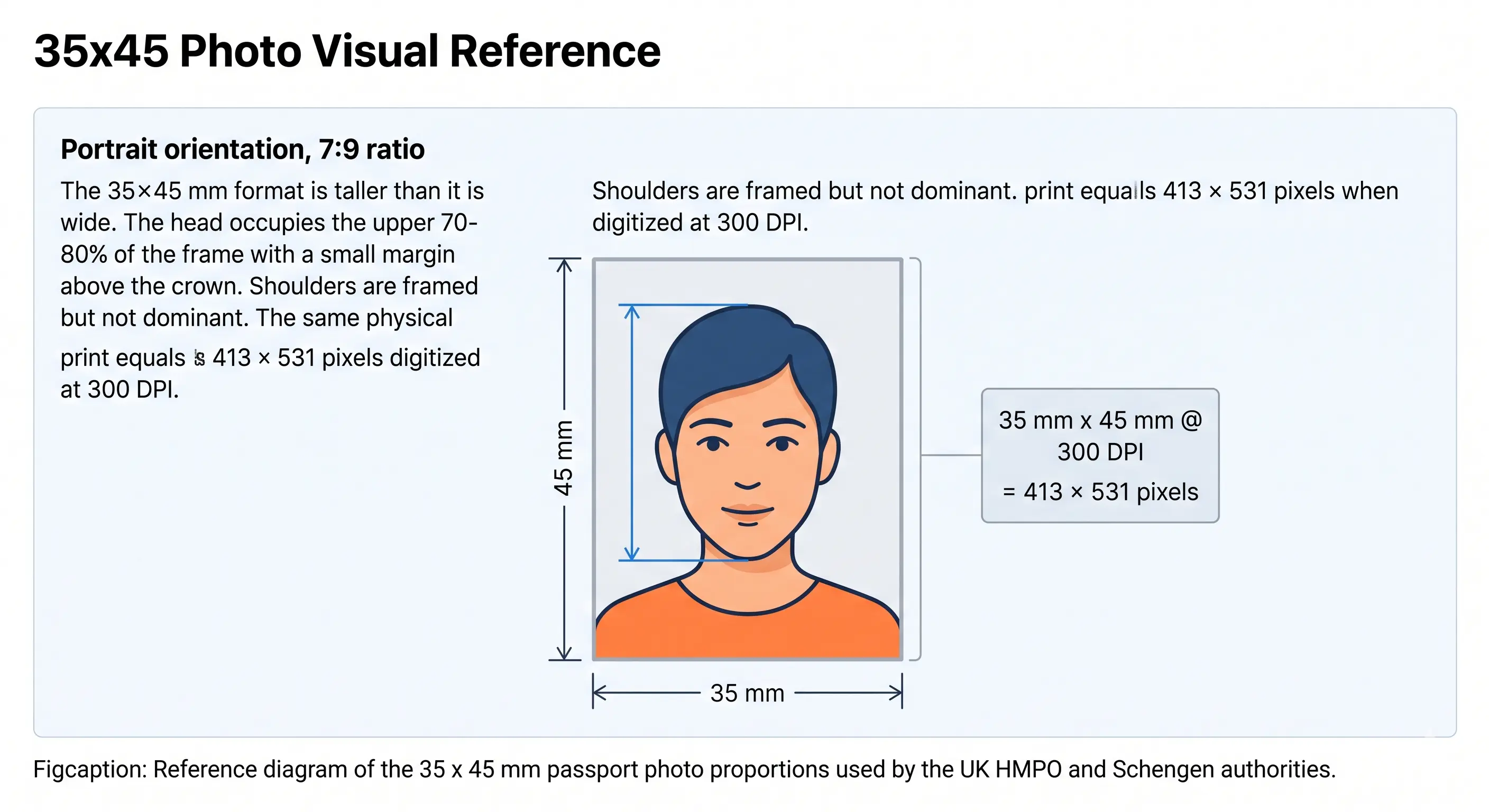
German Passport Photo Visual Reference
The diagram below shows the 35 × 45 mm frame with the biometric face zone marked. Germany shares this format with the rest of the EU, Schengen area and Australia, so the geometry is identical — the background shade and face-height band are what make the German version distinct.
Check Your German Passport Photo Framing Online
Because Germany now requires digital transmission, our tool cannot produce a file you submit directly for a Reisepass. What it does do is let you verify your framing against the German specification before you pay for a studio session or step up to a terminal — the 35 × 45 mm crop, the 32–36 mm face height, the centring and the background. If the framing fails here, it will fail there.
It also produces genuinely submittable 35 × 45 mm files for the many uses where a printed photo is still accepted: Schengen visa applications, a German visa application filed from abroad, non-German passports that use the same format, and company, student or club ID cards.
Upload your photo and our Passport Photo Maker automatically:
- Crops to the 35 × 45 mm frame at a 7:9 ratio
- Centres your face and checks the eye line
- Applies the 32–36 mm face-height band
- Sets a plain light background
- Exports 413 × 531 px or 827 × 1063 px
- Generates a print sheet where printing is still allowed
German Passport Photo Specifications (Full List)
These specifications follow the Bundesdruckerei "Foto-Mustertafel" (photo template) used at every Bürgeramt and Passamt in Germany. They apply to the Reisepass and the Personalausweis equally. Each rule links to the detailed standard in our passport photo rules library.
| Requirement | Specification |
|---|---|
| Submission method | Digital only since 1 May 2025 — on-site terminal or certified studio QR code. Printed photos refused |
| Photo size | 35 × 45 mm (3.5 cm × 4.5 cm) |
| Width | 35 mm (approx. 413 px at 300 DPI) |
| Height | 45 mm (approx. 531 px at 300 DPI) |
| Aspect ratio | 7 : 9 portrait |
| Background | Plain single-colour light grey — not white. Match the shade to hair colour for contrast. See background colour rules |
| Face height (chin to crown) | 32–36 mm. See head size rules |
| Face width (ear to ear) | 16–20 mm — a separate checked parameter |
| Face coverage | 70–80% of frame height. See face size requirements |
| Head position | Frontal and straight, no tilt or rotation beyond a few degrees |
| Eye line | Roughly 27–34 mm from the bottom edge, both eyes open. See eyes requirements |
| Lighting | Even and diffuse, no shadow on the face or the background. See shadow rules |
| Hair | Must not cover the eyes or obscure the face outline. See hair rules |
| Ears | Not strictly mandatory, but the full face outline must be clear. See ears visibility rules |
| Resolution | 600 DPI recommended, 300 DPI minimum. See resolution rules |
| File format | JPEG, no visible compression artefacts |
| Colour | Full colour, sRGB, sharp, no filters or beautification |
| Glasses | Not permitted since 1 November 2020. See glasses rules |
| Expression | Neutral, mouth closed, both eyes open. See smile rules |
| Head coverings | Only for religious reasons, full face visible. See head covering rules |
| Photo age | Taken within the last 6 months |
Not sure your framing passes? Check it against the German specification before you book the appointment.
Face Positioning in the 35x45mm Frame
The Bundesdruckerei face-positioning rule is what trips up most amateur photographers. The face must measure 32 to 36 millimetres from chin to crown inside the 45 mm-tall frame and 16 to 20 millimetres across, leaving narrow margins above the head and below the chin.
Positioning rules
- Top margin: ~3 mm of light background above the head
- Face height: 32–36 mm chin to crown
- Face width: 16–20 mm ear to ear
- Eye line: 27–34 mm from the bottom of the photo
- Bottom margin: chin sits ~7–10 mm above the bottom edge
- Centring: nose vertical aligned with the centre of the frame
How the crop and head-height band are applied together is explained in the crop guide.
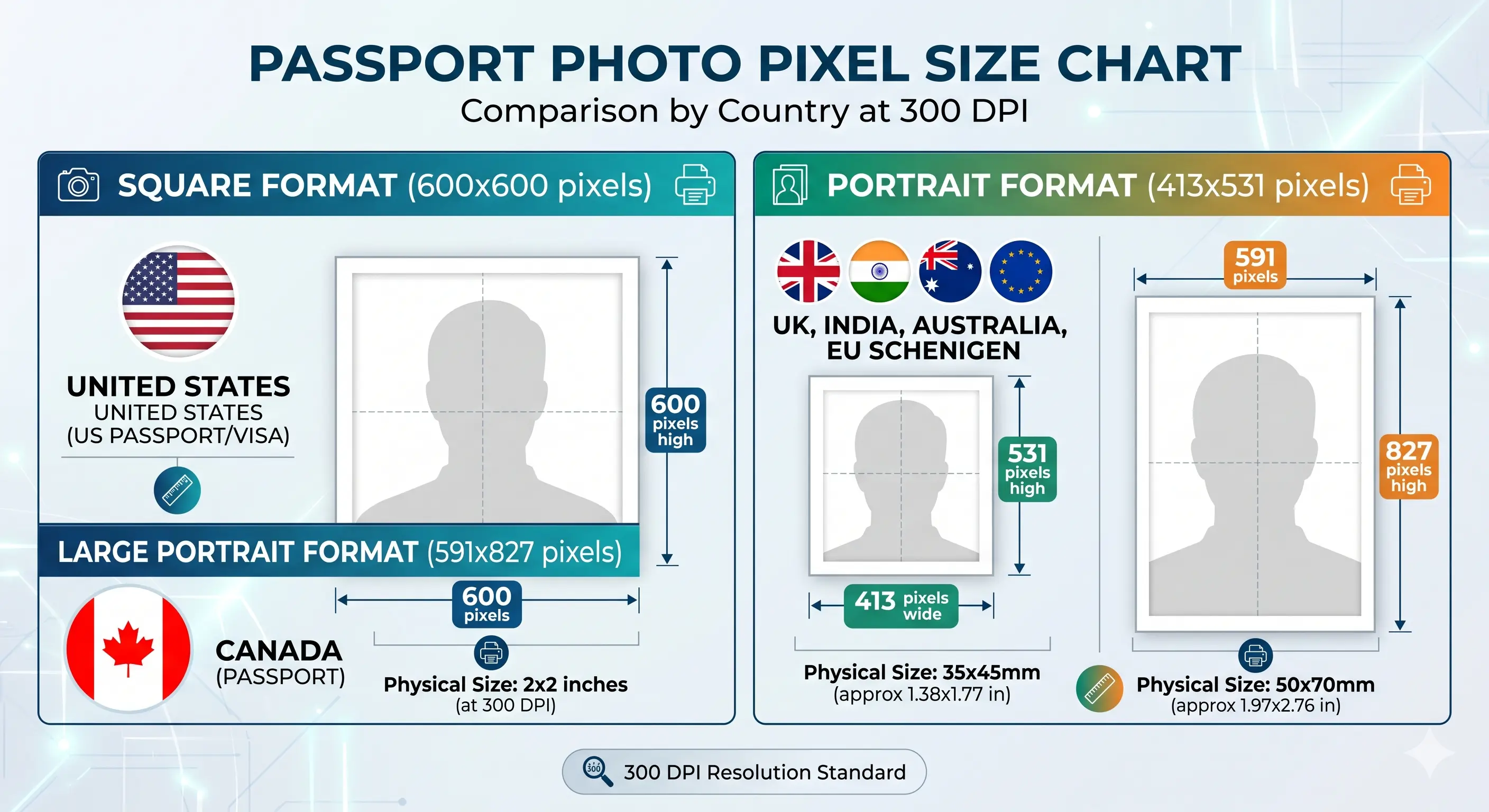
German Passport Photo Size in Pixels, Inches & CM
If you are working in Photoshop, Affinity or Canva, use the conversion chart below to set your canvas size correctly for a German biometric photo. Germany recommends 600 DPI, so the higher pixel value is the safer target.
Germany Compared to Other 35x45mm Standards
Germany shares the 35 × 45 mm size with most of Europe, but the background shade, face-height band and submission route differ. Using a generic Schengen photo for a German passport is a common and avoidable failure.
| Standard | Size | Background | Face height | Submission |
|---|---|---|---|---|
| Germany passport / ID | 35 × 45 mm | Light grey | 32–36 mm | Digital only |
| Germany visa | 35 × 45 mm | Light grey / white | 32–36 mm | Printed with application |
| Schengen visa | 35 × 45 mm | Light grey | 32–36 mm | Printed with application |
| EU biometric standard | 35 × 45 mm | Light grey | 32–36 mm | Varies by member state |
| Austria passport | 35 × 45 mm | Light grey / white | 32–36 mm | Printed or digital |
| Switzerland passport | 35 × 45 mm | Light grey | 32–36 mm | Captured at the office |
| UK passport | 35 × 45 mm | White, cream or light grey | 29–34 mm | Printed or digital upload |
| US passport | 51 × 51 mm (2 × 2 in) | Plain white | 25–35 mm | Printed or digital upload |
| China passport | 33 × 48 mm | Plain white | 28–33 mm | Printed plus digital |
Every national standard is indexed in the passport photo requirements by country hub. If you are a foreign national applying to visit Germany rather than a German citizen, see the Germany visa photo guide, and for travellers to China the China visa photo guide.
What to Do & Avoid for a German Passport Photo
✓ Do This
- Use a plain light grey background
- Match the grey shade to your hair for contrast
- Keep your head perfectly straight, no tilt
- Remove glasses before the photo
- Hold a neutral expression with mouth closed
- Use soft, even daylight from the front
- Keep the full face outline and forehead clear
- Book a certified studio or use the office terminal
✕ Avoid This
- Bringing a printed photo to the appointment
- Pure white, dark, blue or patterned backgrounds
- Wearing glasses, sunglasses or tinted lenses
- Smiling, frowning or an open mouth
- Selfie-mode photos or front-camera distortion
- Beauty filters, skin smoothing or portrait blur
- Shadows on the face or the wall behind
- Hats, caps or non-religious head coverings
How to Get a Compliant German Passport Photo
- Check your framing firstPhotograph yourself against a light grey wall in soft, even daylight, keeping at least 50 cm between you and the wall to avoid shadows. Upload it to the Passport Photo Maker and confirm the 35 × 45 mm crop and 32–36 mm face height pass. This step is free and stops you paying for a session that fails.
- Choose your submission routeEither book a certified photo studio that offers digital transmission, or check whether your Bürgeramt has a self-service photo terminal. Both are compliant; the terminal is usually cheaper, the studio usually gives better lighting control.
- Have the official photo takenAt the studio, tell the photographer it is for a Reisepass or Personalausweis so they apply the German biometric template and use the digital channel. At a terminal, follow the on-screen positioning guides.
- Collect your QR codeA studio gives you a QR code or reference number linked to the transmitted image. Keep it — this replaces the printed photograph entirely.
- Bring the code to your appointmentPresent the QR code at the Bürgeramt with your other documents. Staff retrieve the image from the secure system and attach it to your application.
German Passport Photos for Babies, Infants and Children
Two things changed recently for children, and both are commonly missed.
The Kinderreisepass no longer exists
Germany stopped issuing, extending and updating the Kinderreisepass on 1 January 2024. Children now need a regular electronic Reisepass or a Personalausweis, applied for at the Bürgeramt.
The digital rule applies to children too
A child's photo must also be captured on-site or transmitted digitally by a certified studio. You cannot bring a printed photo of your baby to the appointment.
Same size, same background
35 × 45 mm on a plain light grey background. There is no smaller format and no relaxed background rule for minors.
Face rules relaxed for babies
For infants the strict 32–36 mm face height and neutral expression are applied more leniently, and closed eyes are tolerated for the very youngest. Older children are held to the adult standard.
Child alone in the frame
No supporting hands, arms, car seat, toy or dummy may appear, and no other person may be visible in the photo.
No shadow behind the head
Soft indirect daylight, shot from directly above if the child is lying down. Side lighting creates the background shadow that fails the check.
Technique for photographing newborns and toddlers is covered in the baby passport photo at home guide — useful for the pre-check step even though the final image must come from a studio or terminal.
When You Still Need a Printed 35x45mm Photo
Printing is no longer part of a German passport or ID application. It is still required for several adjacent uses of the same 35 × 45 mm format, and the settings below apply to those.
| Still needs a printed photo | Schengen visa and German visa applications, non-German passports using 35 × 45 mm, company and student ID cards, club and association cards |
|---|---|
| No longer needs a printed photo | German Reisepass, Personalausweis and children's travel documents |
| Print resolution | 300 DPI minimum, 600 DPI preferred — disable fit-to-page scaling |
| Paper | Matte or semi-matte photo paper, 200–250 gsm. No creases |
| Copies per 10 × 15 cm sheet | Six 35 × 45 mm photos with cutting margins |
| Cutting | Guillotine or steel rule for square edges. Do not cut inside the printed border |
| Colour management | sRGB. Turn off printer auto-enhance and colour correction |
Printer settings and cutting technique are covered in the print passport photo at home guide, and sheet layout in the print sheet guide. If your file needs resizing or compressing for a visa upload, see the compress to 240 KB guide and the digital photo requirements guide. iPhone users shooting HEIC should convert first with the HEIC to JPEG guide.
Why German Passport Photos Get Rejected
Each item links to the detailed rule so you can confirm the tolerance before your appointment. The full cross-country breakdown is in passport photo rejection reasons.
Bringing a printed photo
Since 1 May 2025 a paper photograph is refused outright for a Reisepass or Personalausweis, no matter how well it is made. You need a terminal capture or a studio QR code.
Glasses still on
The most common rejection in Germany since 2020. Even thin frames or reflection-free lenses are flagged. See glasses rules.
Wrong face height
Face measuring under 32 mm or over 36 mm chin to crown breaks the biometric rule and is returned automatically. See head size rules.
Face too narrow or too wide
Correct height but a face outside the 16–20 mm ear-to-ear range still fails. Both axes are measured. See face size requirements.
White background
Germany specifies a plain light grey background, not white. A white wall can fail the contrast check, especially with light or blonde hair. See background colour rules.
Smiling
Any visible teeth or raised cheeks cause the facial recognition check to fail. The mouth must be relaxed and closed. See smile rules.
Head tilted
Even a small tilt fails biometric verification. The eyes must sit on a horizontal line and the head must face straight ahead.
Poor lighting
Yellow indoor lighting distorts skin tone, and harsh light creates shadows that mask facial geometry. See shadow rules.
Hair across the face
A fringe over the eyes or hair obscuring the face outline fails landmark detection. See hair rules.
Non-religious head covering
Hats and caps are refused. Religious head coverings are accepted only if the full face stays visible. See head covering rules.
Selfie distortion
Phone front cameras flatten facial features. Use the rear camera or have someone else take the photo, and switch off portrait blur.
Outdated photo
Anything older than six months, or that no longer reflects your current appearance, is refused at the counter.
Germany Passport Photo FAQs
Size & Specification
What size is a German passport photo?
A German passport photo (biometrisches Passbild) is 35 × 45 mm, which is 3.5 cm wide by 4.5 cm tall, on a plain light grey background. The face must measure 32–36 mm from chin to crown and 16–20 mm in width, filling roughly 70–80% of the frame height.
What is the background colour for a German passport photo?
A plain, single-colour light grey background is the German standard, not white. Match the shade to your hair: a slightly darker neutral grey for light or blonde hair, a lighter grey for dark hair, so the head outline stays clearly separated. Patterned, dark and strongly coloured backgrounds are refused. See the background colour rules.
What is the German passport photo size in pixels?
A 35 × 45 mm photo equals 413 × 531 pixels at 300 DPI and 827 × 1063 pixels at 600 DPI. German authorities recommend 600 DPI for biometric capture, so the higher value is the safer target. Full conversions are in passport photo size in pixels.
Is the German passport photo the same as the Schengen visa photo?
The size is identical at 35 × 45 mm, but the submission route is not. A Schengen visa photo is still submitted as a printed photograph with the application, while a German passport photo must now be transmitted digitally. Germany also enforces the light grey background and the 32–36 mm face height more strictly. See our Schengen visa photo guide.
The Digital Submission Rule
Do German authorities still accept printed passport photos?
No. Since 1 May 2025 German passport and ID card applications accept only digital photos. Printed paper photos are refused at the counter. You either have the photo taken on the spot at the authority's own terminal, or you use a certified photo studio that transmits the image electronically and gives you a QR code to bring to your appointment.
Can I take a German biometric passport photo at home?
Not for submission. Since 1 May 2025 a self-made photo cannot be used for a German Reisepass or Personalausweis, because the image must reach the authority through a certified digital channel. You can still photograph yourself at home and check the framing against the specification first, which avoids paying for a studio session that fails.
Does the digital rule apply at German embassies abroad?
The digital transmission system was built for domestic registration offices, and practice at German missions abroad varies. If you are applying at a German embassy or consulate, confirm with that specific mission whether it accepts a printed 35 × 45 mm photo or requires a digital submission before your appointment.
Can I use my phone camera for a German passport photo?
For the pre-check, yes — a modern smartphone has more than enough resolution. Use the rear camera, stand around 1.5 metres from a light grey wall in soft daylight, and switch off portrait blur and skin smoothing. The final submitted image must still come from a terminal or a certified studio.
Appearance Rules
Can I wear glasses in a German passport photo?
No. Since November 2020 glasses are not permitted in German biometric passport photos. Both eyes must be clearly visible without frames, reflections or tinted lenses, and prescription glasses must be removed.
Can I smile in a German passport photo?
No. German biometric standards require a neutral expression with the mouth closed and the head straight. Smiling, frowning or showing teeth causes the facial recognition check to fail.
How recent must my German passport photo be?
The photo must be taken within the last 6 months and reflect your current appearance. A new beard, significant weight change or a different hairstyle means a new photo is required.
Children
What are the German passport photo rules for a child or baby?
The same 35 × 45 mm size and light grey background apply, and the digital-only rule applies to children too. Note that the Kinderreisepass was discontinued on 1 January 2024, so children now need a regular Reisepass or Personalausweis. For babies the strict 32–36 mm face height and neutral expression are applied more leniently, but the child must be alone in the frame with no supporting hands, toy or dummy visible. See the child and infant section.
Official Sources & References
- Bundesportal (verwaltung.bund.de) — Passport application and the digital photograph requirement from 1 May 2025: verwaltung.bund.de
- Die Bundesregierung — Act to Strengthen Security in Passport, ID and Alien Law Documents (3 December 2020): bundesregierung.de
- Landeshauptstadt München — Digital passport photos, in force since 1 May 2025: stadt.muenchen.de
- Stadt Hamburg — Electronic passport photo submission and the studio QR code: hamburg.com
- Willkommenszentrum Berlin — Kinderreisepass discontinued since 2024: willkommenszentrum.berlin.de
- ICAO Doc 9303 — Machine Readable Travel Documents biometric photograph standard: icao.int
Related Passport Photo Guides
Check Your Germany Passport Photo Before You Book
Germany requires a digitally transmitted photo, so the studio or terminal produces your final file. Use the free checker first to confirm your 35 × 45 mm framing, 32–36 mm face height and background pass the German biometric specification — then book knowing it will not be rejected.
Check My Germany Passport Photo