
France Passport Photo Size (35 × 45 mm) & Grey Background Rules
A French passport photo is 35 × 45 mm with the head 32–36 mm from chin to crown, on a plain light grey or light blue-grey background — never pure white — taken within the last 6 months, with the head bare.
Source: Service-Public.fr (F10619)
The Ministère de l'Intérieur and ANTS reject a meaningful share of submissions over framing and background errors alone, which means a stack of correct paperwork can still stall over one photo. This page covers the exact specification, where ClonyPDF's tool helps, and one rule about who's allowed to take the photo that most guides skip entirely.
France Passport Photo Size & Specification
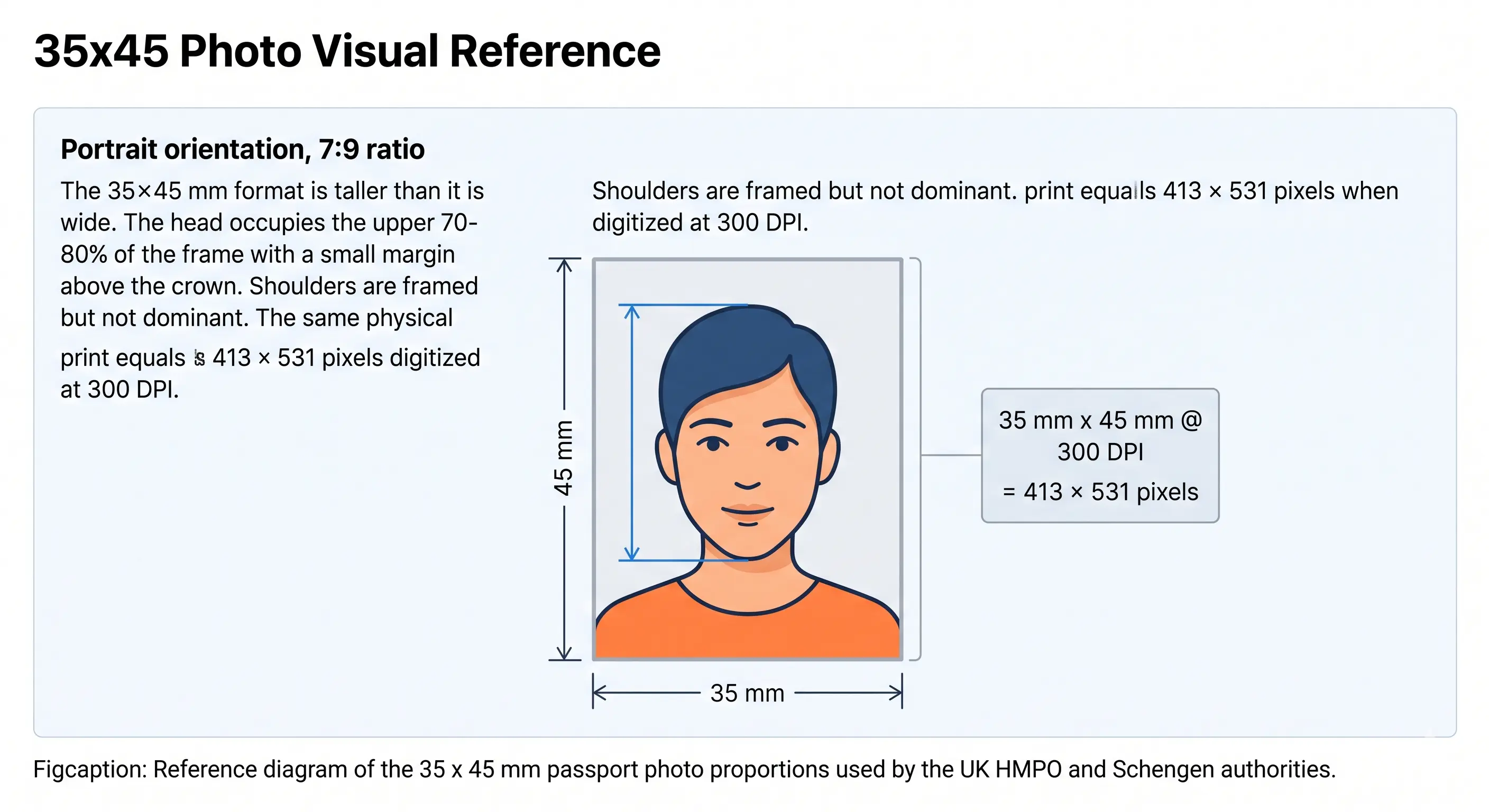
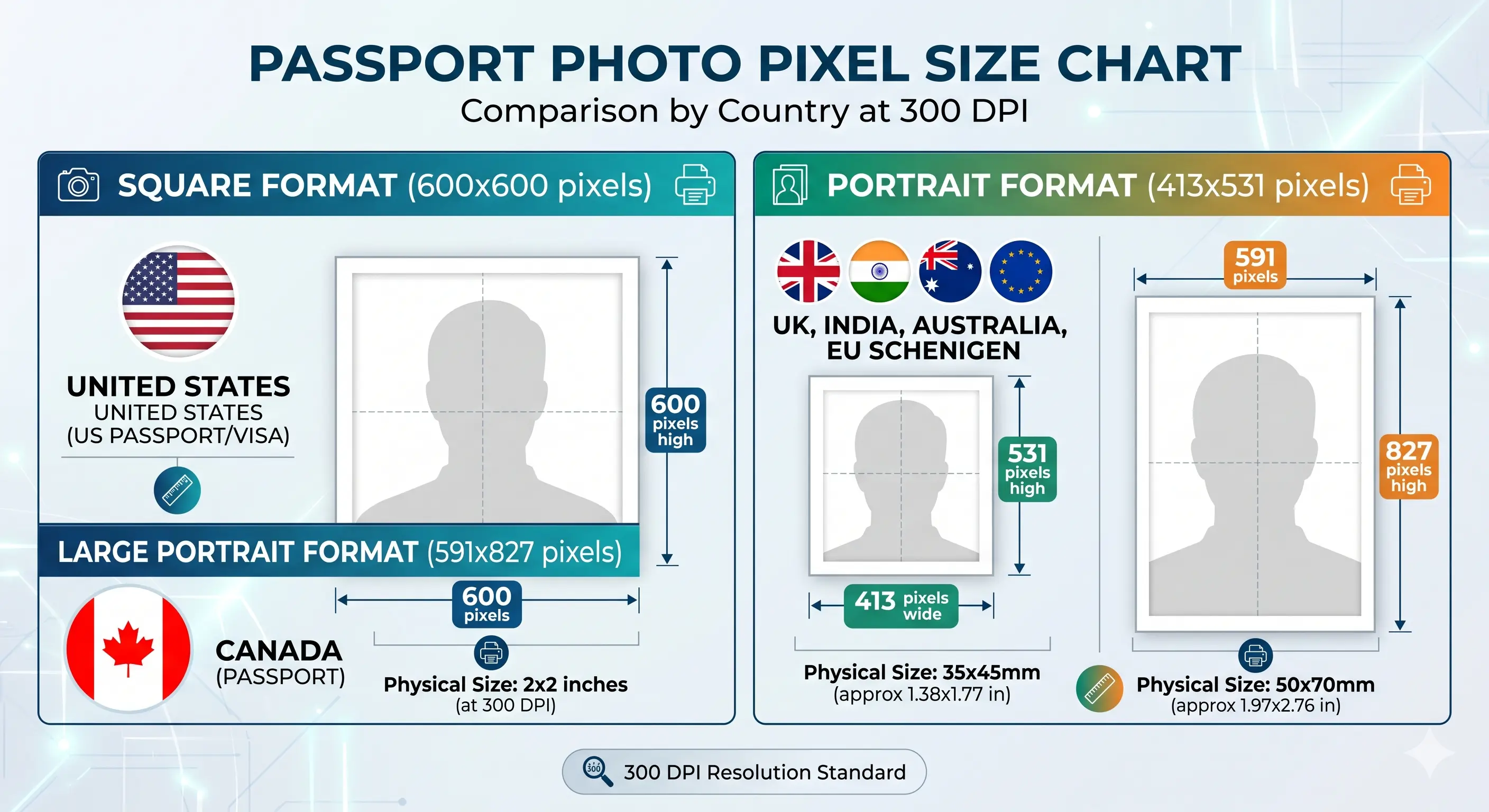
The French passport photo is 35 mm × 45 mm (3.5 × 4.5 cm, 1.38 × 1.77 in) at a 7:9 ratio, equal to 413 × 531 pixels at 300 DPI. The head measures 32–36 mm chin to crown, the eye line sits in the upper 60–70% of the frame, and the background must be plain light grey or light blue-grey.
| Requirement | Value |
|---|---|
| Photo size | 35 × 45 mm (3.5 × 4.5 cm) |
| Aspect ratio | 7 : 9 portrait |
| Pixels @ 300 DPI | 413 × 531 px |
| Pixels @ 600 DPI | 827 × 1063 px |
| Background | Plain light grey or light blue-grey — pure white forbidden |
| Head height | 32 – 36 mm chin to crown (70–80% of frame) |
| Eye line | Upper 60 – 70% of frame height |
| Head covering | Not permitted — tête nue (bare head) required |
| Expression | Neutral, mouth closed, no smiling |
| Age of photo | Less than 6 months old |
| Copies required | One compliant photo, or one ANTS ePhoto code |
| Who may capture it | Approved photographer or certified booth (domestic filings) |
Every French rule is explained in depth in the passport photo rules library, and every national standard is indexed in the requirements by country hub.
Create Your France Passport Photo Maker Online
Most rejected French passport photos fail for one of three reasons: the head sits outside the 32–36mm window, the background isn't a uniform light grey or light blue-grey, or the print resolution is too low for the biometric scan at intake. None of these are visible to the naked eye on a phone screen — they only show up once someone measures the file. Passport Photo Maker handles the measuring for you: it detects your face, crops to the exact 35×45mm frame, centers your head inside the compliant height zone, and replaces your background with an approved light grey tone before exporting a file sized for both digital use and standard photo-booth printing.
Drop a photo here, or click to choose one
JPG or PNG · face forward, even lighting · we crop and color-correct the restOutput: a 35×45mm digital file and a print-ready sheet. This step produces a reference-quality compliant crop — see "Who's actually allowed to take the photo" below before you treat it as your final official copy.
The 35×45mm Frame France Shares with the Schengen Area
France uses the same physical dimensions as every other Schengen and EU member state. The size is identical; the background shade is where France diverges from most of them.
France Passport & Carte d'Identité Photo Requirements
Every row below must pass. Each rule links through to the detailed standard so you can confirm the exact tolerance before your appointment.
| Photo size | 35 × 45 mm (3.5 × 4.5 cm / 1.38 × 1.77 in) |
|---|---|
| Width | 35 mm (413 px @ 300 DPI) |
| Height | 45 mm (531 px @ 300 DPI) |
| Aspect ratio | 7 : 9 portrait |
| Background | Plain, uniform light grey or light blue-grey. Pure white is explicitly forbidden. See background colour rules |
| Lighting | Even and diffuse — no shadow on the face, neck, or the ground behind the head. See shadow rules |
| Head size | 32–36 mm, chin to top of skull excluding hair (roughly 70–80% of frame height). See head size rules |
| Face coverage | 70–80% of frame height. See face size requirements |
| Eye line | Upper 60–70% of the frame height, eyes open and clearly visible. See eyes requirements |
| Hair | Must not fall across the eyes or break the outline of the face. See hair rules |
| Ears | Not required to be visible, but the face outline must be unobstructed. See ears visibility rules |
| Head covering | Not permitted — French ID photos require a bare head (tête nue). No religious exemption applies. See head covering rules |
| Resolution | 300 DPI minimum (≈413 × 531 px); many approved booths capture at 600 DPI (≈827 × 1063 px) |
| File format | JPEG for digital ePhoto submission; matte or glossy print accepted at the counter |
| Colour | Full colour, sRGB, natural skin tones. No filters, beautification or retouching |
| Print finish | No border, no frame, nothing written on the front. Cut square to exactly 35 × 45 mm |
| Copies required | One compliant photo for a counter filing, or one ANTS ePhoto code online |
| Glasses | Permitted only with thin frames that don't cover the eyes, untinted lenses, and no glare — most applicants remove them entirely. See glasses rules |
| Expression | Neutral, mouth closed, no smiling, eyes open and clearly visible, head straight and facing the camera. See smile rules |
| Age of photo | Less than 6 months old at the time of filing, and must resemble your current appearance |
Why a French Photo Isn't Interchangeable with Other 35×45mm Photos
Twenty-plus countries use the identical 35 × 45 mm frame, which is exactly why photos get reused and then refused. The dimension matches; the background shade and head-covering policy do not. A photo taken for an Australian or Japanese passport is white-backed and fails in France immediately.
| Country | Size | Background | Head height | Head covering |
|---|---|---|---|---|
| France | 35 × 45 mm | Light grey / blue-grey — white forbidden | 32–36 mm | Not permitted |
| Germany | 35 × 45 mm | Light grey | 32–36 mm | Religious only |
| United Kingdom | 35 × 45 mm | Cream or light grey | 29–34 mm | Religious only |
| Italy | 35 × 45 mm | White or light grey | 32–36 mm | Religious only |
| Spain | 35 × 45 mm | Plain white | 32–36 mm | Religious only |
| Netherlands | 35 × 45 mm | Light grey | 32–36 mm | Religious only |
| Belgium | 35 × 45 mm | Light grey | 32–36 mm | Religious only |
| Switzerland | 35 × 45 mm | Light grey | 32–36 mm | Religious only |
| Ireland | 35 × 45 mm | Light grey / off-white | 32–36 mm | Religious only |
| Australia | 35 × 45 mm | Plain white | 32–36 mm | Religious only |
| Japan | 35 × 45 mm | Plain white | 32–36 mm | Not permitted |
| United States | 51 × 51 mm | Plain white | 25–35 mm | Religious only |
| China | 33 × 48 mm | Plain white | 28–33 mm | Not permitted |
For the full worldwide reference see passport photo dimensions by country, or the Schengen visa photo requirements if you are applying for a short-stay visa rather than a French title. Travelling further afield? The China visa photo uses a 33 × 48 mm frame that no European format matches.
Wrong background on an existing photo? Re-generate it with the correct French grey tone.
Fix my background →Who's Actually Allowed to Take the Photo
This is the rule that separates France from the US, UK, Canada, or India process: French regulation doesn't just specify the photo's dimensions and background — it specifies who is allowed to capture it. For a passport or carte nationale d'identité filed inside France, the photo must come from an authorized professional photographer or an approved photo booth running a system certified by the Ministère de l'Intérieur. A photo that's perfectly cropped to 35×45mm but taken on your own phone at home isn't eligible for the official filing, regardless of how compliant it looks.
Where this leaves a tool like Passport Photo Maker: it won't replace the legally required booth or photographer capture for a domestic French passport or CNI filing. What it's genuinely useful for is confirming your framing and background before you go — so you can catch a bad booth photo on the spot — and for producing a compliant reference copy for situations the booth rule doesn't cover.
That second category is bigger than it sounds. If you're outside France applying for a French Schengen visa through a consulate or a visa center such as VFS Global or TLScontact, the capture-method restriction generally doesn't apply: a quality photo from any professional studio, or a correctly cropped digital photo meeting the same 35×45mm and background specs, is typically accepted. Policy can still vary by location, so it's worth a quick check with the specific center handling your file. See the France visa photo requirements for that route.
Tête Nue: No Head Coverings, No Exemption
French ID photos require a bare head — tête nue. Hats, caps, headbands, bandanas and religious head coverings are all refused for a passport or carte nationale d'identité, and unlike the United Kingdom, United States, Canada or Australia, France grants no religious exemption for official identity photographs. Only a documented medical reason is considered, and it must be justified at the counter.
Two related details catch people out. Hair itself is fine and does not need to be tied back, but it must not fall across the eyes or break the outline of the face — see the hair rules. And ears do not have to be visible in a French photo, which differs from several Asian standards; what matters is that nothing obstructs the face outline. The head covering rules page compares how each country handles this.
Child Passport and Carte d'Identité Photo Rules
The 35×45mm format and the 32–36mm head-height window apply at any age, including infants. The child must appear alone in the frame — no parent's hand visible holding the head steady, no toys, no pacifier — with eyes open and looking toward the camera. Like adult photos, the capture still has to happen at an approved booth or with an approved photographer; a phone photo at home isn't an accepted substitute even for a newborn's first passport.
No age exemption on size
35 × 45 mm frame with a 32–36 mm head height, exactly as for an adult. There is no smaller infant format.
Child alone in frame
No hands, arms, car seat, toy or pacifier may appear, and no second person may be visible anywhere in the shot.
Expression enforced loosely
Operators generally prioritise open, visible eyes and a relaxed face over a frozen neutral expression on a baby. Ask on-site — enforcement varies.
Same grey background
Light grey or light blue-grey, evenly lit. Laying a baby on a white sheet produces a white background and fails.
A fully neutral expression is hard to guarantee on a baby who won't sit still. If your child genuinely can't hold a closed-mouth expression, most approved photographers will still aim for open, visible eyes and a relaxed look rather than insisting on a frozen neutral face — ask the operator on-site, since how strictly this is enforced can vary between locations. For at-home practice framing before the appointment, the baby passport photo guide covers positioning and lighting, and the eyes requirements page covers the check that fails most often on child photos.
How to Create a France Passport Photo Maker Photo
-
Start with a clean source photo
Face the camera directly under even, shadow-free light. Avoid mirrors, filters, or photos pulled from social media — the tool needs a sharp, unedited frame to detect your face accurately.
-
Upload it to Passport Photo Maker
Drop your file into the upload box above. Detection runs automatically and locates your face, eyes, and chin line. If your phone saves HEIC files, convert first with the HEIC to JPEG guide.
-
Let the tool apply the French 35×45mm crop
Your head is centered and scaled into the 32–36mm height zone, and the background is normalized to a compliant light grey. The crop guide explains how the 7:9 ratio and head-height band are applied together.
-
Review against the spec strip
Check head position, eye line, expression, and background tone against the requirements table above before exporting — this is the step that catches most would-be rejections.
-
Export and confirm your filing route
Download the digital file or print sheet, then confirm whether your specific filing (domestic passport/CNI versus a visa application abroad) requires an approved booth capture or accepts your compliant copy directly.
The ANTS ePhoto Code and the Online Pré-demande
If you want to complete the photo step of your pre-demande on ants.gouv.fr entirely online, you'll need an ePhoto code — a unique alphanumeric identifier issued by an approved photo booth or photographer at the moment your compliant photo is captured. You enter that code into the photo field of your online application, and ANTS pulls the verified image directly from its servers instead of you uploading a file yourself.
The code is tied to the same six-month freshness rule as the physical photo, so an old code becomes invalid even if you haven't used it yet. If you'd rather file the paper version at the mairie or préfecture counter, you can skip the code entirely and simply hand over the compliant print from the same approved source — both routes start from the identical photo standard, they just differ in how it reaches the administration.
For visa routes that do accept a self-supplied digital file, the file-side rules matter as much as the framing. Most Schengen consular portals cap uploads around 240 KB; the compress to 240 KB guide and the reduce file size guide cover hitting that ceiling without dropping below 300 DPI, and the digital passport photo requirements guide covers pixel and format rules across portals.
Printing a 35×45mm French Photo
For a counter filing you hand over a physical print. The print itself is part of the specification — a correctly cropped file printed badly is still refused.
| Print resolution | 300 DPI minimum — export at 413 × 531 px or larger. Disable fit-to-page and auto-scaling, which change the physical size |
|---|---|
| Paper | Photo-quality paper, matte or glossy, 200–250 gsm. Plain copier paper is refused |
| Copies per 4 × 6 in sheet | Six 35 × 45 mm photos with cutting margins |
| Copies per A4 sheet | Around twenty, though you normally need only one |
| Borders | None. No frame, no white edge, nothing written on the front |
| Cutting | Guillotine or steel rule, square to exactly 35 × 45 mm. Do not cut inside the printed border |
| Colour management | sRGB. Turn off printer auto-enhance and colour correction — they shift the grey background out of tolerance |
| Condition | Clean, flat and uncreased. Bent corners or adhesive residue from a previous application can be refused |
Printer settings and cutting technique are covered in full in the print passport photo at home guide, and multi-copy sheet layout in the print sheet guide.
Need a cuttable sheet for your mairie appointment?
Generate print sheet →Common Reasons French Passport Photos Get Rejected
- Pure white background: French rules explicitly forbid white — only light grey or light blue-grey passes. This is the most common failure on reused foreign photos. See background colour rules.
- Wrong head height: the chin-to-crown measurement falls outside the 32–36mm window, usually because the photo was framed too tight or too loose. See head size rules.
- Eye line too low: a correct head height positioned low in the frame still fails the face-position check. The eyes belong in the upper 60–70%. See eyes requirements.
- Head covering worn: any hat, cap or religious covering fails — France requires tête nue with no religious exemption. See head covering rules.
- Visible shadow on the face or background: uneven lighting from a single side reads as non-uniform to the verification system. See shadow rules.
- Hair across the eyes: a fringe over the eyes or hair breaking the face outline fails landmark detection. See hair rules.
- Glare or tint on glasses: reflections under booth lighting are common enough that most applicants just remove their glasses. See glasses rules.
- Smiling or open mouth: France enforces a strict neutral expression — no smiling is allowed, even slightly. See smile rules.
- Photo older than 6 months: even a technically perfect photo gets rejected once it falls outside the freshness window, and an unused ePhoto code expires with it.
- Resolution below 300 DPI: the biometric scan at intake cannot resolve facial landmarks below 413 × 531 px. See resolution rules.
- Filters or retouching: portrait blur, skin smoothing and slimming alter facial geometry and are detected. Shoot in a plain, unfiltered mode.
- Bordered or damaged print: a white edge, frame, crease or bent corner can be turned away even when the image itself is compliant.
- Capture method itself non-compliant: a home or phone photo submitted in place of an approved booth or photographer capture, for domestic passport/CNI filings.
The full cross-country breakdown of refusal causes is in passport photo rejection reasons.
France Passport Photo Questions
Size & dimensions
What size is a France passport photo?
35mm wide by 45mm tall — a 7:9 portrait ratio, equal to 3.5 × 4.5 cm or 1.38 × 1.77 inches. It is the same format used for the carte nationale d'identité and most Schengen visa applications. The head height must fall between 32mm and 36mm, chin to crown.
What is the France passport photo size in pixels?
At 300 DPI the 35 × 45 mm French photo equals 413 × 531 pixels. At 600 DPI, which many approved booths capture at, it equals 827 × 1063 pixels. Files below 300 DPI are refused because the biometric scan at intake cannot resolve the facial landmarks.
Where should the eyes sit in a French passport photo?
The eye line should sit in the upper 60 to 70 percent of the frame height, measured from the bottom edge. Head height alone is not enough — a photo with a correct 32–36mm head positioned too low in the frame still fails the face-position check.
Background & appearance
Can a French passport photo have a white background?
No. France explicitly forbids pure white for passport and carte nationale d'identité photos. The background must be a plain, uniform light grey or light blue-grey with no gradient, pattern or shadow. This is the single most common difference between a French photo and an American, Australian, Spanish or Japanese one, all of which require white.
Are head coverings allowed in a French passport photo?
No. French ID photos require a bare head — tête nue. Hats, caps, headbands and religious head coverings are all refused, and unlike the UK, US, Canada or Australia, France grants no religious exemption for official identity photographs. Only a documented medical reason is considered. See the tête nue section above.
Can I wear glasses in my French passport photo?
Only with thin, untinted frames that don't cover your eyes and produce zero glare. Because glare under booth lighting is hard to avoid, most approved photographers will simply ask you to take your glasses off.
Who can take it & how to file
Can I use a digital photo I took at home for my French passport?
Not for the official domestic filing — the capture itself must come from an authorized photographer or an approved booth certified by the Ministère de l'Intérieur. It remains useful for checking your framing in advance, and for visa filings made from outside France where this restriction generally doesn't apply. Full detail in who's actually allowed to take the photo.
Which authority issues passports in France?
The Ministère de l'Intérieur sets the legal standard, and the Agence Nationale des Titres Sécurisés (ANTS) runs the biometric production system. You file in person at a mairie equipped for biometric titles, a préfecture, or a French consulate if you live abroad.
Do I need an ePhoto code for the ANTS pré-demande?
Only if you want to finish the photo step of your online pre-demande digitally. It's a code issued by an approved booth or photographer that ANTS uses to pull your verified photo automatically. Filing on paper at the counter skips the code — you just hand over the compliant print instead. See the ePhoto section.
How many photos do I need for a French passport application?
One recent compliant photo for a paper filing at the counter, or one ePhoto code if you complete the photo step online. Some mairies ask you to bring a spare, so confirm with the office handling your appointment before you attend.
Children, freshness & printing
What photo is required for a French child's passport or carte d'identité?
The same 35×45mm size, 32–36mm head-height rule and light grey background apply regardless of age. The child must be alone in frame with no hands, toys, or pacifiers visible, eyes open and facing the camera, and the capture still has to come from an approved booth or photographer. See the child rules section.
How recent must my French passport photo be?
Under six months old at the time you file, and it has to still resemble your current appearance. The same six-month limit applies to an ANTS ePhoto code, so an unused code expires too.
How should a French passport photo be printed?
On photo-quality paper at 300 DPI or higher, matte or glossy, with no border, no frame and no writing on the front. Cut square to exactly 35 × 45 mm, and keep the print clean and flat — bent corners or adhesive residue from a previous application can be refused. See the printing section.
Official Sources & References
Specifications on this page are compiled from official French government publications and the international biometric travel document standard. Where a French national requirement differs from ICAO, the French requirement applies.
- Agence Nationale des Titres Sécurisés (ANTS) — pré-demande and ePhoto: ants.gouv.fr
- service-public.fr — official administrative guidance for passeport and carte nationale d'identité: service-public.fr
- Ministère de l'Intérieur — legal photo standard and approved-capture certification: interieur.gouv.fr
- European Commission — Schengen borders and visa policy: home-affairs.ec.europa.eu
- ICAO Doc 9303 — Machine Readable Travel Documents biometric photograph standard: icao.int
Create Your France Passport Photo Maker Now
Get a 35×45mm photo with the correct head height and a compliant grey background in under a minute — then check the booth-capture rule above before your appointment.
Make my France passport photo