The Instituto dos Registos e do Notariado (IRN) sets strict biometric requirements for Portuguese passport photos — and photo submissions are among the most common reasons for passport application delays. Your photo must be exactly 35mm × 45mm, printed on a plain white background, with your face centred and unobstructed. This page covers every IRN rule, explains the most common rejection mistakes, and lets you generate a fully compliant photo in seconds — no studio visit required.
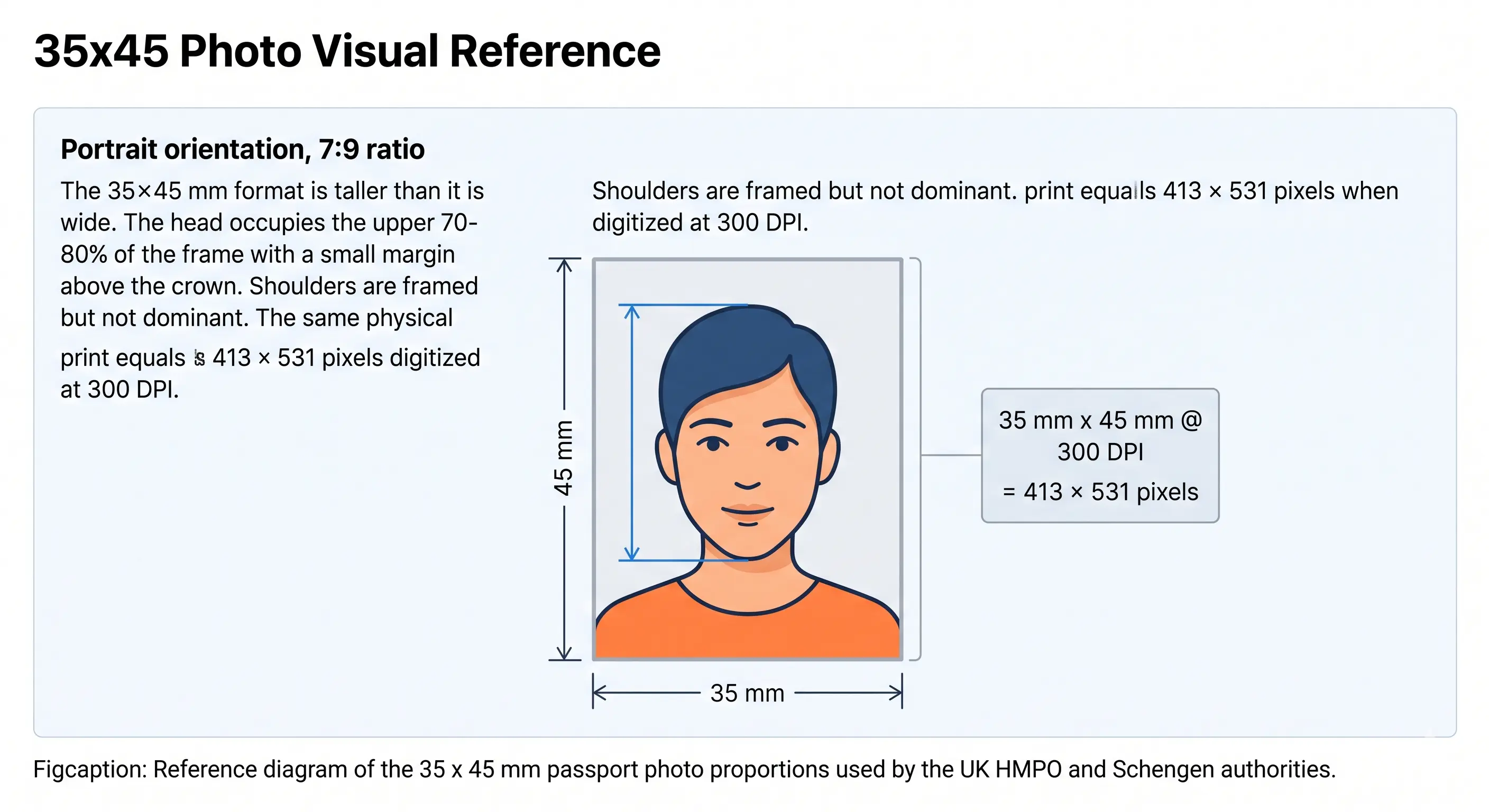
A Portugal passport photo must be 35 mm wide by 45 mm tall on a plain white or very light grey background, with the head measuring 32–36 mm from chin to crown — roughly 70–80% of the frame height. At 300 DPI that equals 413 × 531 pixels; at 600 DPI, 827 × 1063 pixels. Two printed copies are required for in-person applications.
| Requirement | Value |
|---|---|
| Photo size | 35 × 45 mm (3.5 × 4.5 cm) |
| Aspect ratio | 7 : 9 portrait |
| Pixels @ 300 DPI (print) | 413 × 531 px |
| Pixels @ 600 DPI (digital) | 827 × 1063 px |
| Background | Plain white or very light grey |
| Head height (chin to crown) | 32 – 36 mm (70–80% of frame) |
| Eye line from bottom edge | 30 – 36 mm |
| Copies required | 2 printed (in person) · 1 digital (ePortugal) |
| Digital file size | Approximately 200 KB – 3 MB, JPEG |
| Age of photo | Taken within the last 6 months |
| Issuing authority | Instituto dos Registos e do Notariado (IRN) |
Portugal shares this 35×45 mm standard with most of Europe. See the full 35×45 photo size guide, browse every national standard in the requirements by country hub, or read the individual standards in the passport photo rules library.
The diagram below marks the measurements the IRN's biometric scanner checks: the 35 × 45 mm portrait frame, the 32–36 mm chin-to-crown head height, and the eye line 30–36 mm up from the bottom edge.
| Photo Size | 35 mm × 45 mm |
| Width | 35 mm (413 px @ 300 DPI) |
| Height | 45 mm (531 px @ 300 DPI) |
| Aspect Ratio | 7 : 9 portrait |
| Background | Plain white or very light grey — uniform, no patterns or shadows. See background colour rules |
| Head Height (chin to crown) | 32 – 36 mm (70–80% of photo height). See head size rules |
| Face Coverage | 70–80% of frame height. See face size requirements |
| Eye Line | 30 – 36 mm from the bottom edge, both eyes open. See eyes requirements |
| Lighting | Even and diffuse, no shadow on face or background. See shadow rules and lighting requirements |
| Hair | Must not cover the eyes, eyebrows or face outline. See hair rules |
| Ears | Both ears should be visible where hair allows. See ears visibility rules |
| Resolution (digital) | 600 dpi minimum; 300 dpi acceptable for print. See resolution rules |
| File Format (digital) | JPEG — high quality, low compression, approximately 200 KB – 3 MB |
| Print Paper | Matte or semi-matte photographic paper. See print at home guide |
| Copies Required | Two identical prints for in-person applications; one digital upload for ePortugal renewals |
| Expression | Neutral — mouth closed, eyes open, gaze forward. See smile rules |
| Glasses | Not permitted — removed since ICAO 2018 update. See glasses rules |
| Head Coverings | Not allowed except for documented religious reasons. See head covering rules |
| Photo Age | Taken within the last 6 months |
| Digital Submission | Available at select IRN / Loja do Cidadão offices and via ePortugal |
| Colour / Black & White | Full colour only |
| Photo Manipulation | Not allowed — retouching, filters, digital corrections prohibited |
A physical measurement in millimetres means nothing to an upload form — the ePortugal portal validates pixels. The pixel size of a 35 × 45 mm photo depends entirely on the DPI you export at, and the IRN asks for a higher resolution for digital submission than for print.
| DPI | Pixel dimensions | Use |
|---|---|---|
| 150 DPI | 207 × 266 px | Below minimum — refused |
| 300 DPI | 413 × 531 px | Minimum for print |
| 600 DPI | 827 × 1063 px | IRN digital submission standard |
The Instituto dos Registos e do Notariado (IRN), operating under Portugal's Ministry of Justice, is the national authority responsible for issuing Portuguese passports and civil identification documents. The IRN oversees all biometric standards for passport photographs in Portugal, working in alignment with ICAO Document 9303 — the international standard governing machine-readable travel documents used across the European Union and 190+ countries globally.
Portuguese passports are biometric e-Passports featuring an embedded chip that stores your facial image and fingerprint data. Because the chip-stored image is derived directly from the submitted photograph, the IRN applies rigorous biometric verification to every photo submitted. A photo that fails automated face-detection checks, carries shadows, or has incorrect framing ratios will be rejected before your application reaches a human reviewer.
Applications are processed through Lojas do Cidadão (Citizens' Shops), IRN regional delegations, and Portuguese consulates abroad. Online renewals and digital photo submissions are available for eligible applicants through the government's portal at eportugal.gov.pt.
Getting your Portuguese passport photo right the first time saves you from delays, re-submissions, and additional fees. The IRN's biometric requirements are stricter than many applicants expect. Here's a detailed breakdown of every rule that applies to your photo.
Children and infants applying for a Portuguese passport must also submit a biometric photo. The same 35×45mm dimensions and IRN standards apply, but there are practical allowances for very young children who cannot hold the required pose independently.
Understanding where your photo fits into the Portuguese passport application process helps you prepare correctly and avoid delays. The IRN processes passport applications through three main channels.
Book an appointment at your nearest Loja do Cidadão or IRN regional delegation. Bring two identical, recently-taken passport photos (35×45mm) printed on photographic paper, along with your current passport or citizen card, proof of address, and any relevant supporting documents. Processing time is typically 3–7 business days for standard applications; urgent processing (1 business day) is available for an additional fee.
Eligible applicants — generally those renewing rather than applying for their first passport — may submit applications online via the ePortugal citizen portal. Digital photo submission applies here, and the uploaded image must meet the same biometric specifications at 827 × 1063 pixels. You will need a valid Chave Móvel Digital (Digital Mobile Key) or citizen card reader to authenticate.
Portuguese citizens residing abroad apply through the nearest Portuguese consulate or embassy. Photo requirements remain identical. Processing times vary by consulate location; check your specific consulate's website for current timelines and appointment availability.
Portugal is progressively modernising its passport infrastructure, and digital photo submission is increasingly available — particularly for online renewals processed through the ePortugal portal. Here's what you need to know.
Portal rules across different countries and document types are compared in the digital passport photo requirements guide.
Yes — and many thousands of applicants do so successfully each year. The key is meeting every IRN requirement without the controlled environment of a photo studio. Here's exactly how.
Any modern smartphone camera (iPhone XS or later, equivalent Android) produces sufficient image quality. Set the camera to portrait mode only if it doesn't add artificial background blur; otherwise use the standard photo mode. Do not use beauty or filter modes. The rear camera produces better results than the front-facing camera.
Avoid photographing in direct sunlight, which creates harsh shadows. The ideal setup is diffuse natural light from a large window to one side of your face, supplemented by a second diffuse light source on the other side to eliminate shadow. Ring lights work well if natural light is unavailable — position it directly in front of you, at eye level.
Find a plain white wall with no visible texture, or hang a white bedsheet flat against a wall. The background must extend behind your entire head with no shadows cast by your head or body onto it. Stand or sit at least 0.5 metres from the wall to avoid your head's shadow falling onto the background.
For a 35×45mm head-to-photo ratio, your head should fill approximately 70–80% of the frame. With a smartphone held at roughly 1.2 to 1.5 metres, use a tripod or prop the phone against a stable surface. Have someone else take the photo, or use a timer with a stand — selfies at arm's length rarely produce biometric-correct framing. The crop guide explains how the 7:9 ratio and head-height band are applied together.
Because in-person IRN applications require two identical printed photos, printing is part of the specification rather than an afterthought. Standard office printer output on plain paper does not meet the IRN's photographic paper requirement and will be refused.
| Setting | Requirement |
|---|---|
| Print resolution | 300 DPI minimum — export at 413 × 531 px or larger. Disable fit-to-page and auto-scaling |
| Paper | Matte or semi-matte photographic paper, 200–250 gsm. Plain copier paper is refused |
| Copies per 4 × 6 in sheet | Six 35 × 45 mm photos with cutting margins |
| Copies per A4 sheet | Around twenty, though only two are required |
| Colour management | sRGB. Turn off printer auto-enhance, skin smoothing and colour correction |
| Cutting | Guillotine or steel rule for square edges. Do not cut inside the printed border |
| Handling | Let ink dry fully. Do not staple, fold or glue the photo face |
| Where to print | Pharmacy, print shop or photo lab supporting photographic-quality printing |
Passport Photo Maker exports the print sheet automatically. Printer settings, paper choice and cutting technique are covered in the print passport photo at home guide, and multi-copy sheet layout in the print sheet guide.
Portugal shares the 35 × 45 mm size with every EU member state, so a correctly sized photo travels well across the bloc. What varies is the background shade — and that is the detail that catches applicants who reuse a photo accepted elsewhere.
| Country | Size | Background | Head Height |
|---|---|---|---|
| Portugal | 35 × 45 mm | White or very light grey | 32 – 36 mm |
| Spain | 35 × 45 mm | Plain white | 32 – 36 mm |
| France | 35 × 45 mm | Light grey — white not accepted | 32 – 36 mm |
| Germany | 35 × 45 mm | Light grey | 32 – 36 mm |
| Italy | 35 × 45 mm | White or light grey | 32 – 36 mm |
| Netherlands | 35 × 45 mm | Light grey | 32 – 36 mm |
| Ireland | 35 × 45 mm | Light grey / off-white | 32 – 36 mm |
| EU biometric standard | 35 × 45 mm | Light grey | 32 – 36 mm |
If you hold dual nationality or regularly apply for travel documents from both countries, understanding the differences between Portuguese and American passport photo requirements prevents costly re-takes. The two systems differ more than most applicants realise.
| Requirement | Portugal (IRN) | United States (State Dept.) |
|---|---|---|
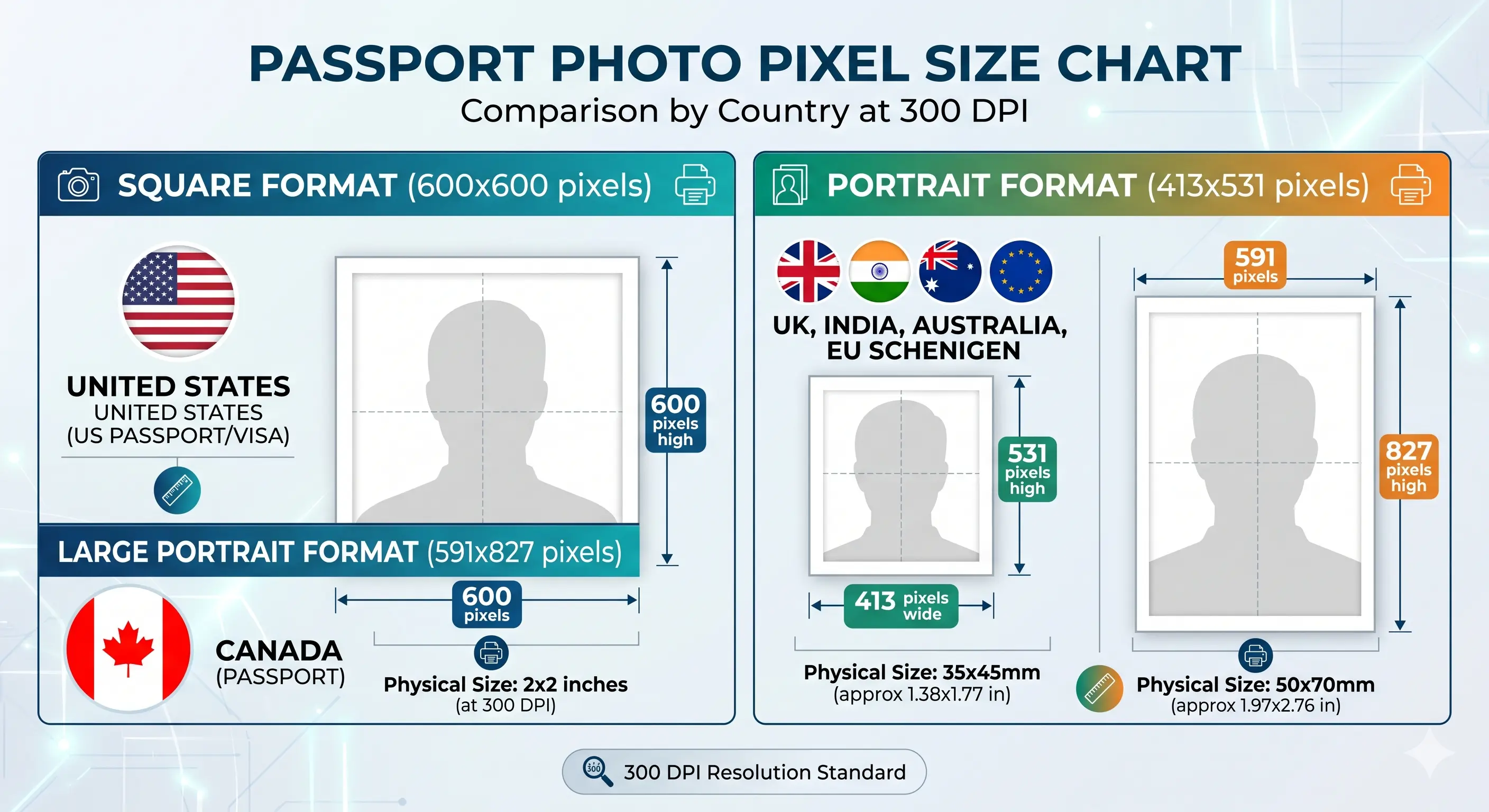
| Photo Dimensions | 35 × 45 mm (portrait) | 51 × 51 mm / 2 × 2 inches (square) |
| Aspect Ratio | Portrait (7:9) | Square (1:1) |
| Pixels @ 300 DPI | 413 × 531 px | 600 × 600 px |
| Head Height | 32 – 36 mm chin to crown | 25 – 35 mm (1″ – 1⅜″) chin to crown |
| Background | White or very light grey | Plain white only — grey not accepted |
| Glasses | Not permitted | Not permitted (since 2016) |
| Expression | Neutral, mouth closed | Neutral or natural smile permitted |
| Copies Required | Two printed | One printed (DS-11 / DS-82) |
| Digital Submission | Available at select offices and via ePortugal | Available via DS-82 renewal online |
| Print Paper | Matte or semi-matte photographic | Matte or glossy photographic |
| Issuing Authority | IRN (Ministry of Justice) | US State Department |
| Photo Age | Within 6 months | Within 6 months |
| Head Coverings | Religious exceptions only | Religious exceptions only |
| Standard | ICAO / EU Biometric (35×45mm) | ICAO / US State Dept. (2×2″) |
Follow these five steps to generate a fully IRN-compliant Portuguese passport photo from a photo taken at home — no photography expertise required.
Click the upload area above or drag your photo directly onto it. Use a recent, front-facing photo taken in good lighting against a plain background. JPG, PNG, and WebP are all accepted. If you don't have a suitable photo yet, take one on your phone following the home photo guidance in the section above.
Passport Photo Maker detects your face and automatically positions it to match IRN biometric framing rules. The crop places your face at the correct 70–80% height ratio within the 35×45mm frame. You can manually adjust the crop if needed — zoom, rotate, or reposition before finalising.
The AI background tool detects and removes your existing background — regardless of its original colour — and replaces it with a plain white background that meets the IRN's requirements. For most photos taken indoors against a light wall, this step is instantaneous and requires no manual editing.
Before downloading, review the compliance checklist within the tool. It flags any detected issues: shadows on the background, face partially cropped, glasses detected, or resolution too low. Resolve any flagged items before proceeding.
Download your photo as a digital file (for ePortugal submission at 827 × 1063 pixels) or as a print-ready sheet with multiple 35×45mm photos. Take the sheet to any pharmacy or print shop for photographic-quality printing, then cut two copies for your appointment.
The IRN's biometric scanning system flags non-compliant photos automatically, and a single issue is enough to delay your entire application. These are the most frequent reasons photos fail Portuguese passport applications. The full cross-country breakdown is in passport photo rejection reasons.
Photo is not exactly 35×45mm. Even 1mm deviation in either dimension can cause automated rejection. See the crop guide.
Off-white, cream, grey (too dark), or any non-white background. See background colour rules.
Face exceeds 36mm chin-to-crown. Biometric scan cannot place the required facial landmarks. See head size rules.
Face is below 32mm chin-to-crown. The head must occupy 70–80% of the photo's height. See face size requirements.
Lighting from below or directly above creates shadows under the nose, chin, or eyes. See shadow rules.
All glasses are prohibited since ICAO 2018. Even thin wire frames cause reflection artefacts. See glasses rules.
Photos older than 6 months are rejected. Your current appearance must be accurately represented.
Head shadow on the background from standing too close to a wall breaks the uniform background requirement. Stand 0.5 m clear.
Smiling, mouth open, raised eyebrows, or squinting. See smile rules.
Skin smoothing, teeth whitening, contrast adjustments, or beauty filters are flagged as manipulation.
Below 413 × 531 pixels for print or 827 × 1063 for digital submission. Upscaling a small file does not pass the sharpness check. See resolution rules.
Motion blur from a shaking camera or a soft-focus photo mode prevents accurate biometric measurement.
Hair covering eyebrows, eyes, or the side profile of the face. See hair rules and ears visibility rules.
Office printer output on copier paper is refused. Matte or semi-matte photographic paper only. See the print guide.
Passport photo requirements set by the Instituto dos Registos e do Notariado (IRN) may be updated without prior public notice. The specifications on this page reflect IRN and ICAO standards as currently documented and were last reviewed on , but you should always verify the current requirements directly with the IRN or your processing office before submitting your application. ClonyPDF Passport Photo Maker is designed to produce photos that meet these standards; however, final approval of any passport photo remains solely at the discretion of the issuing authority. ClonyPDF accepts no responsibility for applications rejected due to changes in official requirements after this page was last updated.
A Portuguese passport photo must be precisely 35mm wide and 45mm tall (35×45mm), a 7:9 portrait format. The face (measured from chin to the top of the head, not including hair) must be between 32mm and 36mm tall, meaning the face should fill approximately 70–80% of the photo's total height. Both measurements must be accurate when printed; even minor deviations can cause rejection during the IRN's biometric verification process. Learn more about the 35×45mm photo size.
A 35 × 45 mm Portuguese passport photo is 413 × 531 pixels at 300 DPI and 827 × 1063 pixels at 600 DPI. The IRN recommends 600 DPI for digital submission through the ePortugal portal, while 300 DPI is the minimum acceptable resolution for printed photos. Anything below 300 DPI prints pixelated and fails the quality check. See the full passport photo size in pixels reference.
Most European and many Asian countries use the 35×45mm portrait format, as defined by ICAO Document 9303. This is the standard for Portugal, France, Spain, Germany, and the Netherlands, among others. The United States, Canada, and some South American nations use a different standard — the square 2×2 inch (51×51mm) format. The two formats are not interchangeable between countries. Always confirm which format your target country requires before preparing your photos.
Since 2018, the International Civil Aviation Organization (ICAO) updated its biometric passport standards to prohibit glasses in all passport photos. The reason is technical: glasses — particularly frames with thick arms, reflective lenses, or tinted glass — interfere with the automated facial recognition algorithms used at border control e-gates. Glasses can partially obscure key facial landmarks (the corners of the eyes, the top of the cheekbones) that the system uses to match your photo to your face. Portugal, as an EU member state and ICAO signatory, applies this rule without exception. See the glasses rules.
Yes, with conditions. The IRN follows the same religious exemption policy applied across the EU: head coverings worn for documented religious reasons are permitted, provided that the covering does not obscure any part of the face. The full face — from the lower chin to the hairline, and from ear to ear — must remain fully visible. The head covering must be worn as a matter of daily religious practice, not worn temporarily for the photo. Documentation confirming the religious requirement may be requested in some cases. Head coverings worn for fashion, medical, or cosmetic reasons are not exempt and are prohibited. See the head covering rules.
Portugal follows the same core ICAO biometric standards as all EU member states — the 35×45mm size is the EU standard, and rules around expression, glasses, and head size are harmonised across the bloc. In practice, the requirements for a Spanish passport photo or a French passport photo are nearly identical to Portuguese ones. The main practical difference is background shade: France, Germany and the Netherlands specify light grey, while Portugal accepts white or very light grey. For Portuguese applications, follow IRN specifications strictly rather than relying on photos previously accepted by another EU country.
The same 35×45mm size, white background and 32–36 mm head height apply to children — there is no reduced format for infants. IRN reviewers make some accommodation for newborns and babies under 12 months, whose eyes do not need to be fully open. The child must be alone in the frame with no supporting hands, parent, toy or dummy visible. Children over roughly six years must meet the adult neutral expression standard. See the child photo requirements section and our baby passport photo guide.
In most cases, yes — both Portuguese passport photos and Schengen visa photos use the same 35×45mm format and follow the same ICAO biometric standards. However, there are a few caveats: your photo must be recent (within 6 months), and some Schengen visa applications require the photo to be taken within a shorter timeframe specified by the particular country's consulate. Additionally, if you have changed your appearance significantly since your passport photo was taken, you should take a fresh photo for the visa application.
Standard in-person Portuguese passport applications require two identical, recent passport photos. Both photos must meet all IRN requirements and be printed on photographic paper. If you are applying online through the ePortugal portal and your office supports digital submission, you may only need to upload one digital file. Always confirm the requirement with your specific processing office, as some consulates abroad may have slightly different requirements.
Yes, but availability varies by application type and location. Online passport renewals submitted via the ePortugal portal (eportugal.gov.pt) support digital photo uploads. Certain Loja do Cidadão offices also capture biometric photos on-site during appointments. However, not all offices are equipped for digital-only processing, so it is strongly recommended to bring two printed 35×45mm photos as a backup to any in-person appointment. Digital submissions must be in JPEG format at a minimum of 600 dpi (827 × 1063 pixels for the 35×45mm size), typically between 200 KB and 3 MB. The same biometric requirements apply regardless of whether you submit digitally or in print.
Print at 300 DPI or higher on matte or semi-matte photographic paper of 200–250 gsm. A 4 × 6 inch sheet holds six 35×45mm photos and an A4 sheet holds around twenty, though only two are required. Disable fit-to-page scaling, turn off printer auto-enhance, cut with a guillotine for square edges, and do not trim inside the printed border. Standard office printer output on plain paper does not meet the IRN photographic paper requirement, so use a pharmacy, print shop or photo lab. See the print at home guide.
Yes. You can take your photo at home with a modern smartphone or digital camera against a plain white wall. You need even lighting, no shadows on the face or background, and the correct framing distance. Stand at least 0.5 metres clear of the wall, use the rear camera at eye level, and switch off portrait blur and beauty modes. Then upload the shot to Passport Photo Maker, which handles automatic background removal, biometric cropping, and resizing to the exact 35×45mm specification.
Upload once — get an IRN-compliant 35×45mm photo that's ready to submit or print. No studio, no appointment, no guesswork.