Polish passport photos must meet strict biometric standards set by the Ministry of the Interior and Administration (MSWiA). The required size is exactly 35×45mm with the head measuring between 32mm and 36mm — deviations of even a millimetre are grounds for rejection. A plain light-grey or white background, neutral expression, and no glasses are mandatory. Getting these details wrong means a return trip to the passport office. Passport Photo Maker applies the correct 35×45mm biometric frame automatically so your photo is compliant before you ever leave home.
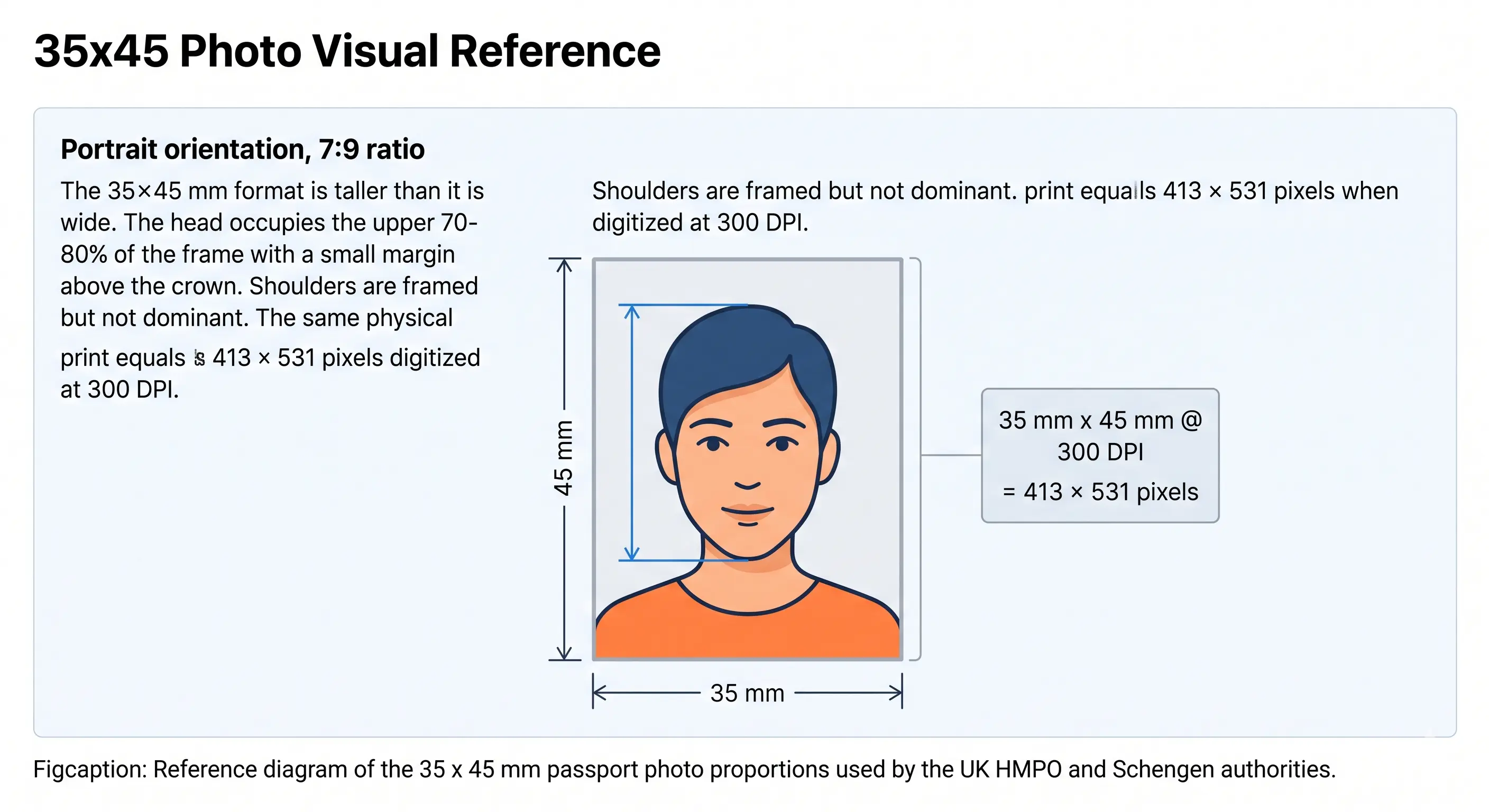
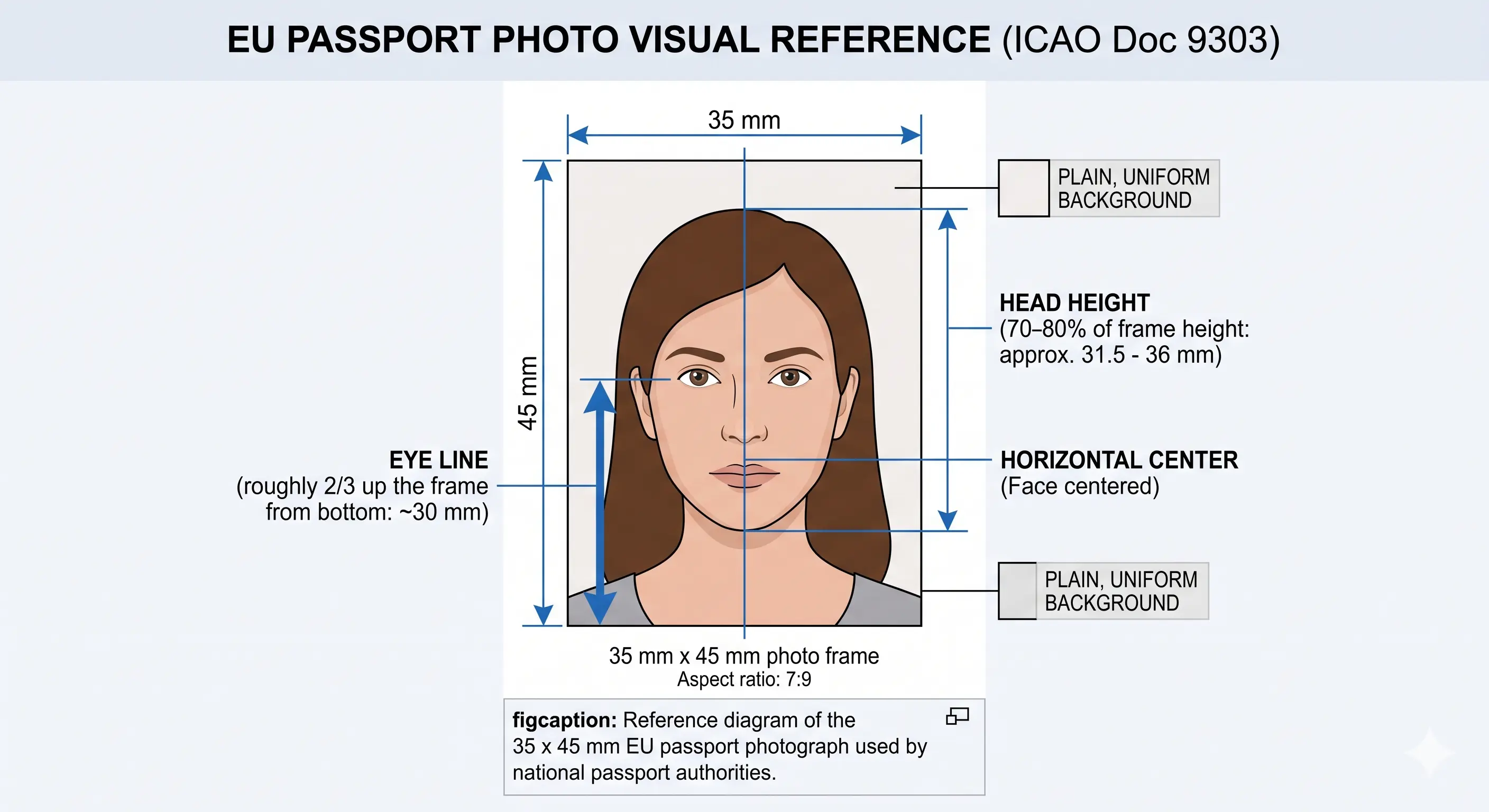
A Poland passport photo must be 35 mm wide by 45 mm tall on a plain light grey or white background, with the head measuring 32–36 mm from chin to crown — roughly 71–80% of the frame height. For printing that equals 413 × 531 pixels at 300 DPI. For the gov.pl digital upload the minimum is 492 × 633 pixels, capped at 2.5 MB.
| Specification | Value |
|---|---|
| Photo size | 35 × 45 mm (3.5 × 4.5 cm) |
| Aspect ratio | 7 : 9 portrait |
| Print pixels @ 300 DPI | 413 × 531 px |
| gov.pl portal minimum | 492 × 633 px (≈357 DPI), max 2.5 MB |
| Head height | 32 – 36 mm chin to crown (71–80% of frame) |
| Background | Uniform light grey or white |
| Glasses | Not permitted |
| Photo age | Within the last 6 months |
| Issuing authority | Ministry of the Interior and Administration (MSWiA) |
Every national standard is indexed in the passport photo requirements by country hub, and each individual rule is explained in the passport photo rules library.
The 35×45mm frame with the head occupying 71–80% of the height is what MSWiA measures digitally at the counter and on the gov.pl portal.
Editing a passport photo manually in Photoshop takes 20 minutes and leaves room for error. Uploading here takes 30 seconds and handles every compliance requirement for you.
Precise cropping to the official Polish dimension — no guesswork, no rulers.
Face detection positions your head within the MSWiA 32–36mm height requirement.
Any background replaced with the required plain light-grey or white in one click.
Download a printable sheet with multiple copies at the correct 300 DPI resolution.
Smartphone, tablet, or desktop — no app download, no Photoshop licence required.
Every output is checked against 35×45mm biometric framing before download is offered.
All specifications are sourced from the Ministry of the Interior and Administration (MSWiA) and apply to both domestic Polish passport applications and renewals. Each rule links to the detailed standard in our rules library.
| Requirement | Specification | Status |
|---|---|---|
| Photo Size | 35 × 45 mm (3.5 × 4.5 cm), 7:9 portrait ratio | Mandatory |
| Width | 35 mm (413 px at 300 DPI) | Mandatory |
| Height | 45 mm (531 px at 300 DPI) | Mandatory |
| Head Height | 32–36 mm measured from chin to crown, filling 71–80% of the frame — see head size rules | Mandatory |
| Face Coverage | 71–80% of frame height — see face size requirements | Mandatory |
| Background Colour | Uniform light grey or white; no patterns, shadows, or gradients — see background colour rules | Mandatory |
| Lighting | Even and diffused; no shadow on the face or the wall behind the head — see shadow rules and lighting requirements | Mandatory |
| Print Resolution | Minimum 300 DPI on photographic paper — see resolution rules | Mandatory |
| Digital Resolution | Minimum 492 × 633 px for gov.pl portal uploads (35×45 mm at ≈357 DPI) | Mandatory |
| File Format | JPEG for both printed and digital portal submissions; sRGB colour space | Mandatory |
| Glasses | Not permitted (biometric standard) — see glasses rules | Restricted |
| Expression | Neutral expression, mouth closed, eyes fully open and looking forward — see eyes requirements and smile rules | Mandatory |
| Hair | Must not obscure the face outline, ears, or forehead — see hair rules | Mandatory |
| Ears | Should remain visible where hair allows so the face outline is unambiguous — see ears visibility rules | Recommended |
| Head Covering | Not permitted, except for documented religious reasons — see head covering rules | Restricted |
| Digital Retouching | Not permitted; filters, skin smoothing and feature editing are detected and rejected — see makeup rules | Restricted |
| Photo Age | Taken within the last 6 months; must reflect current appearance | Mandatory |
| Digital Submission | Accepted via the gov.pl e-passport portal; JPEG, max 2.5 MB | Supported |
Poland uses two different numeric specifications for the same photo, and mixing them is one of the easiest failures to avoid.
| Specification | Printed photo | gov.pl digital upload |
|---|---|---|
| Defined in | Millimetres | Pixels |
| Required size | 35 × 45 mm | 492 × 633 px minimum |
| Pixel equivalent | 413 × 531 px at 300 DPI | ≈357 DPI at 35 × 45 mm |
| File size | Not applicable | Maximum 2.5 MB |
| Format | Photographic paper, glossy or matte | JPEG, sRGB colour space |
| Aspect ratio | 7 : 9 | 7 : 9 (492 ÷ 633 ≈ 0.777) |
Do not upscale a small original to reach 492 × 633. Interpolation invents pixels rather than detail, and the portal's automated sharpness check catches it. Shoot wide and crop down instead — any smartphone from roughly 2018 onward clears the requirement comfortably.
If your export is too heavy for the 2.5 MB cap, the reduce file size guide covers the mechanics, and the compress guide handles tighter ceilings used by other EU portals. iPhone users shooting in HEIC should convert first with the HEIC to JPEG guide. Full cross-portal rules are in the digital passport photo requirements guide.
Whether applying for the first time or renewing, the Polish passport process follows a consistent set of stages. Preparing a compliant photo in advance avoids the most common source of delays.
Gather your current (or expired) passport, national ID card (dowód osobisty), completed application form, and a compliant 35×45mm passport photo. For first-time applicants under 18, parental consent documentation is also required.
Appointments at Polish passport offices can be booked online via the gov.pl portal or by contacting your regional Voivodeship Marshal office directly. Some offices also accept walk-in applications during off-peak hours.
Attend your appointment with the original documents (not photocopies) and your printed photo. The officer will verify dimensions, check biometric framing, and scan your fingerprints at the desk. Online (e-passport) submission is available for renewals through the gov.pl portal, where a digital photo upload is accepted.
Passport fees vary by applicant age and urgency. Standard processing applies to most applications; an expedited fee applies for urgent processing. Fee schedules are published on the official gov.pl passport information page.
Processing typically takes 3–4 weeks for standard applications submitted within Poland. You will be notified when the passport is ready for collection. It must be collected in person at the same office where you applied.
Polish passport offices apply strict checks for facial shadow and background uniformity. Any shadow cast by the nose, chin, or head across the background will result in rejection. Lighting must be diffused and even, illuminating the face without hot spots or underexposure on either cheek. Full setup guidance is in the shadow rules.
MSWiA guidelines currently prohibit glasses in Polish passport photos. This rule was tightened in alignment with EU biometric passport standards to eliminate glare that interferes with automated facial recognition on the document chip. Individuals with a medical necessity for permanent glasses wear may receive a documented exemption — confirmation must be obtained from the relevant passport authority before submitting. See the glasses rules for how other authorities treat the same question.
Hair may be natural in any style, but must not obscure the face outline, ears, or forehead. If the applicant's natural hair creates ambiguity at the hairline, it should be pulled back for the photo. Dramatic changes in hair colour between the photo and identity verification may prompt additional questioning. See the hair rules and ears visibility rules.
Natural everyday makeup is acceptable. Heavy contouring that materially alters the face shape is not. No digital retouching, filters, or skin-smoothing may be applied to the photo — automated biometric systems detect such modifications, and retouched images are rejected on submission. The makeup rules page covers where the line sits.
Hats, headbands and decorative headwear are not permitted. A head covering worn for documented religious reasons may be accepted provided the full face remains visible from the chin to the forehead with no shadow falling across the features. See the head covering rules.
As a Schengen and EU member, Poland's photo specifications closely follow the common EU biometric standard, which itself is derived from ICAO Doc 9303. This means a photo produced for a Polish passport will generally also meet the requirements for other EU member state passports — though always confirm against the destination country's own requirements. Compare with Czech Republic, Slovakia and Lithuania among Poland's neighbours.
Every child travelling on a Polish passport — regardless of age, including newborns — requires their own individual photograph meeting the full MSWiA biometric standard. There are no simplified requirements for infants: the 35 × 45 mm size, the 32–36 mm head-height band and the background rules all apply unchanged.
The child must have eyes open and looking forward. Photographing an infant lying flat on a white sheet is acceptable — the background rules are identical to adults. Parents or carers must not appear in the frame under any circumstances. A soft toy or rolled blanket used to support the infant's head is permitted provided it does not encroach on the background area.
Young children must meet the same neutral expression and open-eye requirements. If a child wears glasses for medical reasons, the same exemption process for adults applies. Hair accessories must not obscure the hairline.
School-aged children should sit upright, look directly at the camera, and maintain a neutral expression. Hats, headbands, and non-religious head coverings are not permitted.
Child passports (applicants under 13) are valid for 5 years rather than the adult standard of 10 years. The photo must be retaken at renewal — a photo from the previous passport cannot be reused regardless of how recent it appears.
Poland's gov.pl portal accepts digital passport photo uploads for renewal applications, removing the need to submit a physical printed photo in many cases. The digital photo requirements differ slightly from print requirements:
The digital portal applies an automated biometric check on upload and will flag non-compliant images before submission is completed. Passport Photo Maker exports files that meet the digital portal's dimension, format, and resolution requirements. See the print versus digital comparison above for why the two pixel figures differ.
Yes — taking a compliant Polish passport photo at home is straightforward if you follow the right setup. Polish passport offices accept photos taken with a smartphone or digital camera, provided the technical requirements are met.
Any modern smartphone camera (from around 2018 onward) produces sufficient resolution for a 35×45mm print at 300 DPI. Avoid using wide-angle or ultra-wide lenses — use the main (1x) lens and maintain a distance of approximately 0.5–1 metre from the subject to minimise facial distortion. Switch off portrait mode, background blur and skin smoothing before you shoot.
Diffused natural light from a window works well. Position the subject facing the light source to avoid shadows on the face. Avoid direct flash, which creates harsh shadows and reflection in glasses. Overcast daylight is ideal — bright sunshine creates directional shadows.
Use a plain white or light-grey wall, a large sheet of white card, or a white bedsheet stretched flat. Remove any items from the background before shooting, and stand at least 50 cm clear of the wall so no shadow falls behind your head. Passport Photo Maker's background removal tool handles imperfect home backgrounds reliably, provided there is sufficient contrast between the subject and the wall.
Shoot wider than you need and crop down. The crop guide explains how the 7:9 ratio and the 32–36 mm head-height band are applied together, which is the part most home attempts get wrong.
Click "Upload Your Photo" above (or use the form at the bottom of this page) and select a JPEG, PNG, or WebP image. A 35×45mm EU biometric template loads automatically. For best results, use a photo taken in good light against a plain background.
Face detection positions your head within the 32–36mm height range Poland requires. Use the adjustment handles if needed — for example if you were wearing a hat during the original shot. The tool constrains the crop to the correct 35×45mm aspect ratio.
Click "Remove Background" to replace any existing background with a compliant plain light-grey. If your photo was already taken against white or light grey, this step is optional — but running it anyway ensures uniformity at the edges.
Passport Photo Maker checks head height ratio, background uniformity, and resolution before allowing download. Any issues are flagged with instructions to correct them. This step catches the most common MSWiA rejection reasons automatically.
Download a print-ready sheet on a 10×15cm canvas (300 DPI JPEG) for printing at any photo kiosk or print shop, plus a single-photo digital file for the gov.pl portal. See the printing guidance below for paper and cutting detail.
If you are submitting a physical photo rather than a gov.pl upload, print quality is part of the specification. Home inkjet output is the single most common printing failure at Polish passport offices.
| Print resolution | 300 DPI minimum — export at 413 × 531 pixels or larger and disable fit-to-page scaling |
|---|---|
| Paper | Standard photographic paper, glossy or matte. Inkjet plain paper and laser-printed paper are refused |
| Where to print | Pharmacy, photo kiosk or print shop using photographic stock rather than a home printer |
| Copies per 10 × 15 cm sheet | Six 35 × 45 mm photos with cutting margins |
| Cutting | Guillotine or steel rule for square edges. Do not cut inside the printed border |
| Reverse of photo | Must be blank — handwritten notes or stamps on the back can cause rejection |
| Colour management | sRGB. Turn off printer auto-enhance, skin smoothing and colour correction |
| Sharpness | Image must be sharp with no blur, pixelation or visible compression artefacts |
Printer settings, paper choice and cutting technique are covered in full in the print passport photo at home guide, and multi-copy sheet layout in the print sheet guide.
Polish passport offices process a high volume of applications. These are the most frequently cited rejection reasons across MSWiA-operated offices, each linked to the detailed rule.
Any deviation from exactly 35×45mm is cause for immediate rejection. Home printing to the wrong paper size is a common culprit. See the crop guide.
Head height must fall between 32mm and 36mm. Photos cropped too tight (head nearly filling the frame) or too loosely (excessive shoulder or background space) both fail. See head size rules.
Cream, beige, yellow-white, or off-white backgrounds are common rejections. The background must be clearly light grey or white with no gradients. See background colour rules.
Shadows across the face, neck, or background — including the shadow of the head falling on the wall behind — are flagged during biometric scanning. See shadow rules.
Polish MSWiA guidance prohibits glasses. Submitting a photo with glasses without a documented medical exemption will result in rejection. See glasses rules.
Partially closed eyes, squinting, or eyes obscured by hair or eyelashes fail the biometric eye-detection check used in automated processing. See eyes requirements.
A fringe over the eyes or hair obscuring the face outline or ears fails landmark detection. See hair rules.
Uploading a 413×531 print file to the gov.pl portal falls below its 492×633 pixel minimum. Export the larger size for online submission.
Officers compare the applicant's appearance to the submitted photo. If the photo appears significantly older than 6 months, it will be rejected.
AI-based biometric processing detects smoothing, blemish removal, and facial feature editing. Retouched photos are rejected at both the portal upload stage and at the counter.
Laser or inkjet printing on plain paper fails the photographic paper requirement. See the print at home guide.
Hats, headbands and decorative headwear are refused. Religious coverings must leave the full face visible from chin to forehead. See head covering rules.
The complete cross-country breakdown of what causes refusal and how to correct it is in passport photo rejection reasons.
If you hold dual citizenship or are applying for documents in more than one country, here is what changes between the standards you are most likely to encounter.
| Requirement | Poland (MSWiA) | United States (DOS) |
|---|---|---|
| Dimensions | 35 × 45 mm | 2 × 2 inches (51 × 51 mm) |
| Aspect ratio | 7 : 9 portrait | 1 : 1 square |
| Head height | 32–36 mm (approx. 71–80% of frame) | 1–1⅜ inches (25–35 mm; approx. 50–69% of frame) |
| Background | Plain light grey or white | Plain white or off-white only |
| Glasses | Not permitted | Not permitted (since 2016) |
| Expression | Neutral, mouth closed | Neutral, natural expression; mouth closed preferred |
| Photo age | Within last 6 months | Within last 6 months |
| Print pixels @ 300 DPI | 413 × 531 px | 600 × 600 px |
| Digital submission | Yes — gov.pl portal, min 492 × 633 px, max 2.5 MB | Yes — min 600 × 600 px, max 1200 × 1200 px; 54 KB–10 MB for online renewal, 240 KB cap on DS-160 |
| Issuing authority | Ministry of the Interior and Administration (MSWiA) | US Department of State (DOS) |
The most significant practical difference is shape — Poland uses a portrait rectangle while the US uses a square. A photo created for a US passport cannot be submitted for a Polish passport without re-cropping. Compare the two formats directly in the 35×45 photo size and 2×2 photo size guides, or see the worldwide reference in passport size photo dimensions.
Polish passport photos must be exactly 35×45mm (width × height), a 7:9 portrait ratio. The head must measure between 32mm and 36mm from chin to crown, filling roughly 71–80% of the frame height. These measurements are set by the Ministry of the Interior and Administration (MSWiA) and are non-negotiable.
For printing, 35×45mm at 300 DPI equals 413 × 531 pixels. For digital upload through the gov.pl portal the minimum is 492 × 633 pixels, which is the same physical size rendered at approximately 357 DPI. Exporting at 492 × 633 or larger satisfies both requirements at once. See the print versus digital comparison.
The 35×45mm size is shared across Germany, France, Italy, Spain, the Netherlands and most other member states, so the geometry transfers. Background shade and head-height bands can differ slightly, so confirm against the destination authority's own published specification. The shared framework is set out in the EU passport photo guide.
The background must be a uniform light grey or white. It must be evenly lit with no shadows, patterns, gradients, or coloured tones. Cream, beige, or "warm white" tones are frequently rejected at MSWiA offices. See the background colour rules.
No. As of current MSWiA biometric guidelines, glasses are not permitted in Polish passport photos. The restriction applies to all types of glasses including clear, tinted, and photochromic lenses. A documented medical exemption is the only exception — contact your regional passport office for the exemption process.
The photo must have been taken within the last 6 months and must accurately represent your current appearance. If you have made significant changes to your appearance (beard, hairstyle, weight change) since the photo was taken, a newer photo is advisable even if the 6-month window has not elapsed.
Yes. Every Polish passport applicant, including infants, requires an individual photograph. There are no age-based exemptions from the biometric photo standard. Infants must have eyes open; parents must not appear in the frame. See the child passport photo requirements section.
Polish citizens travelling on their Polish passport within the EU/Schengen area do not require a separate visa. For third-country nationals applying for a Schengen visa, the photo requirements are very similar to Polish passport standards (35×45mm) but should be verified against the specific consulate's instructions, as minor variations exist. For visas issued by Poland specifically, see the Poland visa photo guide.
Yes. Digital photo uploads are accepted via the gov.pl e-passport portal for renewal applications. The digital file must be JPEG format, at least 492×633 pixels, no larger than 2.5MB, and in the sRGB colour space. The portal applies an automated biometric check on upload.
Yes — provided you use proper lighting, a plain white or light-grey background, and maintain the correct proportions. Use the main camera lens at 0.5–1 metre, avoid wide-angle lenses and direct flash, and switch off portrait blur and skin smoothing. Passport Photo Maker handles cropping, background removal, and biometric framing automatically from any home photo.
Print at 300 DPI on photographic paper, not on inkjet or laser plain paper. A standard 10×15cm photographic sheet holds six 35×45mm copies with cutting margins. Use a pharmacy, photo kiosk or print shop rather than a home printer, keep the reverse of the photo blank, and cut with a guillotine for square edges. See the printing guidance section.
Skip the photo booth. Upload once, get a print-ready 35×45mm MSWiA-compliant photo in under a minute — for your application, renewal, or gov.pl digital submission.